

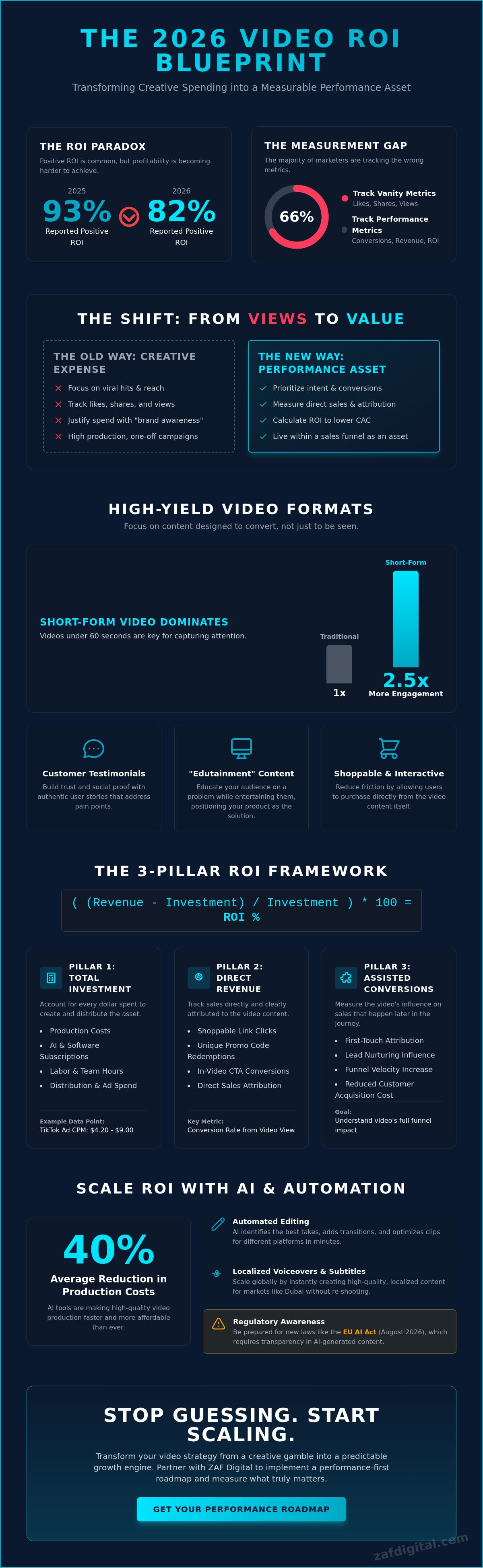
While 82% of marketers report a positive video marketing roi in 2026, a staggering 66% of them are still stuck tracking vanity metrics like likes and shares. You've likely felt the pressure of high production costs and the frustration of trying to prove that a creative asset actually moved the needle on your bottom line. It's difficult to justify a creative expense when you can't see a direct, data-backed path to a purchase.
We're here to change that by shifting your perspective from creative spending to performance scaling. This guide provides the frameworks and AI-driven strategies you need to transform video into a high-yield asset. You'll learn how AI-powered tools have already reduced production costs by an average of 40% and how to navigate new legal landscapes like the EU AI Act transparency obligations arriving in August 2026. We'll give you the exact formula to calculate your returns and show you how to dominate short-form formats that generate 2.5 times more engagement than traditional content. It's time to stop guessing and start measuring what matters.
Key Takeaways
• Shift your focus from vanity metrics to conversion data to ensure every video asset contributes directly to your bottom line.
• Implement our 3-pillar framework to accurately calculate video marketing roi by balancing total investment against direct revenue attribution.
• Identify high-yield formats like customer testimonials and "edutainment" that drive measurable revenue rather than just temporary brand awareness.
• Scale your global reach efficiently by using AI for automated editing and localized voiceovers, specifically tailored for high-growth markets like Dubai.
• Transform your video strategy from a creative expense into a measurable performance asset through a data-driven, growth-focused partnership.
What is Video Marketing ROI and Why Does it Change in 2026?
Video Marketing ROI is the financial blueprint that determines whether your content is an investment or just a sunk cost. In its simplest form, it's the ratio of net profit generated from a video compared to the total cost of its production, distribution, and management. While basic Return on Investment (ROI) formulas have existed for decades, the 2026 landscape has fundamentally changed the variables. We've moved past the era where a viral hit was the ultimate goal. Today, with 91% of businesses using video as a core tool, the competition for attention is fierce. Success isn't about how many people saw your video; it's about how many of those people took a measurable action.
Interestingly, 82% of marketers report a positive video marketing roi in 2026. This is a noticeable drop from 93% in 2025, signaling that the "easy" wins of video are over. You need a sharper strategy to stay profitable. We're seeing a massive shift in how brands treat video. It's no longer a one-off creative campaign. It's a "Performance Asset." This means the video is designed to live within a sales funnel, driving specific outcomes over a long period. Short-form video (under 60 seconds) currently dominates this space, generating 2.5 times more engagement than any other format. However, high engagement doesn't automatically mean high profit.
The Evolution from Views to Value
A million views that result in zero conversions is a failure of strategy. In the modern growth marketing environment, we prioritize intent over reach. 2026 consumer behavior leans heavily toward interactive and shoppable video formats. People don't want to leave the platform to buy; they want to click a link inside the video and check out instantly. If your tracking doesn't capture these micro-conversions, your data is incomplete. Currently, only 30% of marketers measure direct sales attribution. The other 66% are effectively flying blind, relying on "brand awareness" to justify their budgets. We focus on the value of the lead, not the volume of the crowd.
Why ROI is the Only Metric for Scaling
You can't scale a feeling. You can only scale numbers. Many brands make the mistake of over-investing in high-production, cinematic masterpieces without a clear distribution plan. This is a recipe for a negative return. By focusing on video marketing roi, you gain the clarity needed to decide where to put your next dollar. High engagement rates are great, but their true value lies in how they lower your Customer Acquisition Cost (CAC). When a video effectively warms up a lead, your sales team has to work half as hard. We use ROI data to identify which formats are winning, allowing us to double down on what works and cut what doesn't. This analytical approach turns video from a creative gamble into a predictable growth engine.
The 3-Pillar Framework for Calculating Video ROI
Numbers are the truth. Calculating your video marketing roi requires a cold, analytical look at every dollar that leaves your account and every cent that returns. We use a three pillar framework to ensure no data point is left behind. The fundamental formula is simple: (Revenue - Investment) / Investment x 100. However, the complexity lies in how you define those variables. If you don't account for the 40% cost reduction that AI tools now provide in 2026, or the specific ad rates on platforms like TikTok (averaging $4.20 to $9.00 CPM), your calculations will be fundamentally flawed.
Pillar 1: Total Investment.
This includes production, AI software subscriptions, labor, and distribution costs.
Pillar 2: Direct Revenue.
These are sales directly linked to a video through shoppable links or unique promo codes.
Pillar 3: Assisted Conversions.
This measures the video's role in the customer journey, recognizing that a user might watch a video today but buy next week.
By using this framework, you stop treating video as a gamble. You start treating it as a predictable financial instrument. If you're looking for a partner to help run these numbers, our team can help you build a performance-first roadmap tailored to your growth goals.
Tracking Production and Distribution Costs
Transparency is vital. You must track hidden costs like internal team hours and platform fees. In 2026, distinguishing between evergreen content and campaign specific assets is a prerequisite for accuracy. Evergreen videos, like brand explainers, should have their costs amortized over several quarters. This prevents a single month's budget from looking artificially inflated. Integrating a long term video marketing strategy allows you to spread these "heavy lift" costs across the entire lifecycle of the asset.
Attribution Models: Direct vs. Assisted
The "last-click" model is often too narrow for video. While it's easy to track someone who clicks a link in a YouTube Shorts ad (which averages a $4 CPM in 2026), it ignores the "View-Through" conversion. This occurs when a user watches your content, doesn't click, but visits your site later to purchase. We use UTM parameters and dedicated landing pages to bridge this gap. Including video on these pages can increase conversion rates by up to 86%, proving that video marketing roi isn't just about the first touch; it's about the entire conversion ecosystem.
High-Yield Video Formats: What Actually Drives Revenue?
Not all content is created equal. While 91% of businesses use video as a marketing tool in 2026, many still waste budgets on "fluff" that never converts. To maximize your video marketing roi, you must invest in formats that move users through the funnel with precision. The most successful brands today prioritize utility and trust over high-gloss production. We see the highest returns from content that solves specific problems or proves value through the eyes of existing customers. It's about creating assets that work for you 24/7.
Interaction is the new benchmark for engagement. 2026 consumer behavior favors shoppable and interactive videos where users can click products or answer polls directly within the player. These features bridge the gap between "watching" and "acting." Additionally, repurposing long-form webinars into 60-second social clips is a massive efficiency play. Since short-form video generates 2.5 times more engagement than other types, this strategy allows you to extract maximum value from a single production session without doubling your costs.
B2B Case Studies and Testimonials
Social proof remains the most powerful weapon in your marketing arsenal. Customer testimonials are currently the highest ROI format for the middle of the funnel (MOFU). They dismantle buyer objections by replacing brand promises with peer reality. A strategic testimonial doesn't just feature a happy client; it highlights a specific problem, the solution, and the measurable result. To maximize impact, integrate these videos into a high conversion web design. This ensures the user journey from viewing to purchasing is frictionless and fully tracked.
Product Demonstrations and How-To Content
Visual clarity kills hesitation. Product demonstrations and how-to content reduce the friction to buy by showing exactly how a solution works in real time. This isn't just about sales; it's about operational efficiency. Using video to answer common questions can significantly reduce customer support tickets, indirectly boosting your overall video marketing roi by lowering support costs. Success here requires a cohesive social media video strategy that ensures your demos reach the right audience at the right time. By providing value first, you build the authority needed to scale your brand predictably.
Scaling Video ROI with AI and Automation
Efficiency is the engine of scale. In 2026, the secret to a high video marketing roi isn't just spending more; it's spending smarter through automation. AI-powered tools have fundamentally altered the investment side of the ROI equation, reducing average production costs by an estimated 40% as of April 2026. This cost reduction allows you to increase your output without a linear increase in budget. We no longer view AI as a futuristic concept; it's a baseline requirement for any brand that wants to remain competitive in a saturated digital market.
Scaling globally, particularly in high-growth regions like the UAE, now requires less manual labor and more strategic orchestration. AI allows for the rapid generation of localized voiceovers and subtitles, making cross-border expansion frictionless. However, compliance is key. You must navigate the EU AI Act's transparency obligations, which apply in full starting August 2, 2026. Brands must disclose synthetic performers and AI-manipulated content to maintain trust and avoid legal friction. If you're ready to modernize your production, you can explore our AI-driven video services to see how we maximize output while maintaining total transparency.
AI-Driven Production Efficiency
Post-production used to be the biggest bottleneck in the creative process. Today, we use AI to automate color grading, subtitling, and even basic assembly. This rapid iteration allows us to test multiple versions of a single video to see which one resonates best with your audience. By slashing the hours spent on manual editing, we lower the "Investment" pillar of your video marketing roi. At ZAF Digital, we integrate these AI transformations directly into our creative workflows. This ensures that every asset is optimized for performance before it ever hits a platform.
Predictive Analytics and Performance Forecasting
We've moved into the era of 'Data-First' creative. Instead of guessing which hook will stop the scroll, we use predictive AI to analyze viewer sentiment and historical drop-off points. This data allows us to forecast performance before you spend a single dollar on ad distribution. We turn one master video into 20+ platform-specific assets, ensuring you dominate TikTok's $4.20 to $9.00 CPM range and YouTube Shorts' $4 CPM environment simultaneously. This level of precision is only possible when you integrate your video data into a broader growth marketing agency framework. We don't just make videos; we build data-backed assets designed for measurable growth.
Implementing a Performance-First Video Strategy with ZAF Digital
Creative brilliance is useless without a conversion engine. At ZAF Digital, we've moved beyond the traditional agency model where video is treated as a one-time expense. We view every frame as a performance asset designed to drive measurable growth. Our focus is squarely on your video marketing roi, ensuring that the 40% cost reduction provided by AI tools is reinvested into high-impact distribution. We don't just deliver a file; we deliver a strategy that integrates video production with SEO and performance marketing to create a holistic growth ecosystem. This ensures your content doesn't just look good, but actually performs across all digital touchpoints.
The ZAF Digital ROI Methodology
We operate on a 'Test, Learn, Scale' framework. Instead of betting your entire budget on a single "hero" video, we produce multiple AI-optimized variations to identify the highest performing hooks. This data-driven approach allows us to scale volume while maintaining a rock-solid brand identity. By integrating our video workflows with our performance-driven social media management services, we ensure your content reaches the right audience at the right time. We use AI to automate the heavy lifting of localized subtitling and formatting; however, our strategic insights remain human-led. This balance allows us to maintain the authenticity that 2026 consumers demand while leveraging the speed of modern technology.
The Dubai Market Advantage
Operating within the UAE's digital landscape requires more than just high-quality footage. It demands a deep understanding of regional consumer behavior and the ability to scale internationally from a central hub. In a market as competitive as Dubai, you can't afford to be "just another brand." This is why brand identity is important; it acts as the foundation for all your video content, ensuring consistency across TikTok's $4.20 to $9.00 CPM environment. We combine this identity with localized nuances to build trust and drive conversions in both the Middle East and global markets.
Your next step shouldn't be a shot in the dark. It should be a comprehensive audit of your current video assets to identify their untapped ROI potential. We'll help you spot the leaks in your funnel and replace underperforming creative with data-backed assets. The 2026 market doesn't reward those who spend the most, but those who measure the best. We build our partnerships on transparency and a "no-bullshit" approach to data. Partner with ZAF Digital today to transform your video content into a high-yield revenue engine and secure your place as a market leader.
Turn Your Video Data into a Scalable Revenue Engine
Mastering your video marketing roi in 2026 isn't a matter of luck; it's a matter of infrastructure. You've seen how a 3-pillar framework clarifies investment and how AI-driven production can slash costs by 40% as of April 2026. The 82% of marketers reporting success this year aren't just making pretty content. They're deploying high-yield formats like testimonials and short-form clips that generate 2.5 times more engagement than traditional assets. They're also staying ahead of regulations like the EU AI Act's August 2, 2026 deadline. It's about precision, not just production.
You don't have to navigate this transition alone. Our Dubai-based team combines AI-integrated production workflows with deep growth marketing expertise to ensure every frame serves your bottom line. We move beyond creative services to provide measurable growth marketing results that actually scale. It's time to stop treating video as a cost and start treating it as your most powerful revenue driver. Maximize your video ROI with ZAF Digital’s performance-driven creative team. We're ready to help you dominate the 2026 landscape.
Frequently Asked Questions
What is a good ROI for video marketing in 2026?
A benchmark ratio of 5:1 is considered strong, though many performance-driven brands now aim higher due to AI-driven cost reductions. With 82% of marketers reporting positive returns this year, your success should be measured by how effectively video lowers your Customer Acquisition Cost (CAC). Brands typically see conversion rates jump from 2.9% to 4.8% when they move from static images to data-backed video assets.
How long does it take to see a return on investment from video?
Initial engagement data appears within 24 hours, but a full financial return usually requires a window of 30 to 90 days. This timeframe accounts for "view-through" conversions where users watch your content today but purchase weeks later. For evergreen content, we calculate the return over several quarters by amortizing the initial production costs against the long term lead generation the video provides.
Can small businesses achieve high video ROI with low budgets?
Yes, because AI powered tools have slashed average production costs by 40% as of April 2026. You don't need a cinematic crew to win. Authentic, creator-style content often outperforms high-gloss productions in modern markets. Small businesses can maximize their video marketing roi by focusing on platforms like YouTube Shorts or TikTok, where CPM rates remain accessible between $4 and $9.
Which platform offers the best ROI for B2B video marketing?
LinkedIn is the leader for high-ticket lead generation, but YouTube drives the best long term ROI through search-driven "edutainment." In 2026, B2B brands are seeing massive success with short-form clips, which generate 2.5 times more engagement than traditional webinars. The most profitable strategy involves using YouTube for authority building and LinkedIn for direct, targeted performance ads to decision makers.
How do I track video ROI without expensive software?
You can track video marketing roi effectively using Google Analytics 4 paired with UTM parameters and unique promo codes. By setting up specific conversion events for video interactions, you can see exactly which assets led to a purchase. This "no-bullshit" approach allows you to compare your total labor and ad spend against direct revenue without needing a complex enterprise tech stack.
Does video quality significantly impact ROI?
Authenticity now carries more weight than cinematic polish. Research shows 89% of consumers want to see more relatable content from brands rather than over-produced commercials. While clear audio and proper lighting are essential, spending excessively on "movie-quality" visuals often hurts your ROI by inflating costs without a proportional increase in conversions. Performance marketing in 2026 favors speed and relevance over perfection.
How often should I update my video content to maintain ROI?
Paid social ads require a refresh every 4 to 6 weeks to combat ad fatigue and maintain a steady conversion rate. Website hero videos and evergreen explainers can remain effective for 12 to 18 months, provided you monitor viewer drop-off points. If your engagement data shows a significant dip, it's a clear signal to test new hooks or update your call-to-action.
What is the difference between ROI and ROAS in video marketing?
ROAS measures revenue per dollar of ad spend, while ROI accounts for your total investment, including production, software, and labor. ROAS tells you if your distribution is working, but ROI tells you if your entire video department is profitable. In 2026, we focus on ROI because it captures the true impact of the 40% production savings gained through AI automation.