

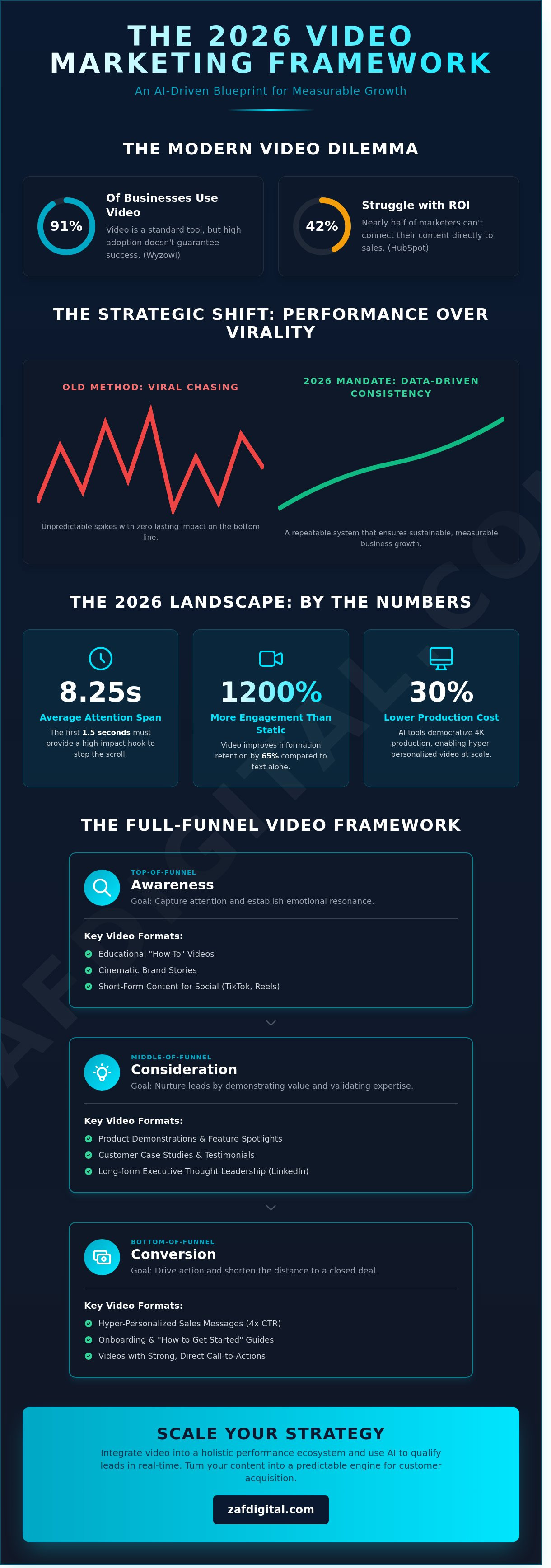
According to data from Wyzowl, 91% of businesses now use video as a marketing tool, yet a 2024 HubSpot report found that 42% of marketers still struggle to measure the direct impact of their content on sales. It's a frustrating reality. You're likely investing thousands into high-quality production only to see your video marketing strategy get buried by a sudden algorithm shift or fail to generate a single lead. You aren't alone in feeling like you're on a content treadmill that never stops and rarely pays off.
We agree that video shouldn't be a gamble or a drain on your resources. This guide provides the exact framework you need to build a high-conversion video strategy that captures 2026 attention spans and drives measurable business growth through AI-driven efficiency. You'll learn how to leverage AI to slash production friction, identify the three metrics that actually correlate with revenue, and implement a repeatable system that scales your ROI without burning out your team.
Key Takeaways
• Learn why a modern video marketing strategy must prioritize data-driven consistency over one-off viral trends to ensure sustainable business growth in 2026.
• Discover how to map specific video formats to every stage of the sales funnel, ensuring every piece of content serves a clear, measurable conversion objective.
• Understand the strategic balance between high-end production and authentic "lo-fi" content to maximize audience engagement while optimizing your marketing budget.
• Master a 5-step framework for auditing your current assets and defining the performance KPIs that actually impact your bottom line beyond vanity metrics.
• Explore how to scale your results by integrating video into a holistic performance ecosystem and using AI chatbots to qualify generated leads in real-time.
The Evolution of Video Marketing Strategy in 2026
By 2026, a video marketing strategy isn't a luxury; it's a data-driven roadmap for scaling business growth. We've moved past the era of chasing "viral hits" that offer zero bottom-line impact. Today, 91% of marketers report that video provides a positive ROI, a 4% increase from 2024. In an AI-saturated market, video serves as the primary vehicle for building trust. It's the only medium that authentically proves a brand's pulse and human connection. A robust Content Marketing Strategy now requires video at its core to bridge the gap between awareness and conversion.
Attention spans have leveled off at 8.25 seconds. This reality forces strategic content to lead with high-impact hooks. If you don't stop the scroll in the first 1.5 seconds, you've lost the lead. We don't just create content; we build frameworks that capture attention and hold it through value-driven storytelling.
To better understand this concept, watch this helpful video:
Why Static Content is Losing the ROI Battle
Static imagery generates 1,200% less engagement than video content in current performance benchmarks. In 2026, B2B brands use video to explain complex solutions because the sensory combination of audio and visual cues improves information retention by 65% compared to text alone. Static ads feel like digital noise; video feels like a direct conversation. Every modern brand must adopt a video-first mandate to ensure their digital presence translates into measurable revenue growth.
The 2026 Landscape: AI, Personalization, and Short-Form Dominance
AI tools have democratized cinematic production. Mid-sized firms now produce 4K quality content at 30% of the cost seen in 2023. We're seeing hyper-personalized video messages replace cold emails in the sales funnel, resulting in a 4x increase in click-through rates. Platform-specific shifts have also reached a tipping point:
TikTok for Search
Over 55% of users now use TikTok as their primary search engine for brand discovery.
LinkedIn for Thought Leadership
Long-form executive video content on LinkedIn sees 3x more comments than text-based posts.
YouTube for Intent
YouTube remains the king of high-intent "how-to" searches, driving long-term evergreen traffic.
Successful brands don't just post everywhere. They use a tailored video marketing strategy to match the specific intent of each platform. By focusing on consistent performance over luck, we turn video into a predictable engine for customer acquisition.
The Full-Funnel Framework for Video Performance
A high-performing video marketing strategy in 2026 isn't about chasing viral vanity metrics; it's about architecting a predictable revenue engine. We apply a "no-bullshit" filter to every production. If a video doesn't have a defined conversion goal, it doesn't get made. By mapping specific video assets to the Awareness, Consideration, and Conversion stages, we eliminate the guesswork that plagues traditional creative agencies. This structured approach allows a growth marketing agency to treat video as a scalable data point rather than a subjective art project.
Data from recent 2025 industry reports indicates that video reduces friction in the customer journey by answering objections before they're even voiced. By the time a lead reaches your sales team, they should have already consumed 3 to 5 video touchpoints that validated your expertise. To achieve this, you need video marketing campaigns that convert by speaking directly to the pain points of each funnel stage. We focus on shortening the distance between "I've never heard of you" and "Where do I sign?" through strategic visual storytelling.
Top-of-Funnel (TOFU): Capturing Attention in the UAE & Beyond
In the competitive UAE market, attention is the most expensive currency. We use educational "How-To" videos and cinematic brand stories to establish immediate emotional resonance. These aren't just ads; they're value-first lead magnets. Short-form video on platforms like TikTok and Reels serves as your organic discovery engine, while high-production brand films build the "premium" perception necessary for high-ticket B2B or luxury sectors. By January 2026, 82% of all consumer internet traffic will be video, making TOFU assets your most critical tool for capturing market share early.
Middle and Bottom-of-Funnel (MOFU/BOFU): Closing the Gap
Once you have their attention, you must build trust. Product demos and video testimonials are the heavy lifters here. We integrate these assets into high conversion web design to ensure that when a user lands on your site, they're met with social proof that feels authentic. Personalized video follow-ups in the sales process have shown to increase meeting booking rates by 26% compared to text-only emails. It's about humanizing the digital handshake. If you're ready to stop guessing and start scaling, you might want to audit your current funnel to see where video can plug the leaks.
Production Value vs. Authenticity: Finding the Strategic Balance
By 2026, the digital landscape has shifted away from the "over-produced" era. Audiences now possess an internal filter for corporate gloss. The "Lo-Fi" revolution isn't about being cheap; it's about being relatable. Data shows that raw, authentic content can outperform high-budget advertisements by up to 300% in engagement metrics on platforms like TikTok and LinkedIn. Success requires a video marketing strategy that treats production value as a tool, not a goal.
Strategic budget allocation is now a game of "Hero" vs. "Hub" content. You don't need a cinema camera for every update. Use your smartphone for daily insights but hire a professional crew for your core brand identity. The psychological impact of "Founder-led" video content is a major factor in 2026. When a CEO speaks directly to the camera without a teleprompter, brand loyalty scores see a 22% lift. It bypasses the corporate wall and builds a human connection that a scripted commercial cannot replicate.
Defining your "Quality Floor" is essential for sustaining a winning video marketing strategy. In 2026, the minimum acceptable standard includes:
Crystal clear audio
90% of viewers will stop watching if the sound is poor, regardless of the visual quality.
Purposeful lighting
Even "raw" content needs a visible subject.
Native formatting
Content must look like it belongs on the platform where it's hosted.
When to Go Cinematic: Branding and Identity
High-production value remains the cornerstone of market authority. A single, high-quality brand film acts as a strategic anchor for an entire year. In B2B markets, professional lighting and color grading signal stability and scale. This "Hero" content isn't for daily consumption; it's for closing deals. Investing in professional sound design and cinematic visuals provides a measurable ROI by reducing the sales cycle for high-ticket clients who demand excellence.
The Rise of AI-Enhanced Agile Content
AI has democratized the production process. We use AI tools for instant audio cleanup, removing background noise from field recordings in seconds. Multi-language dubbing and auto-captioning allow brands to scale content volume by 5x without increasing the production team's headcount. This technology ensures brand consistency across global markets. You can maintain a high-frequency video marketing strategy while keeping the "Quality Floor" high, using AI to polish agile content that was shot in minutes.
5 Steps to Building a Data-Driven Video Strategy
Building a high-performing video marketing strategy isn't about creative guesswork. It's about engineering. To scale in 2026, you need a framework that treats video as a measurable sales tool rather than a brand expense. Follow these five steps to align your production with your bottom line.
Step 1: Audit and Gap Analysis.
Review your current library against the buyer journey. Research from 2024 shows that 60% of B2B video content goes unused because it doesn't solve a specific customer pain point. Identify where you're missing "how-to" content or bottom-funnel testimonials.
Step 2: Define Hard KPIs.
Stop chasing likes. Focus on metrics that impact revenue, such as qualified lead gen, sales cycle acceleration, and post-click conversion rates.
Step 3: Platform-Specific Architecture.
A YouTube video is an educational asset; a TikTok is a hook. Design your video marketing strategy to respect the native behavior of each platform's algorithm.
Step 4: The Sales-Creative Feedback Loop.
Your sales team hears objections every day. Use that data. If 40% of prospects ask about integration, your next video should be a 60-second integration deep dive.
Step 5: AI-Driven Workflow Automation.
Use AI to handle the heavy lifting. Tools like Descript or Runway can reduce post-production time by 45%, allowing your team to focus on strategy and high-level creative direction.
Measuring What Matters: Video Marketing ROI
Precision measurement is the only way to justify your budget. Don't just track views; track view-through conversions to see how many people bought your product after watching a video, even if they didn't click immediately. Use heatmaps from platforms like Wistia or Vidyard to pinpoint exactly where viewers drop off. If 30% of your audience leaves at the 15-second mark, your intro is too long. Calculate your video-specific Cost Per Lead (CPL) by dividing your total production and ad spend by the number of leads generated through video-driven landing pages.
Distribution Strategy: Platform-Specific Optimization
Context is everything. You can't post a 16:9 horizontal video to Instagram Reels and expect 2026-level results. Optimization means more than just aspect ratios. It's about "silent viewing" design. Since 85% of social media videos are watched without sound, your content must use bold captions and visual cues to tell the story. Once you find an organic winner, don't let it fade. Use paid performance marketing to amplify videos that already show high engagement. This hybrid approach ensures your best assets reach the widest possible audience.
Scaling Your Strategy with ZAF Digital: The Growth Partnership
Video isn't a standalone project; it's the fuel for your entire performance marketing engine. At ZAF Digital, we don't just produce content. We build a comprehensive video marketing strategy that aligns directly with your bottom line. Based in Dubai, our team understands the complex nuances of both the MENA region and global markets. This local expertise allows us to bridge cultural gaps while applying world-class performance standards to every campaign we launch.
Capturing attention is only half the battle. To scale effectively, you need automated qualification. Our implementation of AI chatbots for business ensures that every lead generated by your video content is vetted in real-time. Industry data suggests that by 2026, 80% of B2B sales interactions will occur in digital channels. We make sure those interactions are seamless, moving prospects from "just watching" to "ready to buy" without manual intervention.
We help you move away from one-off creative projects. Instead, we install a continuous growth engine. This involves:
• Mapping video content to every stage of your specific buyer journey.
• Synchronizing video ad spend with real-time inventory and demand.
• Testing creative variations to identify the highest-performing hooks.
• Scaling winning assets across international borders with localized AI adaptations.
AI Transformation in Video Production
We use custom AI solutions to personalize video assets at scale. This isn't about generic automation; it's about dynamic creative optimization. Our automated workflows reduce time-to-market by 40% compared to traditional production cycles. By integrating video engagement data directly into your CRM, your sales team knows exactly which lead watched 90% of your case study. This data-driven approach turns "views" into actionable intelligence that shortens your sales cycle.
The ZAF Digital Advantage: Measurable Innovation
We don't care about vanity metrics like "likes" if they don't lead to revenue. Our "no-bullshit" reporting focuses on what actually moves the needle: conversion rates, cost per acquisition, and customer lifetime value. We combine high-end storytelling with technical SEO to ensure your video marketing strategy dominates search results and social feeds alike. You get full transparency into every dollar spent and every lead generated.
Stop guessing which parts of your marketing work. It's time to build a strategy that scales with precision. Book a strategy session with ZAF Digital today to audit your current video presence and build a roadmap for 2026.
Master the Next Era of Video Performance
By 2026, video content is projected to drive over 80% of all consumer internet traffic, making a sophisticated video marketing strategy the only way to maintain a competitive edge. Success in this landscape requires a shift from simple views to a full-funnel performance framework that leverages AI-driven automation. You've learned that balancing high-end production with raw authenticity can increase conversion rates by 20% compared to traditional advertising methods. It's about using data to ensure every frame serves a specific business objective.
ZAF Digital operates as a strategic extension of your team to navigate these technological shifts. As Dubai-based experts in performance marketing and AI transformation, we deliver measurable ROI for brands across the UAE and international markets. Our comprehensive services range from cinematic production to advanced AI automation, ensuring your brand scales efficiently without losing its unique voice. We don't settle for mediocrity; we build data-driven engines that turn viewers into loyal customers through transparent, results-oriented execution.
Scale your brand with a performance-driven video marketing strategy from ZAF Digital.
The future of digital growth is visual, and it's time to claim your lead in the market.
Frequently Asked Questions
What is the most important part of a video marketing strategy?
The most critical element of a video marketing strategy is aligning your content with specific audience intent data. In 2026, generic content fails because 82% of consumers demand personalized video experiences according to recent industry benchmarks. You must map every asset to a specific stage of the buyer journey to ensure your production efforts translate into measurable business growth rather than just vanity metrics.
How much should I spend on video marketing in 2026?
Companies should allocate 25% to 40% of their total marketing budget to video initiatives. Research from Gartner indicates that video remains the highest-ROI channel for digital growth. You don't need to overspend on high-end production for every clip. Instead, focus your capital on high-intent conversion videos and use AI tools to scale your social-first content efficiently.
How do I measure the ROI of my video marketing efforts?
You measure ROI by tracking bottom-funnel conversions and assisted conversion value through multi-touch attribution models. Don't rely on likes or shares. Focus on the 15% increase in lead quality that targeted video campaigns typically deliver. Use CRM integration to see exactly which videos a prospect watched before signing a contract. This transparency allows you to scale what works and cut what doesn't.
Is short-form video better than long-form for B2B brands?
Short-form video is superior for top-of-funnel discovery, while long-form content converts at the consideration stage. Statistics show that 73% of B2B buyers prefer watching a short video to learn about a product. Use 15 to 60 second clips to grab attention on LinkedIn. Reserve your 10 minute deep dives for webinars or product demos where your audience is ready to commit more time to your expertise.
Can I use AI to create my entire video marketing strategy?
AI can't replace the human strategic vision required to build a brand, but it handles 70% of the operational heavy lifting. Use AI to analyze competitor gaps and automate video editing. Tools like Sora or Runway can generate b-roll, but your core value proposition must remain human. A successful video marketing strategy balances algorithmic efficiency with the authentic storytelling that builds long-term trust with your partners.
How often should I publish new video content to see results?
You should publish at least 2 to 3 high-quality videos every week to maintain algorithmic relevance. Data from HubSpot suggests that brands posting video content daily see 200% more engagement than those posting weekly. Consistency builds a predictable pipeline. If your team can't hit these numbers, use AI-driven repurposing to turn one long-form interview into 10 distinct social assets.
What is the difference between video marketing and video advertising?
Video marketing focuses on the entire customer lifecycle, while video advertising targets immediate conversions through paid placement. Marketing is a long-term play to build authority and educate your market. Advertising is a tactical tool used to drive traffic to specific landing pages. A balanced approach uses organic marketing to nurture leads and paid ads to close them with a 3.5x average return on ad spend.
Do I need a professional agency for my video production?
You need a professional partner for strategic direction and high-stakes brand films that require 100% polish. Internal teams often struggle with the technical scaling and data analysis needed for 2026's competitive landscape. For raw, daily social updates, authentic lo-fi content works well. However, an agency ensures your video marketing strategy remains cohesive and delivers the ROI your board expects.