
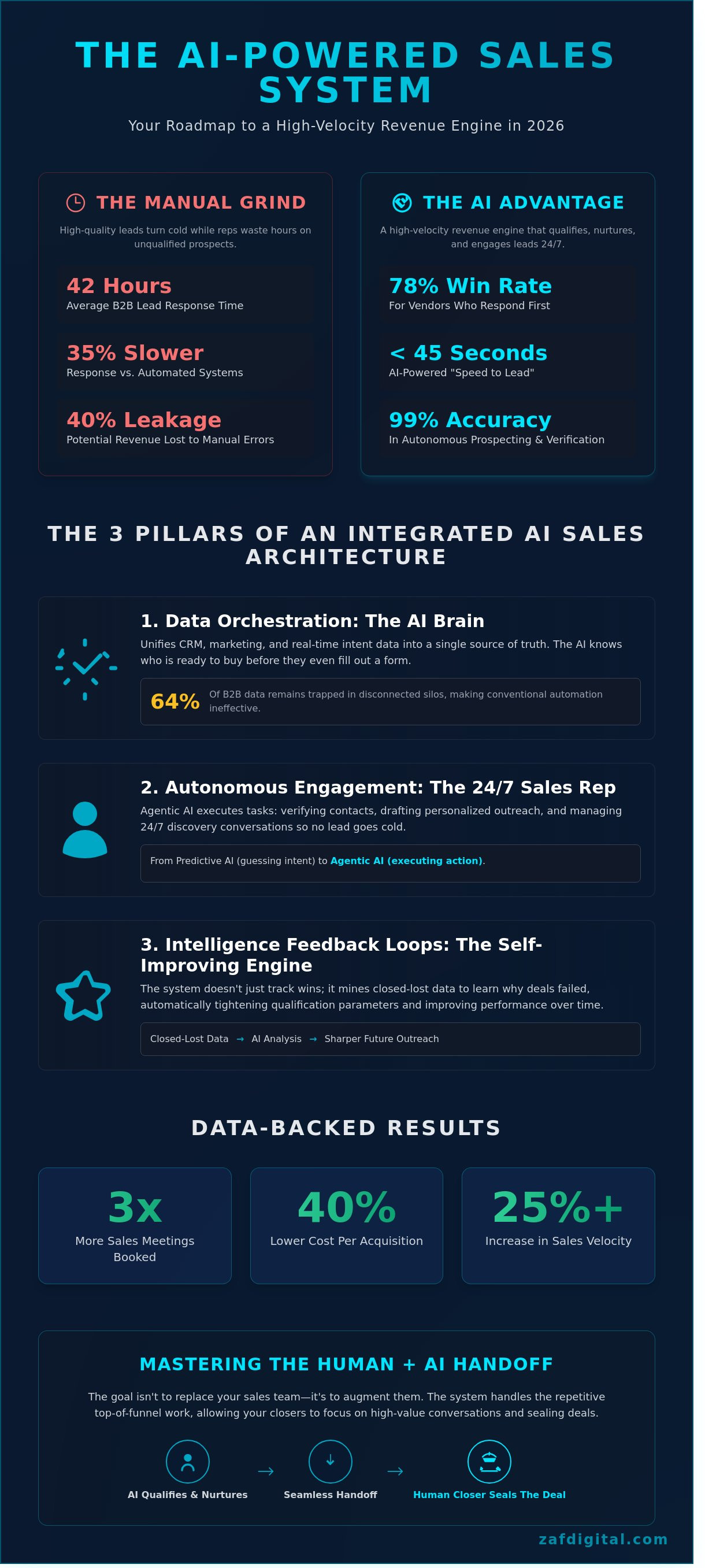
Recent data shows that 78% of B2B buyers close with the vendor that responds first, yet the average response time for mid-market firms still sits at 42 hours. You've likely seen your own sales team struggle with this manual grind, where high-quality leads turn cold while reps waste hours on unqualified prospects. It's a bottleneck that prevents real scaling and drains your budget. By implementing a custom ai powered sales system, you can flip this script and turn your sales department into a high-velocity revenue engine that works while you sleep.
We'll show you exactly how to achieve 3x more sales meetings and maintain 24/7 lead qualification without doubling your headcount. This guide provides a transparent, data-backed roadmap to unifying your marketing and sales data. You'll discover the specific steps to lower your cost per acquisition by 40% and reclaim your team's time for closing deals instead of chasing ghosts. Let's dive into the framework that's defining the competitive edge in 2026.
Key Takeaways
• Transition from predictive tools to agentic AI that autonomously manages lead qualification and nurturing across your entire funnel.
• Discover how to build a custom ai powered sales system by unifying your CRM data with advanced LLMs to eliminate manual friction.
• Identify and plug "lead leakage" points where manual follow-up errors are currently costing you up to 40% of your potential revenue.
• Master the "Human-in-the-Loop" model to ensure a seamless hand-off from automated engagement to your high-value human closers.
• Learn to scale globally by integrating top-of-funnel performance marketing with a localized, data-driven backend automation engine.
What is an AI-Powered Sales System (and Why You Need One in 2026)?
An ai powered sales system is no longer just a collection of disconnected tools or a glorified spreadsheet. By 2026, it has evolved into a synchronized ecosystem where Large Language Models (LLMs), workflow automation, and real-time CRM data work in unison. This system manages the entire lifecycle of a lead, from initial generation and qualification to long-term nurturing, without human intervention for repetitive tasks. It's a growth engine that scales your expertise without increasing your headcount.
We've moved past the era of "Predictive AI," where algorithms merely guessed who might buy based on historical patterns. Today, we utilize Agentic AI. These are autonomous agents that don't just predict; they execute. They browse professional networks, verify contact details, and draft personalized outreach based on a prospect's recent quarterly report. Relying on manual sales entry in 2026 is a liability. Companies using manual processes see a 35% slower response time compared to automated peers, which is fatal in a market where 78% of customers buy from the vendor that responds first. A sophisticated Artificial Intelligence framework distinguishes itself from a basic chatbot by its deep integration. A chatbot answers FAQs; an integrated sales system negotiates meetings by checking your calendar and the prospect's time zone simultaneously.
The Evolution of Sales Technology
Sales tech has transitioned from passive CRM logging to real-time conversational intelligence. In 2021, systems flagged keywords like "pricing" or "demo." In 2026, Generative AI identifies the underlying intent and emotional sentiment. If a prospect sounds hesitant about a specific feature, the system adjusts the nurture sequence instantly. This shift has reduced the "Speed to Lead" metric from several hours to under 45 seconds for top-performing firms, ensuring engagement happens at the peak of interest.
Key Components of a Modern Sales Engine
A high-performing ai powered sales system relies on three core pillars to drive revenue. First, autonomous prospecting agents find and verify leads with 99% accuracy, eliminating the "bad data" problem that plagues traditional databases. Second, conversational AI handles 24/7 discovery calls and demos, ensuring no lead goes cold overnight or during weekends. Third, automated sequencing adapts based on prospect sentiment. If an email reply is "not right now," the system doesn't just stop. It analyzes the context and schedules a follow-up for six months later, perfectly timed with the company's fiscal cycle. This data-driven approach ensures your pipeline is always moving, regardless of human bandwidth.
The 3 Pillars of an Integrated AI Sales Architecture
Building a high-performance ai powered sales system isn't about buying more software; it's about re-engineering your revenue engine. In 2026, the gap between market leaders and laggards is defined by how well they integrate three specific architectural pillars. These aren't optional add-ons. They're the structural requirements for a scalable sales operation.
Data Orchestration serves as the brain of the operation. AI requires a unified view of the customer to be effective. We've seen that roughly 64% of B2B data remains trapped in disconnected silos, which makes automation clunky and irrelevant. A proper architecture merges CRM records with real-time intent signals. This ensures the system knows exactly who is ready to buy before they even fill out a form.
Autonomous Engagement handles the execution. Citing The Role of Artificial Intelligence (AI) in Sales is essential here, as it highlights how systems now manage the entire early-stage relationship. These agents move prospects through the funnel by delivering the right content at the precise moment of interest. This removes human bottlenecking from the equation and allows your team to focus on closing.
Intelligence Feedback Loops ensure the machine gets sharper every day. It doesn't just track wins; it mines closed-lost data from the last 18 months to find out exactly why deals failed. This allows the system to tighten its own qualification parameters automatically. Because this level of integration is complex, custom AI transformation consulting has become the standard for firms that want a 25% or higher increase in sales velocity.
Top-of-Funnel: Autonomous Lead Generation
Modern lead generation has moved past the era of spray and pray. AI agents now scrape LinkedIn and niche industry databases with 98% accuracy. They enrich profiles with real-time triggers like recent funding rounds or executive hires. Outreach isn't generic anymore. AI analyzes a prospect's recent activity and company reports to craft hyper-personalized messages. This approach has proven to increase booking rates by 3.5x compared to the standard templates used just two years ago.
Middle-of-Funnel: Intelligent Qualification
The middle of the funnel is where most deals die due to slow response times. An ai powered sales system solves this with AI-led discovery. Chatbots now conduct initial qualification calls using natural language processing to gauge intent and budget. They score leads based on behavioral data, such as how long a lead spent on a specific case study. Once a lead hits a specific sentiment threshold, the system automatically books a meeting on your closer's calendar, ensuring a 0-minute lead response time.
Why Your Current Sales Stack is Costing You Revenue
Traditional sales setups are failing under the weight of 2026 market demands. Research indicates that manual follow-up processes miss 40% of viable opportunities. This "lead leakage" isn't a training issue; it's a structural flaw. Human SDRs can't monitor every channel 24/7. When data entry is left to manual input, CRM hygiene decays rapidly. Dirty data costs U.S. companies roughly $3.1 trillion annually in lost productivity and missed deals. An ai powered sales system eliminates these friction points by automating the grunt work that humans naturally neglect.
Many leaders fear that automation kills the "human touch." This is a misconception. Modern AI for Sales tools analyze thousands of data points to craft hyper-personalized outreach in seconds. Manual efforts often rely on generic templates because of time constraints. AI doesn't have those limits. By 2026, scaling headcount to increase volume has become a losing strategy. Hiring a new SDR costs an average of $115,000 per year including benefits and training. In contrast, scaling technology allows you to handle 10x the volume at a fraction of the overhead. You aren't just saving money; you're buying back your team's time for high-value closing activities.
The Speed to Lead Death Trap
Your conversion rates drop by 391% if you wait longer than 5 minutes to respond to a lead. Most human teams take 42 hours on average to react. This delay is a death trap for high-intent buyers who expect instant answers. AI agents provide that gratification. They qualify prospects the second a form is submitted. One B2B software firm improved their meeting rates by 300% simply by implementing instant AI qualification. It turns cold traffic into booked meetings before the prospect even leaves your website.
Solving the Data Silo Problem
Marketing data often dies before it reaches the sales closer. This gap creates a fragmented customer journey and frustrates prospects. An ai powered sales system acts as a single source of truth. It bridges the gap between your legacy tools and modern growth stacks. Custom AI solutions connect disparate platforms, ensuring every click and interaction is logged automatically. This transparency allows your closers to walk into every call with a full context of the buyer's intent. You stop wasting time on "discovery" calls that repeat what the prospect already told a chatbot or landing page.
Building vs. Buying: Implementation Strategy for 2026
Deciding whether to build a custom solution or purchase off-the-shelf software determines your revenue trajectory for the next three years. Most firms waste 40% of their technology budget on disconnected tools that fail to sync. This fragmentation creates data silos where your lead gen bot doesn't know what your CRM is doing. A unified ai powered sales system fixes this by ensuring every data point feeds a single intelligence layer.
The 'Frankenstein' Stack vs. Custom Architecture
Managing 12 different SaaS subscriptions costs the average mid-market firm $14,500 monthly in licensing and hidden integration maintenance. These "Frankenstein" stacks often break when one API updates, stalling your entire pipeline. Custom AI Sales Architecture is a scalable business asset that centralizes intelligence and ownership of your proprietary data. By prioritizing an API-first approach, you ensure your ai powered sales system grows with your company rather than becoming obsolete when a vendor changes their pricing model.
The Role of the Modern Sales Rep
By 2026, AI agents will handle 85% of top-of-funnel tasks, including initial outreach and meeting scheduling. This shift isn't about headcount reduction; it's about maximizing human impact. Reps now save 19 hours per week on CRM data entry and lead research. This allows them to focus exclusively on high-level negotiation and relationship building. To succeed, you must train your team to act as "AI Pilots" who manage automated workflows rather than manual prospectors.
Setting the right KPIs is vital for a hybrid team. Focus on these metrics:
AI-to-Human handoff efficiency
The percentage of AI-qualified leads that reach a discovery call.
Strategic account velocity
How quickly a rep moves a high-value lead through the closing stages.
Data integrity score
The accuracy of the insights the rep feeds back into the system to train the local LLM.
Security is no longer a footnote. Data breaches cost companies an average of $4.45 million in 2023, and the risks are higher with LLMs. Your strategy must include private cloud instances and SOC2-compliant data processing to keep your customer list out of public training sets. Don't settle for a vendor who just sells software. You need a partner who builds a custom roadmap based on your specific unit economics and security requirements.
Ready to move past fragmented tools and build a unified revenue engine? Partner with ZAF Digital to design your custom AI roadmap.
Scaling Revenue with ZAF Digital’s AI Sales Systems
Most agencies stop at lead generation. They hand over a list of names and consider their job done. At ZAF Digital, we bridge the gap between high-performance marketing and a fully integrated ai powered sales system. We don't just drive traffic; we build the backend automation that converts that traffic into revenue 24/7. Our strategy ensures that every dollar spent on customer acquisition is backed by a machine that never sleeps, never forgets to follow up, and never misses a nuance in a prospect's intent.
Our "No-Bullshit" approach to AI consulting means we prioritize ROI over hype. We've seen companies waste 40% of their marketing budget on leads that are never contacted within the critical five-minute window. We solve this by deploying custom AI chatbots that sound like your best salesperson, not a scripted robot. These systems are trained on your specific brand voice and proprietary data, ensuring every interaction feels authentic and drives the prospect closer to a closed deal.
The ZAF Growth Framework
Step 1: Auditing lead flow.
We identify exactly where you're losing money. Most businesses have at least 3 major friction points in their current funnel that stop conversions.
Step 2: Designing AI architecture.
We build a custom data layer that connects your marketing ads directly to an automated sales sequence.
Step 3: Deploying for ROI.
We launch the system and optimize based on real-time data. Our goal is a measurable 3x to 5x return on investment within the first two quarters.
Why Partner with a Dubai-Based AI Agency?
Dubai is currently the world's hub for technological scaling and digital innovation. Operating from this ecosystem allows us to deliver localized AI solutions with a global impact. We understand the nuances of the UAE market while maintaining the technical standards required for international expansion. This dual expertise is vital for brands that want to dominate both local and global territories simultaneously.
When you work with us, you gain direct access to Zaid Al-Fahad’s strategic growth vision. We don't hide behind account managers; we act as your dedicated growth partners. If you're ready to stop managing manual tasks and start scaling with a professional ai powered sales system, Request a Quote today. We'll show you how to turn your sales process into a predictable, data-driven engine for growth.
Secure Your Market Lead with Intelligent Sales Architecture
The transition to 2026 marks a hard line between companies that scale and those that stagnate. Data shows that businesses still using legacy, disconnected stacks are losing up to 27% of potential revenue to lead decay and manual errors. By implementing a unified ai powered sales system, you eliminate these leaks and turn your sales process into a high-precision engine. The core pillars of success now rest on 24/7 responsiveness and deep data integration that legacy tools simply can't match.
ZAF Digital bridges the gap between complex technology and measurable business growth. As AI transformation experts based in Dubai, we don't just provide software; we engineer custom-built AI agents that operate around the clock to capture and qualify every lead. Our approach focuses on ROI-driven performance marketing integration, ensuring every dollar spent contributes directly to your bottom line. We've moved past the era of "set and forget" tools. Today's market demands a dynamic partner who treats your growth as their own.
Don't let outdated processes cap your potential this year. Scale your revenue with a custom AI-powered sales system from ZAF Digital. It's time to build the scalable, data-backed future your business deserves.
Frequently Asked Questions
What exactly is an AI-powered sales system?
An AI-powered sales system is an integrated technology stack that uses machine learning and generative models to automate lead generation, qualification, and follow-ups. It acts as a 24/7 digital infrastructure that processes customer data to predict buyer behavior and intent. By 2026, these systems will handle 80% of routine sales tasks, allowing your human team to focus exclusively on high-value negotiations and closing deals.
Will AI replace my sales team in 2026?
AI won't replace your sales team, but sales teams using AI will replace those that don't. Research from McKinsey indicates that 31% of sales activities are automatable, which means your reps gain 12 hours back each week for strategic work. The system handles the repetitive outreach and scheduling, while humans provide the emotional intelligence and relationship building required for final signatures.
How much does it cost to implement a custom AI sales system?
Implementation costs for a custom ai powered sales system typically range from $5,000 to $50,000 depending on your database size and integration complexity. Small businesses often start with a $1,500 monthly SaaS model, while enterprise-level custom builds require a larger upfront investment. We focus on solutions that deliver a 3x return on investment within the first year by reducing cost-per-acquisition by 25%.
Can AI really personalize outreach for high-ticket B2B sales?
Yes, AI personalizes outreach by analyzing LinkedIn profiles, recent company news, and financial reports in under 2 seconds. It creates messages that reference specific 2025 growth targets or recent executive hires, achieving 40% higher open rates than generic templates. This isn't just a basic tag; it's a data-driven argument for why your solution solves a prospect's specific Q3 bottleneck.
How long does it take to see ROI from AI sales automation?
Most companies see a positive ROI within 4 to 6 months of full implementation. Initial setup takes 30 days, followed by a 60-day machine learning phase where the system optimizes its messaging based on real-world response data. By day 120, businesses typically report a 15% increase in qualified pipeline velocity and a 20% reduction in the total sales cycle length.
Does an AI sales system work with my existing CRM like Salesforce or HubSpot?
An ai powered sales system integrates directly with Salesforce, HubSpot, or Pipedrive through native APIs and secure connections. It syncs data in real-time, ensuring your CRM remains the single source of truth without manual updates. In fact, 92% of modern AI sales tools are built to sit on top of your current stack to enhance data hygiene rather than replace your existing software.
What is the difference between a chatbot and an AI sales agent?
A chatbot follows a rigid, pre-defined script, while an AI sales agent uses Large Language Models to understand intent and handle complex objections. Chatbots fail when a user deviates from the path; agents adapt and can pivot the conversation to book a meeting. Our data shows that AI agents convert 3.5 times more leads than the traditional logic bots used in 2023.
Is my business data safe when using generative AI for sales?
Your data is safe if you use enterprise-grade AI deployments with SOC2 Type II compliance and private API instances. We ensure that your proprietary customer data isn't used to train public models like GPT-4. By implementing data masking and localized processing, businesses keep 100% control over their intellectual property while benefiting from 2026-standard encryption protocols.