
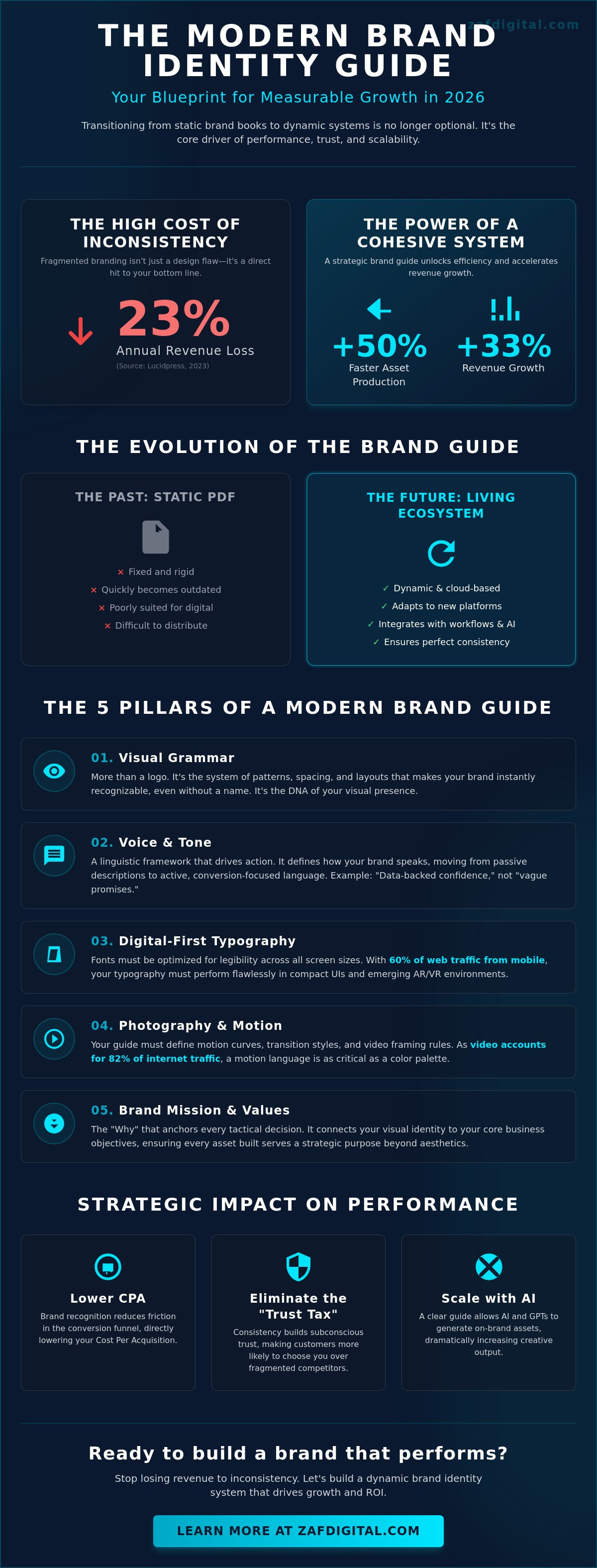
A 2023 study by Lucidpress revealed that inconsistent branding can slash your annual revenue by 23%. If your marketing feels fragmented across channels or your brand looks "cheap" compared to competitors, you aren't just losing face; you're losing money. Most leaders realize that briefing freelancers shouldn't feel like a game of telephone. This is why a data-driven brand identity guide is the most critical asset for your 2026 growth strategy. It's the difference between a pretty logo and a scalable system that drives performance marketing ROI.
We understand the frustration of slow content workflows and mismatched visuals that erode customer trust. You deserve a visual language that works as hard as your sales team. In this article, we'll show you how to build a strategic brand identity guide that prioritizes measurable growth over vanity metrics. You'll discover how to create a cohesive presence that increases conversion rates and allows your team to produce high-performing assets 50% faster. We're moving past the fluff to give you a blueprint for building trust and scaling your performance in the coming year.
Key Takeaways
• Transition from static brand books to dynamic, cloud-based systems that define how your brand behaves across every digital touchpoint.
• Build a high-performance brand identity guide that integrates visual grammar and conversion-focused tone to drive measurable growth.
• Lower your Cost Per Acquisition (CPA) and eliminate the "Trust Tax" by aligning your brand identity with your performance marketing strategy.
• Scale your creative output using AI and custom GPTs to generate brand-compliant assets without sacrificing quality or consistency.
• Execute a strategic implementation roadmap that audits existing gaps and aligns your core values with long-term business objectives.
What is a Brand Identity Guide in 2026?
A brand identity guide in 2026 functions as a living, cloud-based ecosystem rather than a static PDF document. It dictates how your business looks, speaks, and interacts across every digital touchpoint, from AI-driven chat interfaces to spatial computing environments. To understand the roots of this strategy, you can explore What is Corporate Identity? to see how these concepts evolved from 20th-century design to modern performance systems. Traditional branding relied on fixed assets, but 2026 demands extreme flexibility. Your system must adapt instantly to new platforms while maintaining a core DNA that users recognize in milliseconds. In the UAE, where digital transformation accelerated by 40% between 2023 and 2025, a dynamic guide ensures your team remains agile without losing brand equity.
To better understand how these elements come together in a modern design workflow, watch this helpful video:
The Difference Between a Logo and a Brand Identity
A logo is a singular mark, while an identity is the entire sensory and emotional experience. Relying solely on a logo often results in fragmented marketing where the message loses its edge across different platforms. A true identity system integrates specific color palettes, typography, verbal tone, and motion graphics into a cohesive whole. In the UAE's competitive 2026 market, where 78% of users interact with brands primarily through mobile devices, motion and sound have become as critical as a static symbol. When these elements work together, they create a scalable framework that supports growth instead of just a pretty picture.
Why Consistency is the Currency of Trust
Consistency isn't about repetition; it's about reducing cognitive load for the consumer. When a user sees a familiar visual pattern, their brain processes the information faster, which directly impacts conversion rate optimization (CRO). Data from early 2025 shows that brands with high visual consistency across all platforms see a 33% increase in total revenue growth. This familiarity creates a shortcut to trust, making it easier for potential clients to choose your service over a fragmented competitor. By using a brand identity guide, you ensure that every touchpoint reinforces your authority and professional expertise.
Brand consistency is the foundation of performance marketing.
The 5 Essential Pillars of a Modern Brand Identity Guide
A high-performing brand identity guide isn't a static PDF document. It's a strategic blueprint designed to scale performance and build trust. In a market where 71% of consumers are more likely to buy from a brand they recognize, consistency is your most valuable currency. To move the needle in 2026, your guide must move beyond basic aesthetics and focus on these five functional pillars.
Visual Grammar
This extends past the logo. It defines the specific patterns, textures, and negative space ratios that make your brand recognizable even without a nameplate.
Voice and Tone
You need a linguistic framework that drives action. It's the difference between a passive "we provide services" and an active "we scale your revenue."
Digital-First Typography
With 60% of global web traffic coming from mobile devices, your fonts must be legible on small screens and optimized for emerging AR/VR environments.
Photography and Motion
Since video content accounts for 82% of all internet traffic, your guide must specify motion curves, transition styles, and video framing rules.
Brand Mission and Values
This is the "Why" that anchors every tactical decision. Without a clear mission, your visual identity is just decoration.
Developing Your Brand Voice and Tone
Your voice is your conversion engine. You must decide if you're the expert partner who provides stability or the innovative disruptor who breaks the status quo. Use a "Speak this, not that" table to guide your team. For example, speak with "data-backed confidence" instead of "vague promises." This clarity ensures your social media management services maintain a consistent personality that builds long-term ROI. If you're ready to refine your message, our team can help you align your strategy with measurable goals.
Visual Elements: Logo, Color, and Type
Precision in visual elements prevents brand dilution. Your brand identity guide should enforce strict logo rules, such as a minimum 32px height for digital icons and clear space equal to the "X" height of the logo. Color psychology also plays a massive role. In the UAE market, specific shades of green and gold signify growth and prestige, while international audiences may prioritize high-contrast blue for tech-focused trust. Finally, select typography that supports technical SEO. Heavy, custom fonts can tank your PageSpeed Insights score; choose weights that balance brand character with fast loading times to keep your Core Web Vitals in the green.
Why Brand Identity is the Secret Engine of Performance Marketing
Performance marketing isn't just a game of bidding and algorithms. It's a game of trust. When a brand's visual and verbal presence is fragmented, it pays what we call the "Trust Tax." This tax manifests as a higher Cost Per Acquisition (CPA) because users hesitate before clicking or converting. Research shows that inconsistent branding can lead to a 33% drop in revenue growth compared to brands with a unified presence. A weak identity forces your ad spend to work twice as hard to overcome consumer skepticism.
At ZAF Digital, we prioritize a comprehensive brand identity guide before scaling any paid media budget. This isn't about aesthetics; it's about efficiency. A strong guide speeds up creative production, allowing for high-velocity ad testing. When your design team has a clear set of rules, they don't waste hours debating hex codes or font weights. They build assets that convert. This systematic approach is why performance-driven brands prioritize identity. It builds the foundation for long-term Customer Lifetime Value (CLV) by ensuring the first touchpoint feels as professional as the final product delivery.
Reduced Friction
Familiarity lowers the mental effort required to make a purchase decision.
Creative Velocity
Standardized assets mean you can launch new campaigns in days, not weeks.
Scalability
A solid identity ensures that as you grow, your brand doesn't become a "Frankenstein" of mismatched styles.
Lowering CAC through Visual Authority
Professional branding directly impacts your bottom line by improving click-through rates (CTR) on platforms like Meta and Google Ads. When users recognize a brand's visual language, the "Halo Effect" takes over. They associate the positive feelings from past interactions with the new ad they're seeing. This recognition can increase CTR by over 20% in competitive niches. Establishing this visual authority is a core pillar of growth marketing, where every micro-optimization counts toward your total ROI.
Busting the "Just a Logo" Myth
Businesses often fail because they treat branding as an afterthought or a simple graphic design task. If you're still asking why is brand identity important, you're likely missing the strategic "Creative Guardrails" that keep your performance agency on track. A brand identity guide provides the logic behind the visuals. It tells your partners exactly how to communicate your value proposition without drifting off-message. Without these guardrails, your marketing spend becomes a series of disconnected experiments rather than a cohesive growth engine.
Scaling Your Brand Identity with AI and Automation
Manual brand management is no longer viable for companies aiming for 2026 market leadership. Data shows that 72% of high-growth organizations now use AI-driven governance to maintain consistency across fragmented digital channels. Scaling your brand requires moving beyond static PDFs. You must transform your brand identity guide into a living, machine-readable dataset that powers your entire marketing stack.
Training custom GPTs on your specific brand guidelines ensures that every piece of copy, from technical whitepapers to punchy ad headlines, retains a unified voice. This eliminates the 40% of time creative directors usually spend on basic proofing and tone corrections. Beyond text, vision AI now automates brand audits by scanning your digital footprint in real-time. These systems flag assets that use outdated hex codes or unauthorized font weights, protecting your brand equity before a mismatch reaches the public.
AI-Driven Content Creation
Generative AI models like Midjourney or Adobe Firefly work best when fine-tuned on your specific color palettes and font styles. This technical integration ensures your social media video strategy stays visually consistent without constant manual oversight. By applying custom AI filters to raw video footage, you maintain a premium, unified aesthetic across global regions. This automation reduces production cycles by an average of 30% while ensuring 100% compliance with your visual standards.
The Role of AI Chatbots in Brand Voice
Your automated interfaces are often the primary touchpoint for modern consumers. To avoid generic or off-brand interactions, you must embed your brand identity guide directly into AI chatbots for business. Setting strict parameters prevents "AI hallucinations" and ensures the bot uses your specific industry terminology. A well-configured bot doesn't just solve tickets; it projects a human-like, brand-aligned personality that builds trust through every automated conversation.
The next frontier is "Dynamic Branding," where identity elements adjust in real-time based on user data. In 2026, personalized ads that adapt their layout and tone to the viewer's preferences drive 2.5x higher engagement than static alternatives. This isn't about changing who you are; it's about using AI to show the most relevant version of your brand to every individual user.
Ready to build a brand that scales automatically? Work with ZAF Digital to implement an AI-driven growth strategy that delivers measurable results.
How to Implement Your Brand Guide: A Strategic Roadmap
Stop treating your brand like a static asset. A 2024 study by Lucidpress revealed that consistent brand presentation can increase revenue by 33%, yet many companies fail because their brand identity guide sits unused in a forgotten folder. Implementation requires a tactical shift from theory to execution. Start by auditing your current assets. Catalog every social media profile, sales deck, and email signature to identify where your 2023 legacy visuals clash with your 2026 goals.
Execution begins with alignment. Conduct structured interviews with at least five key stakeholders to ensure your core values aren't just corporate jargon. Once the mission is locked, design a visual system that lives in a cloud-based portal. Static files are obsolete. Your team needs real-time access to hex codes, logo variants, and typography. Follow these steps for a successful rollout:
Audit
Map out every digital and physical touchpoint to find inconsistencies.
Interview
Gather insights from sales, product, and support teams to define the brand's "why."
Centralize
Build a digital home for your assets using platforms like Notion or a dedicated brand portal.
Educate
Host a 60-minute workshop for internal teams and external partners to demonstrate correct usage.
Iterate
Schedule a mandatory review every 6 months to adjust based on market shifts and performance data.
From Documentation to Activation
PDFs are where brands go to die. In 2026, agility is your greatest asset. Move your documentation to interactive platforms like Canva or Notion where updates sync instantly. Create "Quick Start" kits tailored for specific departments. HR needs recruitment templates, while Sales needs decks that reflect your high conversion web design strategy. This ensures that every department contributes to a unified brand experience without needing a design degree.
Measuring the Success of Your Brand Identity
You can't manage what you don't measure. Track brand awareness and sentiment through monthly social listening and NPS scores. Data shows that consistent branding improves ad performance; monitor your Click-Through Rates (CTR) to see if visual alignment lowers your Customer Acquisition Cost. If your metrics stagnate, your identity might need a pivot. Ready to scale? Partner with ZAF Digital to build a performance-first brand identity that turns recognition into measurable revenue.
Turn Your Brand Identity Into a Performance Engine
Success in 2026 hinges on your ability to blend creative vision with technical precision. A modern brand identity guide isn't a static PDF; it's a dynamic framework designed for scale. Industry data shows that brand consistency can boost revenue by 23%, yet the real edge comes from AI integration. By 2026, 80% of top-performing companies will leverage automated systems to maintain their global presence. You need a strategy that works as hard in the UAE as it does in international markets. ZAF Digital provides Dubai-based expertise and data-driven branding strategies tailored for the modern economy. We specialize in AI-integrated marketing systems that transform your identity into a measurable growth asset. Don't leave your reputation to chance when you can build it on data. It's time to move beyond aesthetics and start focusing on performance. Our team is ready to help you dominate the 2026 landscape with a brand that's built to last.
Build a Growth-First Brand Identity with ZAF Digital
Let's start scaling your vision today.
Frequently Asked Questions
How much does a professional brand identity guide cost in 2026?
Professional branding services for mid-market firms typically range from $5,000 to $50,000 according to 2024 industry benchmarks from IBISWorld. The final investment depends on the complexity of your brand architecture and the number of digital-first assets required. High-end agency packages focus on deep market research and strategic positioning rather than just visual aesthetics.
Can I create a brand identity guide using AI tools?
You can use AI tools like Midjourney or Adobe Firefly for visual ideation, but they can't build a strategic brand identity guide based on real-time market data. AI currently lacks the capability to ensure 100% legal trademark compliance across global jurisdictions. Use these tools to handle 20% of the creative heavy lifting while letting experts manage the strategic alignment and brand protection.
How long does it take to develop a comprehensive brand book?
A comprehensive project takes 6 to 12 weeks from the initial discovery phase to final delivery. This timeline accounts for three distinct stages: research, design, and documentation. Shortcutting this process often leads to a 30% increase in revision costs later in the year because the foundation wasn't solid. Speed shouldn't come at the expense of scalability.
What is the difference between a style guide and a brand identity guide?
A style guide focuses strictly on visual assets like hex codes, typography, and logo spacing. A brand identity guide is much broader; it incorporates tone of voice, core values, and specific customer personas. Think of the style guide as the manual for "what" people see, while the identity guide explains the "why" behind your market presence.
How often should a company update its brand identity guidelines?
Companies should perform a minor audit every 12 months and a major refresh every 3 to 5 years. Data from the 2024 State of Branding report shows that 74% of high-growth companies update their assets to match shifting consumer behaviors. Regular updates prevent your visual language from becoming obsolete in a fast-moving digital market where trends shift quarterly.
Do small businesses and startups really need a brand guide?
Small businesses need a guide to ensure 100% consistency across all digital touchpoints. Without one, marketing teams waste roughly 5 hours per week searching for or recreating assets. A clear guide acts as a blueprint for scaling. It makes it easier to onboard new team members or agencies without losing the brand equity you've worked hard to build.
What are the most common mistakes in brand identity guides?
The most frequent error is focusing too much on aesthetics while ignoring functional application. 45% of guides fail because they don't provide clear examples for social media or video content. Another mistake is creating a static PDF that isn't updated as the company evolves. Your guidelines must be a living document that reflects current data and growth targets.