

Your marketing agency doesn't own your data; they're just holding the keys to your growth, and it's time to take them back. Most executives hesitate to switch partners because they fear a 30 percent drop in lead volume or losing years of historical tracking data to an agency "hostage" situation. You're right to be cautious. A botched handover can derail your scaling efforts for an entire quarter. However, learning how to transition between marketing agencies smoothly isn't just about avoiding disaster; it's a strategic audit that cleanses your digital ecosystem and protects your future ROI.
We know you're looking for a partner who acts as an extension of your team, not an external black box. This guide provides a disciplined roadmap to condense a standard eight week transition into a high-impact four to six week window. By front-loading the technical heavy lifting into the first 21 days, you'll ensure a seamless transfer of every digital asset. You're about to master a process that guarantees zero performance dips, absolute data ownership, and a direct path to ROI-driven scaling with a partner who values transparency as much as you do.
Key Takeaways
• Avoid the typical 15 to 20 percent lead volume drop by identifying underperforming partnerships early and mitigating the "sunk cost fallacy."
• Ensure total control over your digital ecosystem by reclaiming full administrative access to ad platforms and creative source files before the final handover.
• Discover how to transition between marketing agencies smoothly using a disciplined 30-day overlap plan that prioritizes a silent audit and zero downtime.
• Vet your next performance partner based on technical depth and a "no-bullshit" transparency policy rather than polished sales decks or vanity metrics.
• Leverage ZAF Digital’s growth framework to maintain momentum and ensure your data remains a strategic asset during every stage of the switch.
The Hidden Risks of a Messy Agency Switch (And How to Mitigate Them)
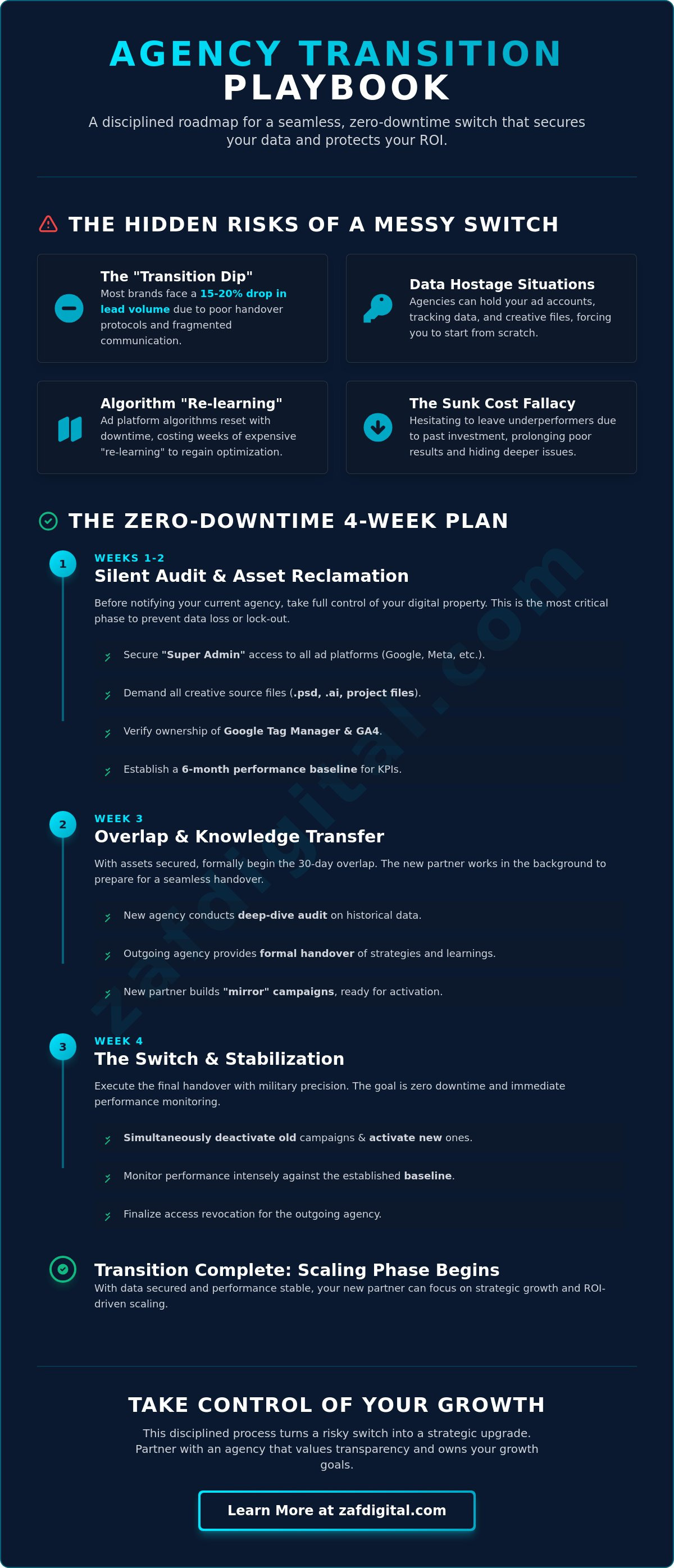
Switching partners is high-stakes surgery on your revenue stream. Most brands experience a "Transition Dip," where lead volume drops by 15% to 20% due to poor handover protocols and fragmented communication. Before you cut ties, it's vital to understand what is a marketing agency in a modern context. Ideally, they're a strategic partner that enhances your data, but many businesses find themselves tethered to vendors that prioritize their own processes over the client's growth.
To better understand the complexities of this process, watch this expert breakdown on avoiding transition stress:
Many leaders fall victim to the "sunk cost fallacy," staying with underperforming partners because they've already invested months of budget and significant energy. This hesitation is often fueled by "black box" agencies that hide their proprietary methodologies. They make you feel like you can't leave without breaking your entire marketing engine or losing access to your own historical performance data. Learning how to transition between marketing agencies smoothly requires recognizing these psychological traps and prioritizing your company's long-term scalability over short-term comfort.
The "Transition Trap" and ROI Protection
A single week of downtime in ad spend doesn't just halt leads. It resets the machine learning algorithms that optimize your conversions, potentially costing you weeks of expensive "re-learning" time. The biggest threat is "quiet quitting" by the outgoing agency. They often stop active optimization the moment they receive a termination notice, leading to a slow decay in performance. To prevent this, you must establish a "Performance Baseline" based on your last six months of verified data before you ever send that notice. This baseline acts as your shield, ensuring the new team knows exactly what numbers they need to defend from day one.
Defining Your "Why" for the Move
Is your move driven by poor ROI, a lack of transparency, or technical obsolescence? In 2026, a "no-bullshit" approach to data is the only way to survive in a competitive digital market. If your current agency can't explain their logic with hard numbers, they're a liability. A clean, structured break is the prerequisite for seo and traffic success. Your new partner should be vetted against non-negotiable KPIs for their first 90 days, focusing on lead quality and conversion stability. When you understand how to transition between marketing agencies smoothly, you turn a risky move into a strategic upgrade that cleanses your digital ecosystem and sets the stage for measurable scaling.
Securing Your Digital Assets: The Technical Handover Checklist
Reclaiming your digital property is the most critical phase of a partner switch. Many brands discover too late that they don't actually own their advertising accounts or tracking infrastructure. To understand how to transition between marketing agencies smoothly, you must treat your digital assets like physical real estate. You need the keys, the deeds, and the blueprints. Start by securing "Super Admin" access to Google Ads, Meta Business Suite, and LinkedIn Campaign Manager. If an agency refuses this, they're holding your growth hostage. You paid for the ad spend and the management; the data belongs to your balance sheet.
Don't settle for flattened .jpg or .mp4 exports of your creative work. Demand the original source files, such as .psd, .ai, or Premiere project files. Without these, your new partner can't iterate on successful campaigns, forcing you to pay for redundant creative labor. Similarly, historical SEO data in Google Search Console and GA4 must remain intact. A gap in data is a gap in your ability to measure ROI. At ZAF Digital, we recommend completing this reclamation within the first 14 days of the transition period to prevent any "accidental" data loss or access revocation.
Data Sovereignty and Tracking Pixels
The Google Tag Manager (GTM) container is the heart of your tracking ecosystem. It must be owned by your brand, not the agency's master account. If the outgoing vendor owns the container, they can cut your data flow with one click. Audit your conversion tracking to ensure no data leaks to the previous vendor's third-party servers. Secure all lead-source attribution logs and historical CRM data. This ensures your new partner starts with a clear map of what drives revenue. If you're unsure about your current tracking health, a technical audit can identify hidden vulnerabilities before they impact your bottom line.
AI and Automation Handovers
In 2026, your competitive advantage often lives in your automation logic. If your previous partner built a custom ai chatbot for business, you need the full training data sets and specific LLM prompts they developed. Proprietary scripts and API keys for automated reporting dashboards must be documented and transferred. Don't let your AI transformation stall because of a messy exit. Secure the documentation for every custom workflow and automation script. This technical transparency is a non-negotiable prerequisite for scaling without losing momentum during the switch.
Auditing the Future: How to Vet Your Next Performance Partner
Don't get blinded by a polished pitch deck. In 2026, the gap between a sales-led agency and a performance-led partner is wider than ever. While a sales team might promise the world, a true growth partner starts by asking about your technical debt and data architecture. Vetting a new partner is the most critical step in learning how to transition between marketing agencies smoothly. It's about finding a team that prioritizes a "no-bullshit" transparency policy over vanity metrics. This means they should be willing to show you live dashboards and real-time attribution models, not just curated screenshots from their best month in 2024.
Technical depth is non-negotiable. Your next partner must demonstrate AI readiness, showing how they use machine learning to optimize bidding or automate creative testing. They should also perform a high conversion web design audit during the onboarding phase. If your landing pages aren't built for ROI, even the best ad campaigns will fail to scale. A partner who understands this will look at your website as a conversion engine, not just a digital brochure.
Performance-First Selection Criteria
Look for case studies that match your specific growth stage. If you're targeting the UAE market or scaling internationally, ask for data-backed evidence of success in those regions. A major red flag is any contract that includes asset lock-ins or proprietary tracking that you can't take with you. Your partner should explain complex data in simple, business-value terms. If they hide behind jargon, they're likely masking a lack of results. Test their ability to link marketing spend directly to your bottom-line revenue before signing any long-term agreement.
The Strategic Alignment Session
Stop looking for a vendor and start looking for a strategic growth partner. This partner won't just "take over" your accounts; they'll perform a deep audit of previous campaigns before making a single change. This prevents repeating past mistakes and identifies quick wins. During this session, you should also define a forward-looking video marketing strategy. In 2026, video is the primary driver of performance marketing, and your agency must have the technical capability to produce and optimize it for specific conversion goals. Mastering these selection criteria is how to transition between marketing agencies smoothly while ensuring your next move is an upgrade, not just a change.
The 30-Day Overlap: A Step-by-Step Execution Plan
A successful switch doesn't happen on a Friday afternoon; it's a month-long strategic maneuver. To understand how to transition between marketing agencies smoothly, you must ignore the urge to fire and hire on the same day. This impulsive approach is exactly how brands lose 15% of their lead volume in a single week. Instead, implement a 30-day overlap period where both agencies are technically active, but their roles are clearly segregated. This ensures your data remains unbroken and your ROI stays protected during the handover.
Week 1: The Silent Audit.
Your incoming agency observes. They review your historical performance, account structures, and the tracking vulnerabilities we identified in the previous sections. They don't make changes yet; they simply map the terrain.
Week 2: Official Notice and Asset Reclamation.
You send the termination notice to the outgoing partner. Simultaneously, you execute the technical handover checklist, reclaiming "Super Admin" access and securing all creative source files.
Week 3: Parallel Tracking and Strategy Calibration.
The new agency sets up their reporting dashboards and parallel tracking pixels. This verifies that the data coming in matches your historical benchmarks before the old agency stops their work.
Week 4: Final Cut-over and Access Revocation.
The new agency takes full control of the bidding and optimization. Once the new campaigns are stable, you revoke all access for the previous vendor.
Front-loading this process is essential. According to industry data from May 2026, a disciplined process can condense a complex transition into roughly four to six weeks, provided you complete the technical heavy lifting within the first 14 to 21 days. This speed prevents the "Transition Dip" from becoming a permanent revenue loss.
Managing the Overlap Phase
Managing the "two agencies in one room" dynamic requires firm leadership. You must ensure the outgoing partner fulfills their final SOW obligations. Some vendors might attempt "campaign throttling" or stop active optimization once they receive notice. If you see a sudden drop in conversion frequency, call it out immediately. Your outgoing agency is still a paid vendor until the final day of their contract; hold them to the performance baseline you established earlier.
The Post-Transition Performance Sprint
The first 30 days with your new partner should focus on a performance sprint. This isn't the time for vague brand-building; it's time for "Quick Wins." Your new agency should execute an immediate technical SEO and UX audit to remove legacy friction that the previous team ignored. This identifies low-hanging fruit that can provide an immediate ROI boost. If you're ready to stop the lead leakage and start scaling with a partner who values transparency, book a strategy audit with our performance team today.
Scaling Beyond the Switch with ZAF Digital’s Growth Framework
Surviving a partner change is a low bar for a high-growth brand. While most guides focus on avoiding disaster, our framework is built to ensure you thrive the moment the new campaigns go live. Learning how to transition between marketing agencies smoothly is only the first step; the real objective is to build a digital ecosystem that is more efficient, transparent, and scalable than what you left behind. At ZAF Digital, we don't view ourselves as an external vendor. We act as your strategic growth partner, integrating directly into your business logic to turn marketing spend into a predictable revenue engine.
Our methodology focuses on the "Zero-Downtime" onboarding process. We've seen that a disciplined transition, which typically takes four to six weeks, can be optimized to produce results in the first 21 days if you front-load the technical work. We prioritize measurable ROI over vanity metrics like impressions or clicks. If a campaign isn't contributing to your bottom line, it's waste. We eliminate that waste immediately, allowing you to reinvest those funds into high-performance channels that drive actual scale in the UAE and international markets.
Our Growth-First Onboarding
We start with a deep-dive account audit that often identifies 15% to 25% of ad spend being wasted on non-converting search terms or poorly targeted audiences. Our team restructures your digital ecosystem to ensure maximum scalability from day one. You won't have to wait for monthly PDFs to see how you're doing. We implement real-time performance dashboards that you own completely. This level of transparency is a core part of our "no-bullshit" approach, providing you with 24/7 visibility into your conversion data and cost-per-acquisition (CPA) metrics.
Future-Proofing with AI and Innovation
In 2026, standard marketing isn't enough to stay ahead of the competition. We integrate AI transformation into your standard marketing stack to automate lead follow-ups and optimize bidding strategies in real time. By deploying custom AI solutions, we help you capture and nurture leads that would otherwise slip through the cracks. This technological edge is paired with cinematic video production designed specifically to fuel performance ads, ensuring your brand stands out in a crowded digital landscape. We don't just help you switch; we help you evolve into a market leader.
Ready for a smooth transition? Request a quote from ZAF Digital to see how we can secure your data and accelerate your ROI. Mastering how to transition between marketing agencies smoothly is easier when you have a partner committed to your long-term success.
Take Control of Your Marketing Momentum
Transitioning isn't a retreat; it's a strategic upgrade. By reclaiming your data sovereignty and following a disciplined overlap schedule, you eliminate the risks of the performance dip we discussed. You've learned how to transition between marketing agencies smoothly by prioritizing technical audits and transparency over empty sales promises. This process ensures your lead generation doesn't stall while you shift toward a more scalable, AI-ready future. A clean break from an underperforming partner is the first step toward reclaiming your competitive edge.
You deserve a partner that acts as an extension of your own team. As Dubai-based performance experts, we specialize in AI-driven growth strategies that deliver proven ROI for international brands. Don't let your data stay hostage to a vendor that hides behind black-box methodologies. Stop settling for mediocre results, transition to ZAF Digital today. Your growth shouldn't wait for the next quarter. It's time to build a digital ecosystem that works as hard as you do. We're ready to help you scale.
Frequently Asked Questions
How much notice should I give my current marketing agency?
Standard industry contracts typically require a 30 to 90 day notice period. You must review your specific agreement to identify termination clauses and avoid financial penalties. We recommend providing the exact notice required while ensuring your new partner is ready to begin their silent audit the same day you notify the outgoing vendor.
Will my Google Ads performance drop if I switch agencies?
A temporary fluctuation of 15% to 20% in lead volume is common during the first 14 days of a switch. This happens as machine learning algorithms stabilize under new management. You can minimize this "Transition Dip" by ensuring a 30 day overlap where the new team audits the account before making aggressive bidding changes.
Can an agency refuse to give me access to my own ad accounts?
No, an agency cannot legally withhold access to accounts where your brand paid the media spend directly. You should always maintain "Super Admin" status on Google Ads and Meta Business Suite. If an agency refuses to grant this access, it's a major red flag that they're prioritizing their leverage over your data sovereignty.
What is the most common mistake when transitioning agencies?
The most frequent error is "The Clean Cut," where a brand terminates the old agency on a Friday and expects the new one to be live by Monday. This creates a data vacuum. To understand how to transition between marketing agencies smoothly, you must avoid this gap by maintaining a 30 day overlap for strategy calibration and tracking verification.
How do I tell my current agency we are moving on without burning bridges?
Keep the conversation focused on strategic alignment and evolving business goals. Explain that your 2026 scaling targets require specific technical capabilities, such as AI transformation or international performance marketing, that necessitate a new partnership. A professional, direct exit prevents sabotage and ensures a cleaner technical handover of your creative assets.
Should the new agency audit the old one before we sign the contract?
Yes, a pre-contract audit is essential for protecting your ROI. The incoming agency should identify waste in your current ad spend and tracking vulnerabilities before you commit to a long term partnership. This ensures they have a realistic roadmap for the first 90 days and can defend your performance baseline from day one.
How long does a smooth marketing agency transition usually take?
A disciplined transition takes 4 to 6 weeks. While complex handovers can stretch to 8 weeks, completing the technical heavy lifting within the first 21 days is the goal. This timeline allows for a silent audit, official notice, and a parallel tracking phase to ensure zero downtime in your lead generation.
What technical assets are most commonly "held hostage" by agencies?
Google Tag Manager (GTM) containers and creative source files are the most frequent targets. Agencies often provide flattened exports but withhold the original .psd or .ai files, forcing you to pay for redundant creative labor. Additionally, custom AI chatbot training data and API documentation are increasingly held as leverage in 2026 transitions.