

Your CFO doesn't care about "brand sentiment" or "organic reach" when they're reviewing a $15,000 monthly agency invoice. In 2026, many executives still view marketing as a black hole where capital vanishes without a traceable exit point. You're likely feeling the pressure to deliver immediate revenue while justifying marketing agency costs to management against a backdrop of tightening budgets and the FTC’s latest Consumer Review Rule. It's a frustrating position when you know the potential for growth but lack the data-backed language to prove it to the board.
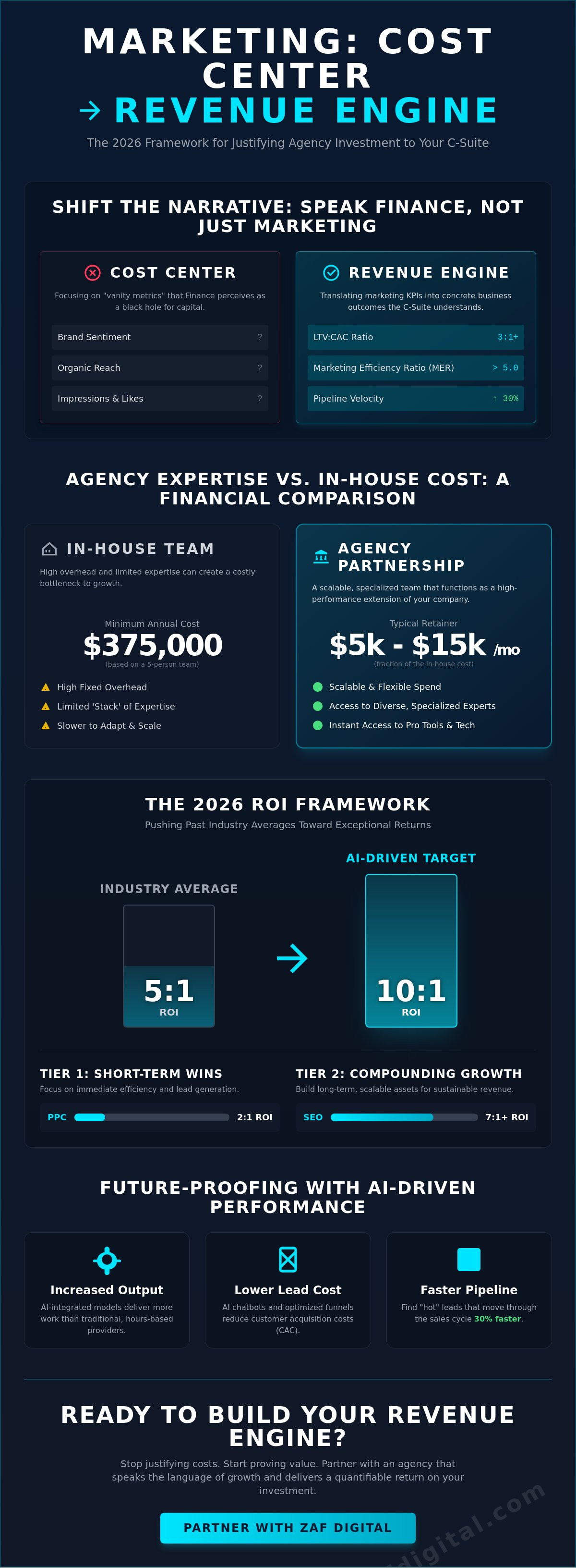
This article will show you how to transform marketing from a perceived cost center into a high-performance revenue engine. You'll learn our 2026 ROI Framework, designed to push past the industry average 5:1 return toward an exceptional 10:1 ratio using AI-driven performance tracking. We'll compare agency scalability against the $375,000 minimum annual cost of a five-person in-house team and provide the exact reporting structures you need to win approval for an increased budget.
Key Takeaways
• Shift the internal narrative from viewing marketing as an expense to a strategic investment by replacing vanity metrics with concrete business outcomes.
• Build a data-backed business case for justifying marketing agency costs to management by focusing on Customer Lifetime Value (LTV) and Acquisition Costs (CAC).
• Understand the financial advantage of an agency's specialized expertise over the high overhead and 'stack' limitations of a $375,000+ in-house team.
• Align agency deliverables with specific corporate milestones, such as 20% revenue growth, to ensure every dollar spent has a clear performance target.
• Leverage AI-integrated agency models and chatbots to increase output and lower lead conversion costs compared to traditional, hours-based service providers.
Why Management Sees Marketing as an Expense (And How to Shift the Narrative)
Management's skepticism toward marketing budgets isn't a lack of vision. It's a reaction to years of vague reporting. When a CFO looks at a marketing invoice, they often see a "cost center," an unavoidable expense that eats into the company's EBITDA without a guaranteed return. This perception stems from a fundamental disconnect: marketers report on activities, while management cares about outcomes. In 2026, the board expects marketing to function like a predictable sales machine, not a creative experiment.
The friction between Marketing and Finance usually boils down to accountability. Finance departments operate on hard data and historical performance. If you can't show how a $10,000 monthly retainer leads to a specific increase in market share or revenue, you're not just failing to prove value; you're making justifying marketing agency costs to management nearly impossible. To bridge this gap, you must stop talking about what you're "doing" and start talking about what you're "building."
To better understand how these costs break down and how to view them from a strategic perspective, watch this helpful video:
The Language Gap: Speaking Finance, Not Just Marketing
C-suite executives don't care about "likes" or "impressions" because those metrics don't pay the bills. To win approval, you must translate marketing KPIs into business outcomes. Instead of talking about reach, discuss your Return on Marketing Investment (ROMI). When you frame agency fees as a lever for increasing revenue or lowering customer acquisition costs, the conversation shifts. Transparency in agency fee structures is non-negotiable; management needs to see exactly where the capital goes and how it fuels the growth engine.
Marketing as a Scalable Asset
Think of your digital presence as digital real estate. SEO and high-performance web design aren't just monthly expenses; they're long-term assets that build equity over time. This is similar to how a company views Research and Development (R&D) or Capital Expenditure (CapEx). By investing in a comprehensive growth marketing strategy, you're creating a scalable system that generates value long after the initial spend. This shift in perspective, from "buying ads" to "building an asset," is the key to justifying marketing agency costs to management for the long term.
Building a Data-First ROI Framework for 2026
Data is the only shield you have in a budget review. To start justifying marketing agency costs to management, you need a clear baseline. Calculate your current Customer Acquisition Cost (CAC) across every active channel. If you don't know the exact dollar amount required to win a customer right now, you won't be able to prove that an agency is optimizing your spend. By reframing marketing as an investment, you shift focus toward Customer Lifetime Value (LTV). High upfront agency fees are easier to swallow when they're tied to a strategy that boosts LTV by 20% through superior positioning and retention.
Success in 2026 requires "Success Tiers." You can't promise a 10:1 ROI in month one. Instead, set tiers. Tier 1 focuses on short term wins like PPC efficiency. In this area, the industry average is a $2 return for every $1 spent. Tier 2 focuses on long term compounding growth through SEO, which often yields ROIs upwards of 700% over a 12 month period. This tiered approach manages expectations while showing a clear path to the "revenue engine" status management demands.
The Metrics That Actually Matter to the CEO
The CEO doesn't care about platform specific ROAS. They care about the Marketing Efficiency Ratio (MER). This is your total revenue divided by total marketing spend. It shows the health of the entire ecosystem. Agencies also impact Pipeline Velocity. Expertly managed campaigns don't just find leads; they find "hot" leads that move through the sales cycle 30% faster. When you combine this with a strong social proof strategy that lifts your retention rate, you're not just spending money; you're increasing the enterprise value of the company.
Attribution in the Age of AI
The linear buyer journey is dead. In 2026, a customer might see a short form video on LinkedIn, read an SEO blog, and receive three AI personalized emails before converting. Attribution modeling is the bridge between spend and revenue. We've moved away from "Last Click" models because they ignore 90% of the influence. Modern AI tools now track previously invisible touchpoints, allowing us to see how a top of funnel blog post actually contributed to a closed deal three months later. This holistic view is essential for justifying marketing agency costs to management. If you're ready to see how these metrics look in practice, our team can help you audit your current growth infrastructure.
Agency Expertise vs. In-House Teams: A Financial Comparison
Building an internal marketing department is a massive capital commitment. A fully loaded in-house team consisting of a manager, SEO specialist, content writer, and PPC expert costs between $375,000 and $585,000 per year. These figures don't just cover salaries; they include health insurance, payroll taxes, and training. Agencies offer a fractional model. You get an entire department's worth of specialized talent for the cost of a single mid-level hire. This stark contrast is your strongest lever for justifying marketing agency costs to management during annual budget planning.
One person can't master every discipline. Expecting a single marketing manager to handle technical SEO, AI bidding strategies, and high-end video production leads to mediocrity. Agencies solve this "Stack Problem" by providing a team where each member is a deep specialist in their field. You aren't just paying for hours; you're paying for the collective intelligence of a group that lives and breathes performance data. This eliminates the hiring and firing cycles that plague growing companies when their needs shift from brand awareness to lead generation.
What's the price of waiting? If you spend six months trying to recruit and onboard the perfect in-house SEO lead, you've lost half a year of compounding growth. With long-term SEO campaigns often delivering a 700% ROI, a six-month delay on a $10,000 monthly budget effectively costs your business $420,000 in unrealized revenue. Speed is a financial metric. Inaction isn't free; it's an expensive choice that hands market share to competitors who moved faster.
The Technology Advantage
Agencies amortize expensive software costs across dozens of clients, saving you thousands in monthly subscriptions. A modern marketing tech stack including enterprise-level CRM, AI-driven analytics, and heatmapping tools can easily exceed $5,000 per month. An agency provides these as part of the service. This includes the implementation of high conversion web design, which acts as a one-time structural investment that yields recurring returns for years. You get the tools without the overhead.
The Expertise Gap and Speed-to-Market
Trends move fast. Agencies live in the "Agency Innovation" cycle, testing new AI tools across multiple industries simultaneously. This cross-industry insight prevents "In-House Stagnation," where a team becomes blind to better ways of doing things. An agency's learning curve for 2026's AI transformation is measured in days, not months. This agility is vital when justifying marketing agency costs to management, as it ensures your brand remains a first-mover rather than a laggard in a shifting market.
How to Present the Business Case: A Step-by-Step Communication Guide
Presenting a proposal to the C-suite is not a request for permission; it's a strategic roadmap for revenue acquisition. To succeed in justifying marketing agency costs to management, you must shift the focus from what the agency does to what the business gains. Start with a performance audit to identify your "Growth Ceiling." This is the point where your internal team's capacity or expertise stops producing incremental gains. Once identified, align the agency’s deliverables with a non-negotiable corporate goal, such as a 20% year-over-year revenue increase. This alignment turns a service fee into a growth requirement.
Address risk head-on. In 2026, market shifts are rapid, particularly with new AI transparency laws like the New York regulation effective June 9, 2026. Explain how the agency acts as a buffer, ensuring compliance and performance despite these shifts. If the board is still hesitant, suggest a 90-day pilot program. This lowers the entry barrier and provides a window to prove the framework's effectiveness before a long-term commitment. Finalize the plan by defining a strict reporting cadence. Management shouldn't wonder if the investment is working. Establish a monthly "ROI Summit" where the focus remains on financial outcomes, not creative outputs.
Handling Common Management Objections
Management often pushes back with "it's too expensive." Your response should bypass the price and focus on the LTV:CAC ratio. If a $10,000 spend secures $100,000 in lifetime value, the cost is irrelevant. When they claim they "can't track it," demonstrate the SEO and traffic dashboard that connects clicks to closed deals. Finally, if they want to "wait," show them the opportunity cost. Every month of delay in a competitive market isn't just a pause; it's a permanent loss of potential market share. This data-first approach is the only way to win the room.
Visualizing Success: The ROI Dashboard
A management-ready report must be concise. Forget the 50-page slide decks. Use a "Traffic Light" system: Green for on-track goals, Yellow for areas needing attention, and Red for critical blockers. Focus on a single "North Star" metric that the board cares about, such as Pipeline Contribution or Marketing Efficiency Ratio (MER). This level of clarity builds the trust needed for justifying marketing agency costs to management over the long term. If you need a template to get started, you can book a strategy consultation with our growth team.
Future-Proofing Your Investment with AI-Driven Performance
The traditional agency model of billing purely for hours is becoming obsolete. In 2026, time is a poor metric for value. AI-integrated agencies deliver significantly more output per dollar by automating manual workflows and focusing human talent on high-level strategy. This structural shift is a core component of justifying marketing agency costs to management. When you pay for outcomes rather than activity, the financial risk shifts away from the company and toward a performance-based partnership. Management no longer has to wonder if they're paying for "busy work" because every dollar is tied to a scalable system.
Lead conversion is often where marketing budgets bleed out. Integrating AI chatbots for business can drastically lower these costs by providing 24/7 engagement and qualification without increasing your internal headcount. Beyond simple automation, we use predictive analytics to forecast marketing outcomes before you commit your budget. Instead of guessing which channels might work, we use AI-assisted bidding and historical data modeling to project potential returns. This level of foresight provides the financial stability and predictability that CFOs demand during budget reviews.
Efficiency as a Cost-Saving Measure
Automated reporting and AI-driven content workflows are no longer optional. 94% of marketers now use AI in their content creation processes to maintain pace with the market. This efficiency doesn't just speed up delivery; it makes your budget go further. We redirect the budget saved from manual data entry and basic drafting into high-impact creative and technical strategy. Management needs to see that you're move away from "paying for time" and toward a model where you pay for the growth engine's results. This transition is essential for justifying marketing agency costs to management in a performance-first economy.
Strategic Partnership: Beyond the Invoice
ZAF Digital doesn't function as a distant vendor. We act as a strategic extension of your business innovation team, constantly searching for new growth levers. For brands competing in high-ticket markets like Dubai, a cinematic video marketing strategy is vital for establishing the authority needed to close large deals. Short-form video remains the highest ROI format in 2026, with 91% of businesses using it as a primary tool. By combining this high-end creative with our analytical rigor, we ensure your investment builds long-term brand equity.
The most expensive agency is the one that doesn't deliver results. A low-cost agency that fails to hit a 5:1 ROI is a net loss for the company. A performance-driven partner that hits a 10:1 ROI is a profit center. By following this 2026 framework, you aren't just asking for a budget; you're presenting a data-backed plan to increase the company's enterprise value.
Turn Your Marketing Budget Into a Scalable Profit Center
Winning C-suite approval requires a total shift from vanity metrics to hard business outcomes. By focusing on the Marketing Efficiency Ratio (MER) and the long-term value of digital assets like SEO, you move the conversation away from overhead and toward equity. Justifying marketing agency costs to management becomes a simple equation once you demonstrate that a performance-driven partnership delivers the specialized expertise of a $375,000 in-house team at a fraction of the cost. The data proves that agencies using AI-integrated workflows can now achieve ROIs exceeding the 10:1 benchmark by cutting manual busy work and focusing on high-impact strategy.
Don't let your growth plateau because of a cost center mindset. Our Dubai-based team combines global reach with AI-driven efficiency to ensure every dollar of your spend is tracked, optimized, and tied to revenue. If you're ready to stop defending your budget and start scaling your results, it's time for a different approach. Request a custom ROI-focused growth proposal from ZAF Digital today and let's build your 2026 revenue engine together. Your next phase of growth starts with a single, data-backed decision.
Frequently Asked Questions
How do I calculate the ROI of a marketing agency in 2026?
Calculate your return by subtracting the total agency fees and ad spend from the gross profit generated by their campaigns; then divide that number by the total investment. In 2026, you must use holistic attribution to track the 4,200% average ROI of email marketing alongside lower-return channels like PPC. This formula ensures your calculations reflect actual bankable profit rather than just top-line revenue.
Is it cheaper to hire a marketing agency or an in-house team?
Hiring an agency is almost always more cost-effective because it eliminates the high fixed costs of a $150,000 to $500,000 annual in-house payroll. Small businesses can secure a professional agency strategy for between $1,500 and $4,000 per month. This allows you to access a full suite of specialists without the burden of health insurance, software licenses, or payroll taxes for five different employees.
What are the most common hidden costs in marketing agency contracts?
The most frequent hidden costs include ad spend management fees, CRM seat surcharges, and creative revision limits. Many agencies charge a 10% to 20% markup on top of your actual advertising spend. You should prioritize justifying marketing agency costs to management by demanding a "no-bullshit" contract that lists every software subscription and third-party tool cost upfront to avoid budget creep.
How long does it typically take to see a return on investment from an agency?
PPC campaigns generally show measurable data within 30 to 90 days; however, SEO and branding initiatives require 6 to 12 months to reach their full compounding potential. While short-form video delivers the highest immediate ROI for 91% of businesses, long-term organic strategies often peak after the first year. You should set management expectations around these separate timelines to maintain trust during the initial build phase.
What metrics should I show my CFO to justify a marketing budget increase?
Focus on the Marketing Efficiency Ratio (MER) and the LTV:CAC ratio to prove the financial health of your department. A CFO cares about how a budget increase will lower the blended cost of acquisition over time. Show them that 63% of businesses are increasing digital spend because data-driven scaling directly correlates with higher enterprise value. This financial language is the most effective tool for justifying marketing agency costs to management.
Can AI automation really reduce the cost of digital marketing services?
AI automation reduces costs by eliminating billable hours on repetitive tasks like data entry, basic content drafting, and reporting. Since 94% of marketers plan to use AI in 2026, agencies can now produce significantly more output without increasing their retainers. This shift allows your budget to be spent on high-level strategy and creative direction rather than manual execution.
What is a reasonable 'Marketing Efficiency Ratio' (MER) for my industry?
A healthy MER typically falls between 3.0 and 5.0 for most competitive industries. An MER of 4.0 means you are spending 25% of your total revenue on marketing efforts. If your ratio is above 5.0, you have an exceptionally efficient engine; if it's below 3.0, you likely need to optimize your conversion funnel or agency performance to ensure long-term profitability.
How do I handle a management request to cut the marketing budget during a downturn?
Present the "Cost of Inaction" by showing how a budget cut will hand cheaper market share to your competitors. During downturns, ad costs often drop; this allows brands that maintain their spend to acquire customers at a lower CAC. Use historical data to demonstrate that companies maintaining their marketing presence recover 2.5 times faster than those that go dark.