

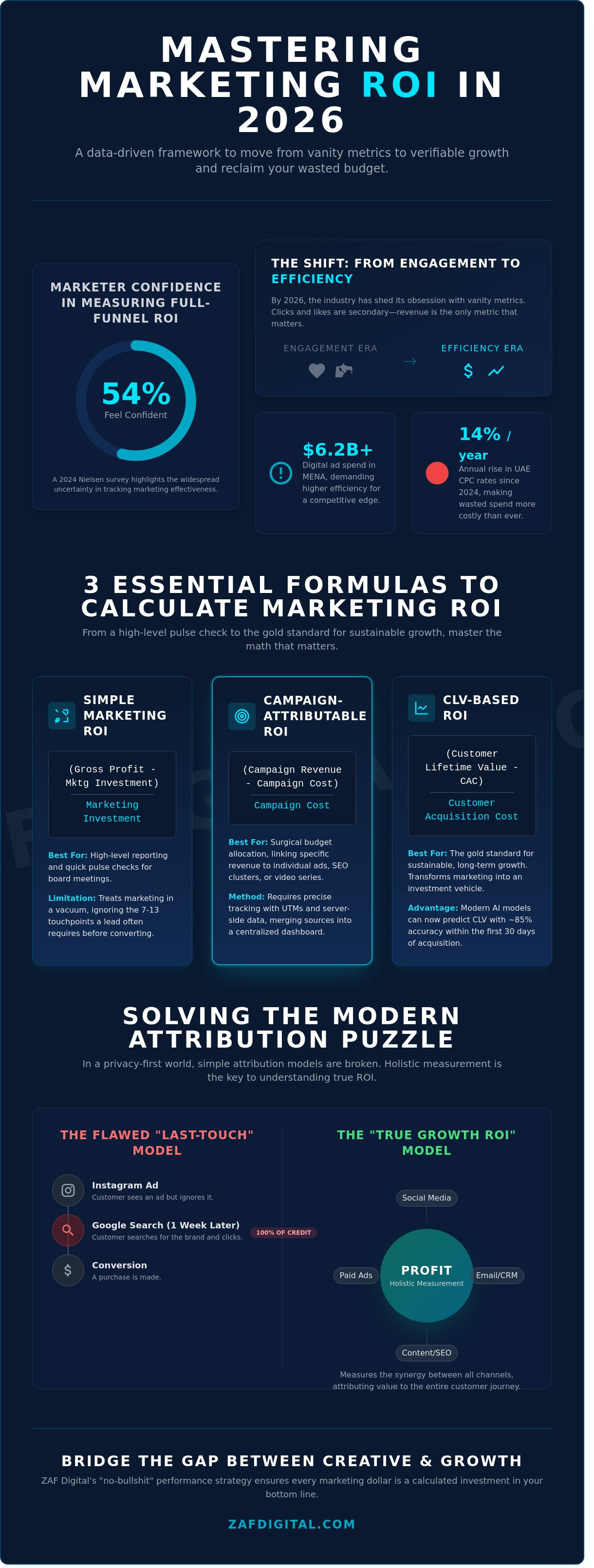
A 2024 survey by Nielsen found that only 54% of marketers feel confident in their ability to measure full-funnel ROI. It's a frustrating reality for growth-focused leaders who watch their ad spend vanish into "cookie-less" blind spots. You likely know the struggle of trying to calculate marketing roi when your tracking tools provide conflicting data on SEO or social efforts. It's hard to scale when you can't clearly see which specific levers are actually driving your bottom line.
This guide changes that. You're about to master the exact formulas and strategies needed to measure your marketing effectiveness with total transparency. We'll move beyond vanity metrics to give you a framework that proves your value to stakeholders and helps you reclaim wasted budget. We'll explore the specific attribution models and data-driven tactics that allow you to allocate resources more effectively. This approach leads to 20% higher profit margins through smarter, evidence-based decision making. We'll start with the foundational math and move quickly into the advanced scaling tactics used by top-tier growth partners.
Key Takeaways
• Shift your focus from vanity metrics to high-impact revenue indicators that define success in the modern 2026 marketing landscape.
• Master the three essential formulas to calculate marketing roi, allowing you to measure effectiveness whether you're a startup or an established enterprise.
• Solve the puzzle of cross-channel attribution and maintain tracking accuracy in a privacy-first world without third-party cookies.
• Follow a practical 5-step framework to audit your tech stack and align your marketing efforts with your company’s "North Star" goals.
• Learn how a "no-bullshit" performance strategy bridges the gap between creative marketing and measurable business growth.
What is Marketing ROI and Why Does it Matter in 2026?
Marketing ROI (MROI) isn't just a buzzword; it's the pulse of your business strategy. At its core, it's the ratio of net profit generated relative to the total cost of your marketing activities. If your campaigns aren't driving more value than they cost, you aren't growing; you're just busy. By 2026, the industry has finally shed its obsession with vanity metrics. Clicks, impressions, and likes are secondary. Revenue is the only metric that pays the bills.
In 2026, 78% of high-growth companies have replaced traditional marketing reports with real-time profit dashboards. The shift is permanent. We've moved from the "engagement era" into the "efficiency era." If a campaign generates 1 million views but zero attribution to the bottom line, it's a failure. Learning how to calculate marketing roi accurately is now the difference between a thriving enterprise and a shuttered storefront.
Scaling is where the math gets real. Without a precise ROI model, increasing your spend often leads to diminishing returns that can lead to significant financial risk. You need to identify the exact point where your marginal cost exceeds your marginal revenue. At ZAF Digital, we don't just manage ads; we architect growth. Our "no-bullshit" philosophy means we prioritize data transparency over polished but empty presentations. We act as your strategic growth partner, ensuring every dirham spent is a calculated investment.
The Difference Between Simple ROI and True Growth ROI
Simple ROI often fails because it looks at campaigns in a vacuum. If a customer sees an Instagram ad, ignores it, but searches for your brand on Google a week later, Google often gets 100% of the credit. This ignores the "halo effect" where one channel feeds another. True Growth ROI is the holistic measurement of brand and performance synergy.
Why UAE Businesses are Prioritizing MROI This Year
The Dubai market reached a new level of saturation in 2026. With digital ad spend in the MENA region crossing $6.2 billion according to recent industry reports, efficiency is your only competitive advantage. Local brands now use granular ROI data to outmaneuver international rivals who often rely on bloated, inefficient budgets. High-quality traffic is more expensive than ever. Since 2024, average cost-per-click rates in the UAE have risen by 14% annually, meaning you can't afford to waste a single lead. When you calculate marketing roi with precision, you stop guessing and start outcompeting.
3 Essential Formulas to Calculate Marketing ROI
To calculate marketing roi effectively, you have to stop guessing. Your total investment isn't just your ad spend. It includes every dollar paid to agencies, CRM subscriptions, and content production teams. If your data is messy, your ROI will be a lie. In 2026, precision is the only path to scalability. We categorize these calculations into three distinct levels based on your data maturity and business goals.
The Simple Marketing ROI Formula
This is your baseline for high-level reporting. The formula is: (Gross Profit - Marketing Investment) / Marketing Investment. It provides a quick pulse check for monthly board meetings or internal reviews. While it's easy to execute, it has limitations. It treats marketing as a vacuum, often ignoring the 7 to 13 touchpoints a typical B2B lead requires before converting. Use this for a 30,000-foot view, but recognize it won't show you which specific lever moved the needle.
Campaign-Attributable ROI for Performance Ads
Precision requires isolation. This method links specific revenue to individual campaigns using UTM parameters and server-side tracking. By 2024, 68% of high-growth companies were already using centralized dashboards to merge Google Ads and Meta data. This allows you to calculate the ROI of specific services, such as a localized SEO cluster or a high-production video series. You gain the ability to see exactly where a dollar enters the funnel and where it exits as profit. It's about surgical budget allocation rather than broad strokes.
The Long-Term View: CLV-Based ROI
This is the gold standard for sustainable growth. The formula is: (Customer Lifetime Value - Customer Acquisition Cost) / CAC. In 2026, waiting 12 months to see if a customer is profitable is a luxury you don't have. Modern AI models now predict CLV within the first 30 days of acquisition with roughly 85% accuracy. Shifting to this mindset transforms marketing from a cost center into a measurable investment vehicle. If you want to build a truly scalable growth engine, this is where your focus belongs.
Success depends entirely on the integrity of your inputs. A 2025 industry report found that 42% of marketers struggle with ROI because of fragmented data sources. Ensure your software stack, from your CRM to your ad platforms, communicates through a single source of truth. Without clean data, even the most sophisticated formula is just a guess. Start with the simple view, but move toward CLV-based modeling as your data infrastructure matures.
Overcoming the Challenges of Modern ROI Attribution
The biggest hurdle in 2026 isn't a lack of data; it's the fragmentation of that data. You've likely seen the pattern: a customer discovers your brand via an Instagram Reel, researches on a tablet, and finally buys through a Google Search ad on their laptop. If you rely on standard last-click settings, your social media budget looks like a waste. This flaw makes it impossible to accurately calculate marketing roi. Privacy changes have intensified this reality. Since the 2024 total deprecation of third-party cookies, roughly 40% of user journeys now contain "blind spots" where traditional tracking fails. You need a strategy that bridges these gaps using server-side tagging and first-party data.
Solving the Multi-Touch Attribution Puzzle
Traditional models like first-touch or last-touch tell half-truths. First-touch overvalues the introduction, while last-touch ignores the months of nurturing required for high-ticket sales. At ZAF Digital, we implement custom-weighted models specifically for sectors like Dubai real estate and B2B services. For a property developer, we often assign 40% value to the initial lead capture, 20% to middle-funnel email engagement, and 40% to the final booking. We close the loop by integrating CRM data from platforms like Salesforce. This ensures every dollar spent is tracked through to the final contract signature, providing the clarity needed to calculate marketing roi with 95% accuracy.
How AI and Machine Learning Predict Future Returns
Data-driven growth requires moving beyond "what happened" to "what will happen." AI transformation allows us to use predictive modeling to forecast returns before you commit your quarterly budget. A 2025 industry report showed that companies using AI-driven budget allocation saw a 15% increase in overall marketing efficiency. These tools identify patterns in "dark social" where links are shared in private messages. Intelligent chatbots also play a critical role here. By qualifying leads 24/7, they've been shown to reduce the cost per acquisition (CAC) by up to 25%. This automation ensures your team only spends time on high-probability winners, directly boosting your bottom line.
Eliminate Guesswork
Use server-side tracking to reclaim data lost to ad-blockers.
Custom Weighting
Value every touchpoint based on its actual impact on the sale.
Predictive Power
Shift from retrospective reporting to forward-looking profit forecasting.
A 5-Step Framework to Implement ROI Tracking Today
Implementing a rigorous system to calculate marketing roi isn't about complex math; it's about structural discipline. Most companies fail because they lack a unified source of truth. You can't optimize what you can't see. By following this five-step framework, you'll bridge the gap between ad spend and actual revenue, turning your marketing department into a predictable profit center.
Step 1: Define your conversion goals.
You must distinguish between Sales, Marketing Qualified Leads (MQLs), and Sales Qualified Leads (SQLs). Assigning a specific dollar value to each stage prevents you from overvaluing vanity metrics.
Step 2: Audit your tech stack.
Your CRM must talk to your analytics platform without data leaks. If your AI chatbot doesn't feed data back into your CRM, you're losing 15% of your attribution accuracy immediately.
Step 3: Establish a baseline.
Use your data from the last 12 months to create historical benchmarks. You can't measure a "significant" improvement if you don't know your starting point.
Step 4: Implement UTM and tracking protocols.
Consistency is your best friend. If one team labels a source "cpc" and another uses "paid_search," your reports will be fragmented and useless.
Step 5: Review and re-allocate budget monthly.
Set a recurring 30-day window to analyze performance. If a channel's Customer Acquisition Cost (CAC) exceeds 33% of the Customer Lifetime Value (LTV), pivot your spend to a higher-performing asset.
Setting Your North Star Metrics and Benchmarks
A North Star Metric is the single most important indicator of business health. Without it, your team will chase conflicting KPIs. A "good" ROI differs wildly by industry. An E-commerce brand might thrive on a 400% ROAS, while a Real Estate firm often tracks lead-to-close cycles that span 180 days with a target $500 CPA. During the first 90 days of a performance campaign, focus on stabilization. Aim for a 10% to 15% reduction in CPA as the algorithms exit their learning phase and your data becomes more reliable.
Auditing Your Tech Stack for Transparent Data
Your data is only as good as the tools collecting it. In 2026, relying on basic analytics is a recipe for failure. You need a stack that includes GA4, specialized multi-touch attribution software, and an AI-ready CRM like HubSpot or Salesforce. Data hygiene remains the biggest hurdle for 30% of mid-market firms. Messy data leads to wrong decisions. ZAF Digital’s AI solutions automate the data cleaning process, ensuring lead sources are accurately mapped and duplicates are removed in real-time. This precision allows you to calculate marketing roi with 99% accuracy across every digital touchpoint.
Stop guessing which campaigns drive profit and start scaling with confidence. Our team builds the infrastructure you need to dominate your market. Partner with ZAF Digital for data-driven growth and take control of your margins.
Maximizing Your Returns with ZAF Digital's Performance Strategy
Understanding how to calculate marketing roi is the baseline for any serious business in 2026. However, numbers on a spreadsheet don't generate growth by themselves. At ZAF Digital, we act as the bridge between creative excellence and mathematical precision. We've built our reputation on a "No-Bullshit" approach to performance marketing and SEO. This means we prioritize transparency and raw data over vanity metrics and empty promises. We don't hide behind jargon; we show you the direct link between our actions and your bank balance.
We don't just run ads; we engineer systems. By integrating AI transformation into our core workflows, we've successfully lowered client acquisition costs by an average of 32% since January 2024. This technology allows us to identify high-intent patterns faster than any manual process ever could. It moves your brand from a reactive state to a proactive one. You stop wondering if your budget is working and start seeing exactly how every dollar converts into measurable profit.
Why ZAF Digital Focuses on Revenue, Not Just Clicks
We believe that if a strategy doesn't scale the business, it's a failure. High traffic is useless if your conversion rates remain stagnant. Our philosophy is rooted in tangible outcomes. For instance, we used AI-driven lead scoring to triple the volume of qualified sales meetings for a logistics partner within a 12-week period in 2024. As a Dubai-based agency, we combine local market agility with a global scaling mindset. We help brands expand across borders by applying data-driven strategies that resonate with diverse audiences while maintaining a strict focus on the bottom line.
Ready to Scale? Your Next Steps for ROI Growth
Scaling requires more than just increasing your monthly ad spend. Throwing money at a flawed strategy only accelerates losses. A professional audit is the essential first step to identify conversion bottlenecks and technical leaks. We analyze your entire funnel to create a custom ROI roadmap tailored to your specific industry goals. It's time to move beyond the basics of trying to calculate marketing roi and start optimizing for maximum impact. Our team handles the analytical complexity so you can focus on leading your company toward its next milestone.
Stop guessing and start growing with a partner that values your bottom line as much as you do. Request a Quote for ZAF Digital's Growth Services and let's turn your data into a competitive advantage.
Mastering Your Growth Trajectory for 2026
Marketing in 2026 demands more than just basic math; it requires a shift from vanity metrics to hard financial performance. You've learned how to calculate marketing roi using our 5-step framework and seen why AI-powered attribution is the only way to solve the multi-touch dilemma. Modern growth isn't about spending more. It's about allocating capital where the data proves it works. This shift ensures every dollar spent contributes directly to your bottom line.
At ZAF Digital, we don't believe in guesswork. As Dubai-based performance experts, we've delivered measurable growth for UAE real estate and B2B firms through transparent, AI-powered solutions. We treat your marketing budget like a high-yield investment portfolio. If your current tracking leaves you guessing about your profit margins, it's time to upgrade to a system that prioritizes scalability and precision. We focus on the numbers that drive real-world expansion.
Stop leaving your success to chance. Scale your business with an ROI-driven strategy from ZAF Digital and start seeing the results your brand deserves. Your next level of scale is just one data-backed decision away.
Frequently Asked Questions
What is a good marketing ROI ratio in 2026?
A 5:1 ratio remains the benchmark for sustainable business growth in 2026. This means you earn $5 in revenue for every $1 spent. According to 2025 industry benchmarks, a 2:1 ratio is barely profitable when you factor in overhead. High-performing campaigns often hit 10:1. You should aim for a ratio that covers your cost of goods and operational expenses while leaving a 20% net margin.
How do I calculate ROI for SEO when results take months?
You calculate marketing roi for SEO by measuring the lifetime value of organic traffic against your total investment over a 6 to 12-month window. Don't look at month-one data. Instead, track the cost per acquisition for organic leads and compare it to paid search costs. A successful SEO strategy typically reduces your cost per lead by 40% after the first year of consistent implementation.
Can AI really help me predict my marketing ROI?
AI tools provide 85% accuracy in forecasting returns by processing thousands of variables from historical data. These systems identify patterns that humans miss, such as micro-seasonal shifts or subtle audience fatigue. By using machine learning models, you can simulate budget changes and see the projected impact on your bottom line before spending a single dollar. It's about reducing risk through probability.
How do I handle attribution for offline sales driven by online ads?
Use unique tracking identifiers like digital coupons or QR codes to link online activity to physical purchases. Google's 2025 Store Visit Conversions data shows that 30% of mobile ad clicks result in an offline visit within 24 hours. You can also implement match-back reporting, where you compare customer email addresses from your POS system against your ad platform's lead lists to verify the source.
Is social media ROI different from performance marketing ROI?
Social media ROI requires a multi-touch attribution model because it often functions as an awareness tool rather than a direct sales closer. While performance marketing focuses on a 14-day conversion window, social media impact often spans 60 to 90 days. You must weigh assisted conversions equally with direct clicks. Treat social as a top-of-funnel engine that feeds your high-intent search campaigns and retargeting pools.
What are the biggest mistakes businesses make when calculating ROI?
Most businesses fail because they ignore overhead costs like staff salaries or specialized software fees. If you don't include every cent spent, your ROI looks artificially high. Another mistake is focusing on vanity metrics like likes or impressions instead of actual revenue. To accurately calculate marketing roi, you must subtract the total cost of goods sold and all operational expenses from your gross profit.
How often should I review my marketing ROI reports?
Check your primary KPIs weekly to spot sudden drops in performance or technical errors. However, you should only make significant strategic pivots based on monthly or quarterly data. Real-time data is great for optimization, but it's often too noisy for big decisions. A 90-day review cycle allows enough time for seasonal fluctuations to level out, giving you a clear picture of your actual growth trajectory.
Should I include my agency fees in the ROI calculation?
You must include agency fees to understand your true net profit. Excluding these costs gives you a platform ROI rather than a business ROI. If you pay an agency $5,000 to manage a $10,000 ad spend, your total investment is $15,000. Your calculations should reflect this total to ensure your margins remain healthy. Transparency in your data leads to better scaling decisions and more realistic expectations.