
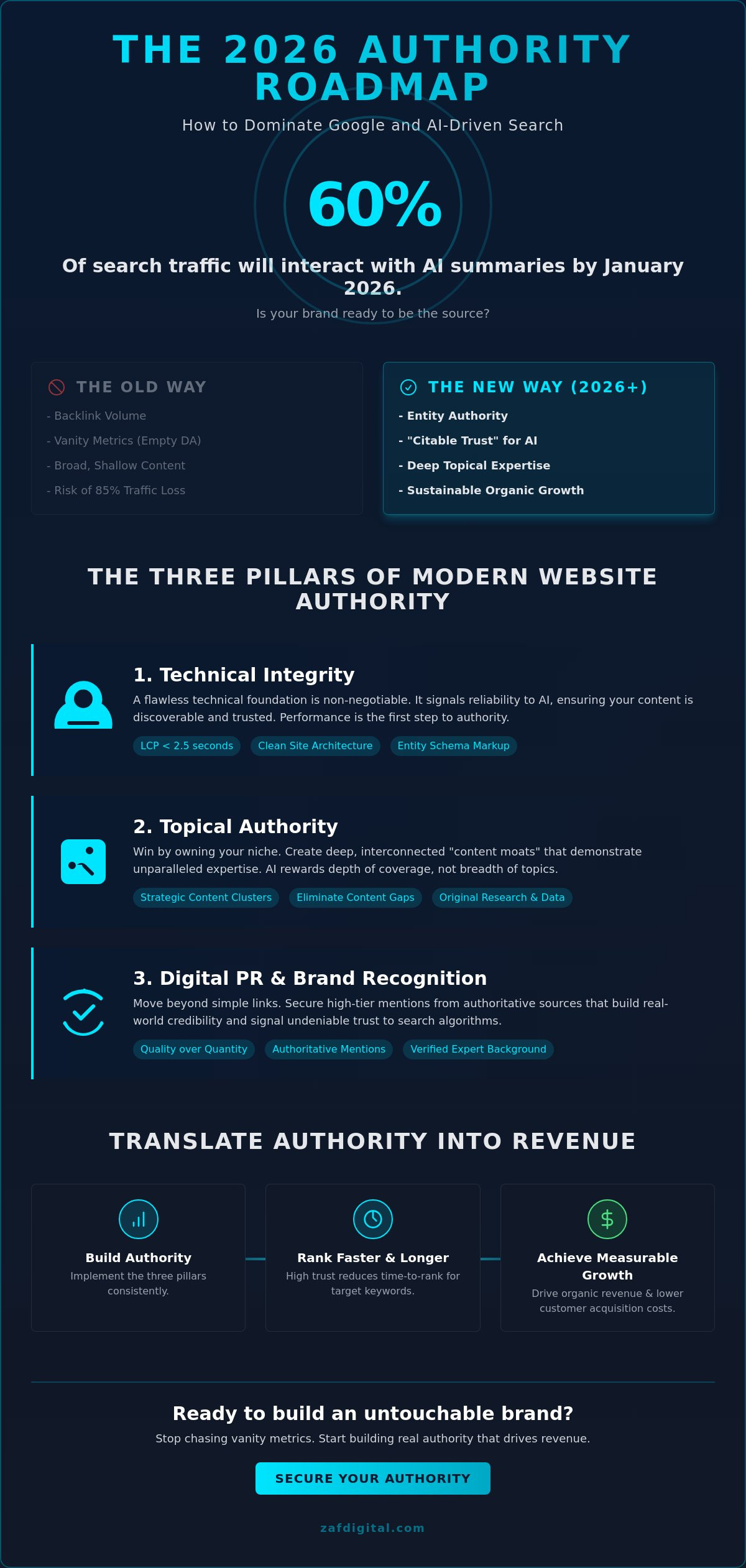
By January 2026, nearly 60% of search traffic will interact with AI-driven summaries before ever reaching a traditional website. You've likely experienced the burnout of publishing 12 long-form pieces a month only to see zero growth in your ranking positions. It's a common pain point for businesses that find technical metrics confusing and disconnected from their actual revenue. If you're worried that AI search engines are ignoring your brand, you aren't alone. To win in this new environment, you must learn how to build domain authority by moving beyond simple backlinks and focusing on becoming a verified entity that AI models trust.
At ZAF Digital, we don't believe in vanity metrics or empty promises. We focus on transparent, measurable growth that converts. This guide delivers the exact framework you need to transform your website into a trusted industry leader that dominates both Google and AI-driven answers. You'll learn the specific steps to secure citations from models like ChatGPT while driving organic traffic that actually impacts your bottom line. We're going to break down the 2026 authority roadmap, starting with the technical signals that establish your brand as the definitive source of truth in your market.
Key Takeaways
• Shift your focus from backlink volume to "Entity Authority" to ensure your brand is the preferred choice for both traditional search and AI engines.
• Implement a technical and content framework designed to build domain authority by proving niche expertise through strategic topical clusters.
• Transition from traditional outreach to high-tier Digital PR to secure authoritative mentions that drive real-world credibility and trust.
• Execute a precise, two-step roadmap to audit technical infrastructure and eliminate content gaps that are currently holding your site back.
• Translate abstract authority scores into measurable business outcomes by tracking the direct link between site trust and organic revenue growth.
What is Domain Authority in the Age of AI Search?
Domain Authority has evolved into a predictive measure of trust that extends far beyond traditional search engines. In 2026, we define it as the degree of confidence an AI model or search algorithm has in your brand's ability to provide accurate, expert information. Understanding What is Domain Authority requires looking past third-party scores. At ZAF Digital, we view authority as a performance-marketing asset. It's a strategic moat that protects your traffic from algorithm shifts and ensures your brand remains a primary source for AI-generated answers. To effectively build domain authority, you must focus on "Citable Trust." This means your site shouldn't just exist; it must be a recognized entity that Search Generative Experience (SGE) feels safe quoting. When your authority is high, your content ranks faster and stays there longer. We don't chase vanity metrics. We focus on authority because it's the most reliable way to scale organic growth without a proportional increase in ad spend. To better understand how this metric impacts your visibility, watch this detailed breakdown:The Evolution: From Backlinks to E-E-A-T
The days of winning with sheer link volume ended with the core updates of 2024 and 2025. Today, search engines value Entity Authority. Experience and Expertise have become the primary drivers of site trust. AI models now use your site's historical accuracy to verify facts in their responses. Trust remains the ultimate ranking tie-breaker when content quality is equal across competitors. If two sites provide the same answer, the one with the verified expert background wins the top spot every time.
Authority vs. Popularity: Knowing the Difference
High traffic doesn't guarantee high authority. A site can attract 50,000 visitors through a viral trend but possess zero long-term search trust. We've seen "empty" DA scores built on irrelevant link farms result in 85% traffic losses during quality resets. True authority is about relevance and reliability. When you build domain authority the right way, you're investing in a lower Customer Acquisition Cost (CAC). High-authority domains require less promotional effort to rank for high-intent keywords, allowing your organic channel to outperform paid acquisition over time. It's a shift from renting attention to owning the market conversation.
The Three Pillars of Modern Website Authority
Authority isn't a single metric anymore. It's a composite of technical health, content depth, and brand recognition. To understand how search engines evaluate your site, you should look at The Three Pillars of Modern Website Authority as a single, interconnected ecosystem. You can't just buy links and expect to win. You need to build domain authority through a multi-layered approach that satisfies both human users and AI-driven crawlers.
Technical Integrity as an Authority Signal
Google's 2024 updates solidified that performance is non-negotiable. If your Largest Contentful Paint (LCP) exceeds 2.5 seconds, search engines won't classify you as a top-tier resource. Technical health signals reliability. You're often choosing between Technical SEO vs. Content SEO, but the truth is they're inseparable. A clean site architecture allows crawlers to map your pages efficiently. Use Schema Markup, specifically Organization and Person types, to help AI engines identify your brand as a distinct entity. This 2026 approach ensures your data is readable by Large Language Models, not just traditional search bots.
Topical Authority through Strategic Content
Broad content is dead. To build domain authority, you must create content moats. These are deep, interconnected clusters of information that competitors can't replicate with AI-generated fluff. In 2026, algorithms reward "depth of coverage" over "breadth of topics." A site with 50 pages on a specific niche outranks a site with 500 pages on general topics. Include original research to solidify your position. A 2025 industry report showed that 74% of high-authority backlinks are earned through original data and proprietary case studies. Stop summarizing what others said. Produce new insights that others are forced to cite.
The Link Pillar has evolved into what we call Referral Integrity. It's not about 1,000 low-quality links; it's about 10 links from established industry leaders. If a top-tier news outlet or a government domain references your data, your authority spikes. Finally, the Brand Pillar focuses on your digital footprint. Search engines look for your brand across social platforms, review sites, and news mentions. If your entity information is consistent, your authority grows. If you're unsure where your site stands, we can help you audit your current authority metrics to find the gaps.
Link Building in 2026: Quality over Everything
The era of mass-produced guest posting has officially ended. By mid-2025, search engines became proficient at identifying "link neighborhoods" designed solely for SEO, rendering traditional outreach cycles obsolete. If you want to build domain authority today, you must pivot from quantity to high-impact Digital PR. This involves earning mentions from authoritative global outlets or regional powerhouses like Gulf News and The National in the UAE. These placements do more than pass PageRank; they establish your brand as a verified entity in an AI-saturated market.
Successful brands now utilize a "Source-First" strategy. Instead of asking for links, they create proprietary datasets, whitepapers, or interactive calculators that journalists and AI models are forced to cite. A 2025 industry report showed that original research pieces earned 410% more backlinks than standard "how-to" articles. You aren't just publishing content; you're creating the primary source material for your industry.
Closing the "Link Gap" requires surgical precision. We don't look at total backlink counts anymore. We analyze the specific high-intent pages where your competitors hold a monopoly. If a top-ranking competitor has five links from major industry associations and you have zero, that is your roadmap. Data-driven growth means matching that specific authority, not chasing 1,000 irrelevant directory listings.
Earning "Referral Trust" instead of just Links
Referral Trust is the new currency. A single link from a high-traffic industry leader or a .gov resource carries more weight than 500 low-tier blog comments. Search engines now track how much actual traffic flows through a link to determine its value. If nobody clicks it, it likely doesn't help you build domain authority. Modern algorithms also recognize unlinked brand mentions as valid authority signals, treating a citation in a major publication as a vote of confidence even without a direct hyperlink.
Avoiding the "Toxic Link" Trap
Automated link-building tools are now the fastest way to trigger a spam filter. In 2026, "toxic" doesn't just mean gambling or adult sites; it means any pattern that looks generated by AI-driven outreach bots. You need to audit your profile quarterly. If you see a sudden influx of links from sites with zero organic traffic, disavow them immediately. We treat link profiles like a garden; strategic pruning of low-quality referring domains is just as important as planting new seeds. It's about maintaining a clean, high-velocity profile that reflects genuine market leadership.
A Step-by-Step Roadmap to Build Domain Authority
Building authority isn't a guessing game. It requires a clinical, data-backed execution plan. To build domain authority in 2026, you must move beyond simple link building and focus on the technical and semantic signals that Google's AI-driven algorithms prioritize. We don't settle for "good enough" content; we build digital assets that demand recognition.
Phase 1: Fixing the Foundation
You can't scale on a broken base. Start by conducting a comprehensive SEO audit to eliminate technical leaks that drain your crawl budget. If Google's bots waste time on 404 errors or duplicate paths, your authority stagnates. Prioritize mobile-first optimization, as 63% of organic search traffic now originates from mobile devices. Technical debt is the silent killer of rankings. For a localized execution plan, follow this SEO Audit Dubai Checklist to ensure your site is ready for international competition.
Next, identify "Authority Gaps." Use tools like Semrush to compare your content library against the top 3 competitors in your niche. If they have comprehensive guides on high-intent topics you've ignored, you have a gap. Close these gaps with long-form, data-rich content that answers complex user queries better than anyone else on the first page.
Phase 2: Scaling the Influence
Once the foundation is solid, focus on creating "Foundational Content." These are original research papers, proprietary data sets, or deep-dive case studies. Industry data suggests that original research generates 74% more backlinks than standard listicles. This strategy attracts passive backlinks, which are the most sustainable way to build domain authority over time.
Develop a Digital PR strategy that focuses on original value. Don't just ask for links; provide a reason for journalists to cite you as a source. Optimize for "Entity Recognition" by using advanced Schema markup. This helps Google's Knowledge Graph connect your brand name to specific industry keywords. Use social signals to boost brand trust. A consistent brand voice across all platforms ensures that both users and algorithms recognize your site as a singular, authoritative entity.
Finally, track your progress. Monitor your metrics using Moz, Semrush, and Google Search Console. We don't obsess over daily fluctuations; we look at the 90-day trend. Growth is a marathon, not a sprint, and it requires constant refinement based on real-time data.
Ready to dominate your niche with a proven framework? Partner with ZAF Digital for a strategic growth plan.
Measuring ROI: How Authority Translates to Revenue
Many marketers treat Domain Authority as a vanity metric. That's a mistake. At ZAF Digital, we view the effort to build domain authority as a direct investment in your company's balance sheet. Authority isn't just a number; it's a leading indicator of future organic revenue growth. When your Authority Score climbs, your average ranking position follows a predictable upward trajectory. Data from 2025 performance benchmarks shows that websites increasing their score by 10 points typically see a 22% correlation with improved visibility for high-intent keywords within 90 days.
This growth creates what we call the "Authority Multiplier." A trusted domain makes every new page rank faster. While a low-authority site might wait months for Google to index and rank a new service page, an authoritative domain can hit the first page in under 48 hours. This speed to market allows you to capture search volume before your competitors can react, drastically shortening the time to see a return on your content investment.
Beyond the Score: Real Business Metrics
We look past the third-party tools to measure "Share of Voice" in your specific industry niche. This metric tells us what percentage of the total market conversation your brand owns. High authority also provides a hidden benefit for your paid media. Google's algorithm often rewards trusted domains with higher Quality Scores, which can reduce your average CPC by 12% to 15%. We also track assisted conversions from top-of-funnel content. It's common to see authoritative blog posts serve as the first touchpoint for 30% of final conversions, proving that trust scales revenue.
Partnering for Growth: The ZAF Digital Approach
ZAF Digital doesn't rely on guesswork. Our AI-driven SEO strategies analyze the competitive landscape to identify the exact link gaps that hinder your growth. We integrate authority building into a total Performance Marketing strategy, ensuring every backlink and content piece serves a commercial purpose. As a Dubai-based agency, we offer a strategic advantage for brands looking to scale both regionally in the Middle East and across international markets. We understand the technical nuances of global competition and the data-backed methods required to win in 2026.
Stop settling for stagnant rankings and start building a digital asset that works for you. Book a strategy session to scale your domain authority and let's map out your path to market leadership.
Future-Proof Your Search Presence for 2026
Success in the next era of search isn't about gaming the system; it's about strategic dominance. You've seen how the shift toward AI-driven search engines changes the rules of engagement. To build domain authority effectively, you must focus on high-quality link profiles and content that satisfies both users and LLM crawlers. Market data indicates that 70% of top-ranking sites in 2026 will prioritize E-E-A-T signals over raw backlink volume. This transition requires a move from generic SEO to a sophisticated digital transformation strategy that scales across international markets.
ZAF Digital is a performance-first agency based in Dubai. We specialize in AI-driven SEO that targets measurable growth rather than vanity metrics. Our team focuses on the intersection of technology and ROI, ensuring your authority translates directly into revenue. We're ready to act as your strategic partner in this evolving landscape, providing the transparency and data-driven insights your business needs to lead the market.
Stop guessing and start growing, get a professional SEO strategy from ZAF Digital today.
The 2026 search landscape is competitive, but it's full of opportunities for brands that act now. Let's start building your legacy.
Frequently Asked Questions
How long does it take to build domain authority in 2026?
It typically takes 6 to 12 months of consistent SEO effort to see a measurable increase in your score. New domains often stay in a sandbox period for the first 180 days while search engines verify their reliability. To build domain authority effectively, you need a sustained strategy focused on high-quality backlinks and technical stability. Data from Ahrefs shows that only 5.7% of newly published pages reach the top 10 within a year.
Can I buy domain authority safely?
No, buying domain authority through low-quality link packages or "DA 50+" services is a high-risk strategy that leads to Google penalties. Google's SpamBrain AI identifies unnatural link patterns with 99% accuracy. Instead of wasting budget on vanity metrics, invest in PR-led outreach that earns links from legitimate news outlets. Real authority comes from 10 high-quality editorial mentions rather than 1,000 automated profile links.
Does social media activity help build domain authority?
Social media doesn't directly increase your score because most social links are "nofollow" and don't pass link equity. However, social signals drive 12% more referral traffic which increases your brand's visibility and the likelihood of earning natural backlinks. A 2024 study showed that content with high LinkedIn engagement receives 2.5 times more organic citations. Use social platforms as a distribution engine to get your research in front of journalists.
What is a "good" domain authority score for a new business?
A score between 10 and 20 is standard for a business website in its first 12 months of operation. You shouldn't compare your startup to established giants like Forbes or Amazon which hold scores of 90+. Focus on your top 5 direct competitors instead. If the average score in your specific niche is 35, hitting 30 makes you a serious contender for page one rankings.
Why did my domain authority score drop even though I added content?
Your score likely dropped because other sites in the index grew faster than yours or you lost a few high-value backlinks. Domain authority is a relative metric calculated on a 100 point logarithmic scale. If a competitor gains 50 premium links while you only add 5 blog posts, your relative standing might decrease. Check your "lost backlinks" report in Moz or Semrush to identify if a specific referring domain went offline.
How do AI search engines like ChatGPT determine which sites are authoritative?
AI engines prioritize sites that demonstrate high E-E-A-T and are cited frequently in the Common Crawl dataset. OpenAI's GPT-4 relies on training data that favors established sources with clear citations and factual accuracy. To build domain authority that AI recognizes, ensure your site has a clear "About" page with verifiable credentials. 70% of AI-generated summaries pull information from the top 3 organic results.
Is domain authority more important than keyword rankings?
Keyword rankings are more important for immediate revenue, but domain authority acts as the ceiling for how high those rankings can go. A site with a score of 60 will rank for a difficult term much faster than a site with a score of 20. Think of authority as your site's reputation and rankings as individual sales pitches. You need both to scale your organic growth sustainably over a 24 month period.
Do internal links help increase my domain authority?
Internal links don't increase your overall domain authority, but they're essential for distributing link juice to your most important pages. A well-structured silo can boost the ranking power of a product page by 40% by passing equity from a high-authority blog post. Use descriptive anchor text to help crawlers understand your site's hierarchy. This ensures that every external link you earn benefits your entire domain rather than just one page.