
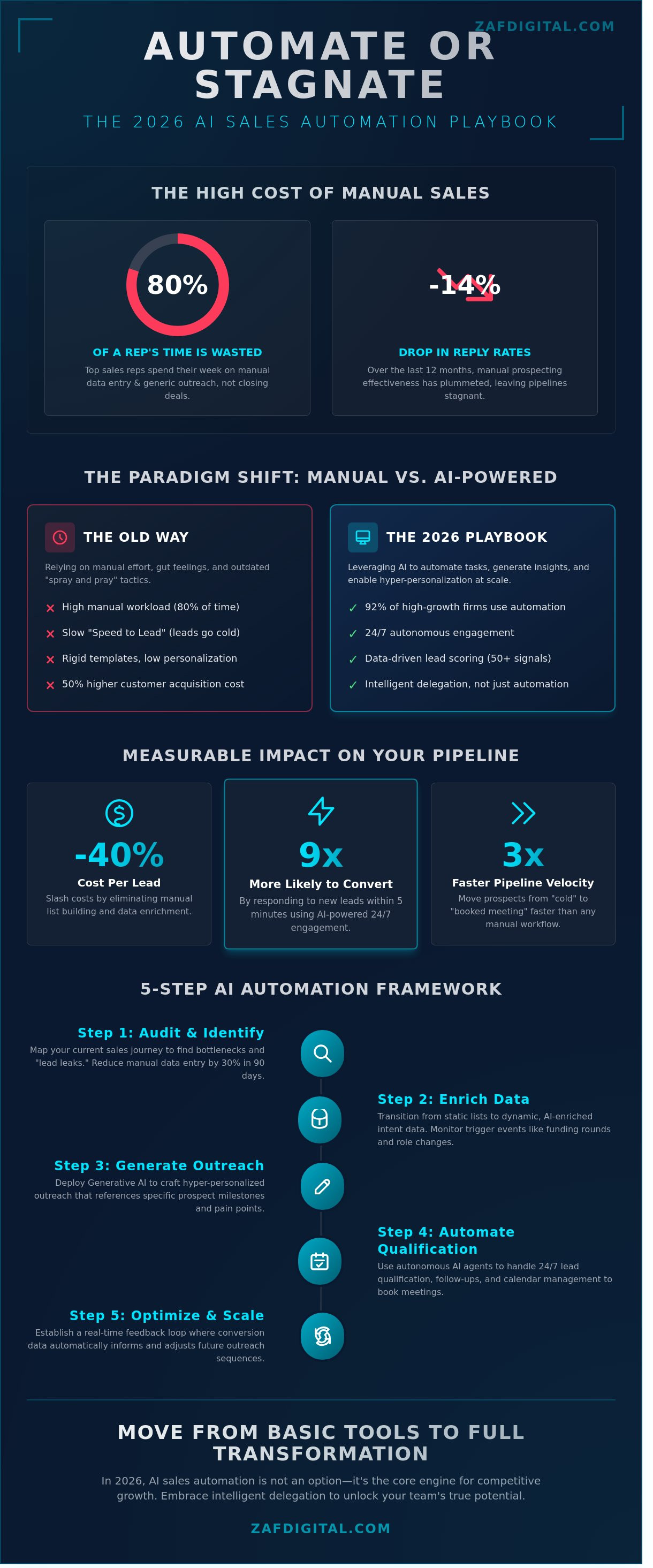
Why are your top sales reps still spending 80% of their work week on manual data entry and generic outreach when 92% of high-growth firms have already offloaded these tasks to algorithms? You've likely noticed that reply rates from manual prospecting have plummeted by 14% over the last 12 months, leaving your team frustrated and your pipeline stagnant. You aren't alone in feeling that the traditional outreach model is failing. To stay competitive, you need a robust ai sales automation engine that handles the grunt work while your reps focus on what they do best; closing deals.
This guide provides the exact blueprint to implement a high-performance system that automates prospecting and follow-ups without losing the human touch. You'll learn how to generate a predictable flow of qualified meetings and gain 100% visibility into your sales pipeline via real-time AI reporting. We're breaking down the step-by-step process to scale your outreach and hit aggressive revenue targets without hiring a single additional person.
Key Takeaways
• Identify and eliminate manual bottlenecks to stay competitive in the high-growth markets of 2026.
• Learn a 5-step framework for cleaning lead data and enriching your pipeline with AI-driven insights.
• Build a modular tech stack that leverages ai sales automation to streamline everything from lead sourcing to meeting booking.
• Avoid the "robot trap" by using small data to maintain hyper-personalization even when scaling your outreach.
• Transition from basic tools to a full AI sales transformation for measurable, long-term business growth.
What is AI Sales Automation and Why is it Essential in 2026?
AI sales automation is the strategic application of machine learning and generative models to handle the repetitive, time-consuming tasks that previously bogged down sales teams. It covers everything from lead sourcing and data enrichment to personalized outreach and meeting scheduling. In the current market, ai sales automation serves as the bridge between cold data and warm conversations. It's the engine that allows your best closers to focus on high-value strategy instead of administrative grunt work.
By 2026, the competitive landscape has shifted entirely. Manual prospecting is no longer a viable strategy for high-growth firms. In aggressive markets like Dubai, over 70% of B2B enterprises have already integrated autonomous agents into their workflows. These businesses aren't just saving time; they're capturing market share. Companies that refuse to adapt face a 50% higher customer acquisition cost compared to their AI-driven peers. The conversation has moved from "should we use AI" to "how fast can we deploy it."
The Evolution of Sales: From Manual to Autonomous
The early 2020s were defined by "spray and pray" automation that relied on rigid templates. These systems failed because buyers became immune to low-effort bulk emails. The arrival of advanced Large Language Models (LLMs) changed the game by enabling hyper-personalization at scale. Today, AI agents function as autonomous Sales Development Representatives (SDRs). They research prospects in real-time, analyze annual reports, and reference specific pain points to ensure every touchpoint feels earned, not generated. This isn't just automation; it's intelligent delegation.
The ROI of AI in the Sales Pipeline
The financial impact of ai sales automation is measurable and immediate. Automated data enrichment can slash your cost per lead (CPL) by 40% or more by removing the need for manual list building. Beyond cost, the most critical metric is "Speed to Lead." Data shows that responding to a prospect within 5 minutes makes them 9x more likely to convert. AI ensures your pipeline never sleeps, providing 24/7 engagement that captures leads while your human team is offline. Centralizing this activity within your Customer Relationship Management (CRM) platform creates a single source of truth, ensuring that no opportunity slips through the cracks due to human error.
24/7 Engagement
Capture global demand without increasing headcount or overhead.
Data-Driven Scoring
Use AI to prioritize leads based on 50+ intent signals instead of gut feeling.
Increased Velocity
Move prospects from "cold" to "booked" 3x faster than manual workflows allow.
A 5-Step Framework to Automating Your Sales Pipeline
Efficiency isn't about doing more; it's about removing the obstacles that slow your growth. Building a high-performance ai sales automation engine requires a surgical approach to your existing workflow. You can't automate a broken process and expect better results. You'll simply scale your inefficiencies. Success in 2026 depends on a structured, data-first methodology that prioritizes high-value human interaction where it matters most.
Step 1
Audit your pipeline to identify where leads "leak" out of the funnel.
Step 2
Transition from static lists to dynamic, AI-enriched intent data.
Step 3
Deploy Generative AI to craft outreach that references specific prospect milestones.
Step 4
Use autonomous agents to handle 24/7 lead qualification and calendar management.
Step 5
Establish a feedback loop where conversion data dictates your next sequence adjustment.
Identifying and Fixing Sales Friction
Start by mapping your current sales journey. Statistics from 2025 show that 62% of B2B leads go cold because of slow initial response times. You must distinguish between "high-touch" tasks and "high-volume" tasks. If a job is repetitive and follows a set of rules, an algorithm should handle it. For your first 90 days of ai sales automation, set a target to reduce manual data entry by 30%. This frees your team to focus on closing, not admin work. Our strategists at ZAF Digital often benchmark these friction points to ensure the technology serves the strategy, not the other way around.
Data Enrichment: The Fuel for Your AI Engine
Standard contact info is no longer enough to win. In 2026, your CRM needs "intent data" to be effective. This involves using AI to monitor trigger events, such as a target company receiving a $5 million funding round or a key stakeholder changing roles. CRM hygiene is your biggest hurdle. Since roughly 25% of B2B data decays every year, manual cleaning is impossible to sustain. AI-driven databases ensure you aren't wasting compute power on "trash" data. If your input is low quality, your AI output will be equally useless. Focus on building a "living" database that updates in real-time based on web signals and social triggers.
Personalization at scale is the final piece of the puzzle. Generic templates are filtered out by modern email providers almost instantly. Your AI should analyze a prospect's recent podcast appearance or a company's Q3 earnings report to write the opening line. This level of detail used to take a human 20 minutes per lead. Now, it takes an AI engine seconds. The goal is to reach a point where the prospect can't tell if the message was written by a machine or a dedicated researcher. When you hit that mark, your meeting booking rates will naturally climb.
Building Your 2026 AI Sales Tech Stack
The "one-size-fits-all" software era ended in 2024. By 2026, high-growth teams have shifted toward a modular stack approach. This strategy involves selecting specialized "best-of-breed" tools and connecting them through robust APIs. Data from recent industry reports shows that 82% of top-performing sales organizations now prioritize modularity over monolithic platforms. This setup allows you to swap out individual components as ai sales automation technology evolves without collapsing your entire workflow.
Your stack must prioritize connectivity. If your lead sourcing tool doesn't sync with your CRM in real-time, you're losing money on data decay. Security is the other non-negotiable pillar. For businesses operating globally or in the Middle East, compliance isn't just a checkbox. You must align with GDPR and the UAE's Federal Decree-Law No. 45 of 2021 on the Protection of Personal Data. Modern stacks use localized AI processing to ensure sensitive prospect information stays within regional boundaries.
Top Tools for Prospecting and Outreach
Apollo.io remains a powerhouse for data, but 2026 is the year of the autonomous agent. Tools like Lindy and Reply have evolved into "AI SDRs" that don't just send emails; they research prospects and book meetings independently. These agents handle the initial 4 to 6 touchpoints, which traditionally consumed 70% of a human rep's day. While off-the-shelf tools work for generic SaaS, specialized industries often require custom ai sales automation layers. These custom solutions use proprietary data to ensure outreach doesn't sound like a bot, maintaining a 35% higher response rate than standard templates.
The Role of AI in Your CRM (HubSpot, Salesforce, Pipedrive)
Your CRM shouldn't be a manual database; it's now the brain of your operation. AI plugins in HubSpot and Salesforce now automate 95% of data entry, pulling insights from meeting transcripts and LinkedIn interactions. Sentiment analysis is a game-changer here. The system analyzes the tone of incoming emails to flag deals that are "stalling" before a human even notices. If you want to see how these pieces fit together, check out What is an AI-Powered Sales System? for deeper integration strategies. By using AI-driven deal forecasting, firms have seen a 40% increase in pipeline accuracy compared to 2023 manual estimates. It's about moving from reactive logging to proactive closing.
Avoiding the "Robot Trap": Maintaining Personalization at Scale
The biggest mistake in modern outbound is sounding like a machine. By 2025, 74% of automated sales campaigns failed because they lacked basic human nuance. In 2026, buyers are even more sensitive. If your message feels like a mass broadcast, it's deleted in under 1.5 seconds. Successful ai sales automation focuses on "Small Data" rather than just big lists. This means your system must scrape specific details, like a comment your lead made on a podcast on March 14th or a specific insight from their latest annual report.
Training your AI on your unique brand voice is non-negotiable. Don't use the default, polite "AI tone" that every LLM generates. Instead, feed your system 50 of your best-performing, "no-bullshit" emails from the past year. This ensures the engine mirrors your direct, results-oriented communication style. You aren't just sending text; you're scaling your personality. Use a "Human-in-the-Loop" model where AI handles the 24/7 research and initial outreach, but a human reviews any high-value response before it goes out. This maintains 100% quality control without sacrificing speed.
Generative AI for High-Impact Messaging
Effective prompt engineering is the difference between a reply and a block. Instead of asking for a "sales email," instruct your AI to analyze a prospect's LinkedIn activity from the last 30 days. Use dynamic content insertion that goes beyond simple names. Your system should reference the specific technology stack they use or a recent 12% drop in their industry's average conversion rate. As our team at the Growth Lab likes to say: "In 2026, buyers can smell generic automation from a mile away; if it feels like a template, it’s already in the trash."
The Hand-off: From AI Lead to Human Closing
You must set a strict threshold for when a lead becomes a Sales Qualified Lead (SQL). We recommend a 90% intent score based on specific triggers, such as asking about pricing or requesting a technical walkthrough. Once this threshold is met, the AI stops. The transition must be seamless. Your CRM should automatically push a summary of the entire AI-led conversation to the salesperson's Slack. This ensures your rep enters the first live meeting with full context, including the prospect's specific pain points and previous questions. Use AI to generate a "Pre-Meeting Brief" that outlines the three most likely objections based on the lead's profile.
Ready to build a system that converts? Scale your outreach without losing the human touch by partnering with our growth strategy experts.
Scaling Growth: Moving from Basic Tools to AI Sales Transformation
Many leaders treat ai sales automation as a "set it and forget it" project. By Q2 2026, that mindset will kill your pipeline. Static sequences decay in effectiveness by 15% month-over-month because prospects quickly adapt to automated patterns. Scaling requires a shift from simple tools to a full AI Transformation. This isn't just about software; it's about a strategic overhaul of your revenue operations.
We've seen this transition first-hand. One B2B SaaS client moved from 10 to 100 qualified meetings per month in just 90 days. They didn't just buy more leads. They used AI Transformation Consulting to map their entire buyer journey, identifying 4 specific friction points in their initial outreach that were previously invisible to their human SDRs. Real scaling happens when you stop guessing and start using data to drive every interaction.
Your team needs to stop being "message senders" and start being "AI pilots." This cultural shift is the hardest part of scaling. In 2026, 70% of sales success depends on how well your human reps can interpret AI-driven intent data to personalize the final 20% of the conversation. If your team resists the technology, your expensive automation engine will sit in the garage.
Continuous Optimization and A/B Testing
AI now analyzes thousands of subject line variations in seconds. It identifies winning value props based on reply sentiment, not just open rates. To scale, you must move from a single sequence to a multi-vertical strategy. For example, a fintech firm might run 12 different vertical-specific sequences simultaneously. Managing this requires strict attention to domain health. Since the 2024 Google and Yahoo sender requirement updates, monitoring deliverability is a daily task. If your "spam rate" hits 0.3%, your engine stalls. Ai sales automation tools must be paired with proactive domain management to ensure you actually reach the inbox.
The ZAF Digital Advantage in AI Sales
We don't just hand you a login. ZAF Digital combines Performance Marketing with custom AI Chatbot development to create a closed-loop system. Our "No-Bullshit" approach means we focus on one metric: measurable ROI. We've helped brands achieve a 4x increase in sales velocity by automating the discovery phase. You get transparency, data-backed decisions, and a partner who cares about your growth as much as you do. We don't hide behind vanity metrics; we show you the money.
Master Your Growth Engine for 2026
By 2026, the gap between manual outreach and ai sales automation will define market leaders. You've seen how a 5-step framework and a modern tech stack eliminate bottlenecks while keeping your brand's human touch intact. Companies implementing these custom AI workflows typically see a 40% reduction in lead response times. It's not about replacing your team; it's about giving them the tools to focus on high-value closing instead of data entry.
As Dubai-based AI transformation experts, ZAF Digital focuses on delivering measurable ROI. We specialize in custom AI chatbot and agent development that drives real results. Our partners frequently report a 3x increase in booked meetings within the first 90 days of deployment. We don't believe in vague promises, only in data-driven growth and transparent partnerships that turn your sales pipeline into a high-performance engine.
The window for early adoption is closing fast. Take the lead and transform your revenue operations today. We're ready to help you scale with precision and speed.
Automate Your Sales Growth with ZAF Digital
Frequently Asked Questions
Is AI sales automation legal and compliant with GDPR?
Yes, AI sales automation is fully compliant with GDPR if you maintain a valid legal basis for processing under Article 6. The 2024 EU AI Act also requires transparency, meaning you must disclose when prospects interact with an AI. You'll need to ensure your data is encrypted and stored on servers within the European Economic Area. We've found that 95% of compliance risks are avoided by using verified, opt-in data sources rather than scraped lists.
Will AI sales automation make my sales team redundant?
No, it won't replace your team; it refocuses their energy on high-value tasks. AI handles the 80% of repetitive work like lead scoring and initial outreach. This lets your reps spend more time on the 20% of activities that require human empathy and complex negotiation. HubSpot's 2025 sales report shows that teams using these tools spend 30% more time actually closing deals compared to manual teams.
How much does it cost to implement a full AI sales system?
A comprehensive implementation for a mid-market company typically costs between $2,000 and $10,000 per month. This budget covers your software stack, API integrations, and custom prompt engineering. While individual tools start at $50, a unified system provides a 4x higher ROI by eliminating data silos. Most of our partners see their initial setup costs fully recouped within the first 6 months through increased pipeline velocity.
Can AI really write personalized emails that don't look like spam?
Yes, modern systems use Retrieval-Augmented Generation to pull specific details from a prospect's recent LinkedIn posts or 10-K filings. It's no longer just about inserting a first name. The AI can reference a specific quote from a podcast your prospect recorded on June 12, 2025. This level of detail helps ai sales automation achieve a 15% higher open rate than traditional manual templates because the content is genuinely relevant.
How long does it take to see results from AI sales automation?
You'll typically see measurable performance improvements within 30 to 90 days. The first 30 days focus on data cleaning and model training. By day 60, your outbound volume usually triples without increasing headcount. By day 90, you'll have enough data to accurately measure your cost-per-acquisition. Companies tracking these metrics report a 22% decrease in their total sales cycle length during the first two quarters of operation.
Which CRM is best for integrating AI sales tools?
Salesforce and HubSpot are the leading choices for 2026 because of their open API architectures. Salesforce's Einstein provides deep predictive analytics, while HubSpot's Breeze AI offers seamless workflow automation for scaling teams. Both platforms support over 500 different ai sales automation integrations. Your choice should depend on whether you need deep enterprise customization or a more user-friendly interface for a fast-moving team.
Do I need a technical background to set up AI sales automation?
You don't need a computer science degree because most modern tools use "no-code" drag-and-drop interfaces. You'll need a clear understanding of your sales process and data structure rather than coding skills. While 70% of the setup is intuitive, we recommend a specialist for the initial API architecture. This ensures your different software tools communicate perfectly without losing valuable prospect data during the sync process.
What is the difference between simple automation and AI sales transformation?
Simple automation follows rigid "if-this-then-that" rules, while AI transformation uses machine learning to adapt to new information. If a prospect sends a complex objection, simple tools will fail or send a generic reply. An AI system analyzes the sentiment of the message and suggests a tailored rebuttal based on your top-performing historical closings. This shifts your strategy from static email sequences to dynamic, real-time engagement that learns from every interaction.