
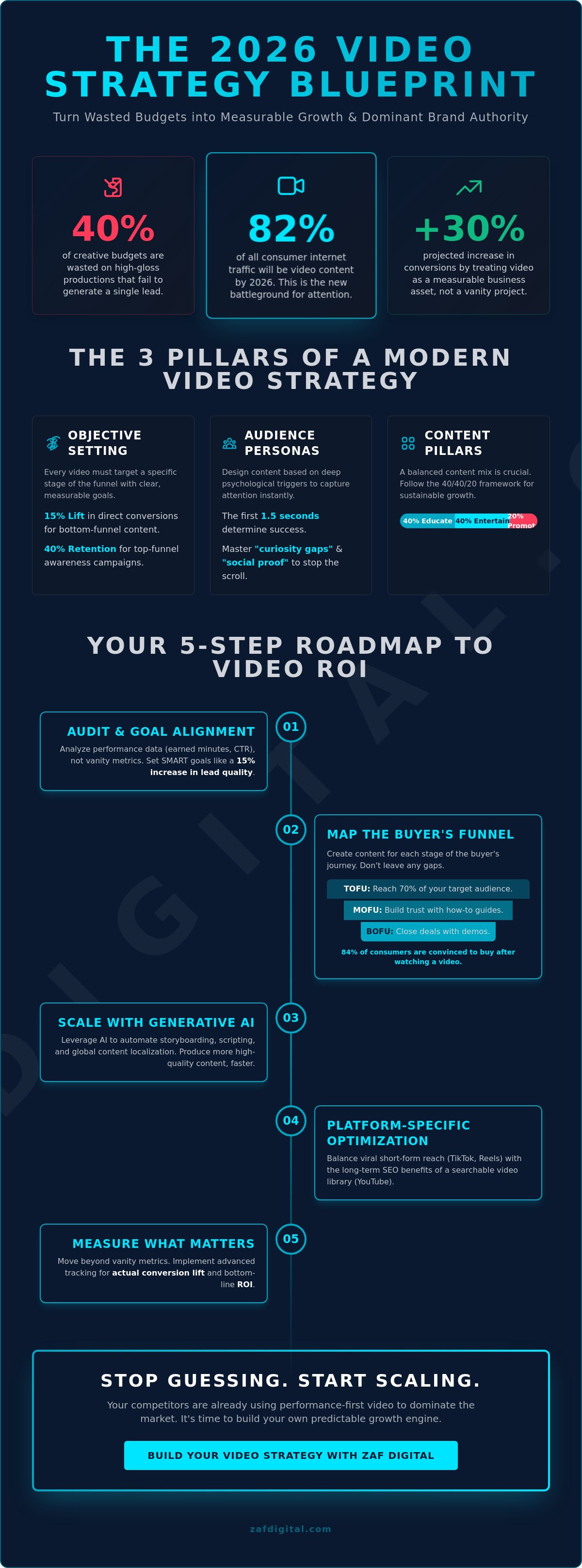
By 2026, 82% of all consumer internet traffic will be video content, yet most brands are currently wasting 40% of their creative budgets on high-gloss productions that fail to generate a single lead. High production costs no longer guarantee attention; in fact, they often lead to a low engagement trap that kills your organic reach. You've likely felt the frustration of an inconsistent posting schedule or the paralyzing confusion of which platforms to prioritize. It's exhausting to play catch-up with an algorithm that rewards volume and relevance over cinematic perfection. To win, you need a performance-first social media video strategy that treats content as a measurable business asset rather than a vanity project.
We're here to help you flip the script. You'll learn how to build a scalable, AI-enhanced workflow that captures attention and drives tangible growth. We'll show you exactly how to increase your conversion rates by a projected 30% while establishing dominant brand authority. This guide provides the repeatable framework you need to stop guessing and start scaling your presence across every major platform with confidence and precision.
Key Takeaways
• Learn to treat video as a core performance pillar rather than a "nice-to-have" asset to drive measurable business growth.
• Execute a 5-step strategic audit to define a brand voice and visual aesthetic that commands attention in a competitive landscape.
• Scale your social media video strategy efficiently by using Generative AI to automate storyboarding, scripting, and global content localization.
• Navigate platform-specific nuances to balance viral short-form reach with the long-term SEO benefits of a searchable video library.
• Move beyond vanity metrics by implementing advanced tracking that measures actual conversion lift and bottom-line ROI.
What is a Social Media Video Strategy in 2026?
A social media video strategy is no longer just a creative content calendar. It's a high-precision roadmap that synchronizes content creation, platform-specific distribution, and granular performance measurement. In 2026, video has transitioned from a supporting asset to the central pillar of digital growth. Data from recent industry shifts shows that 92% of high-growth brands now prioritize video as their primary customer acquisition channel. We don't view video as a "nice-to-have" element; it's the engine that powers your entire marketing ecosystem.
The landscape of user attention has fundamentally changed. We've moved from an era of passive scrolling to a period of active engagement. Users don't just watch; they interact, remix, and purchase directly through the video interface. This shift requires a strategy that treats Social video marketing as a two-way dialogue rather than a broadcast. For any serious growth marketing agency, integrating video into broader business objectives is the only way to maintain a competitive edge in a crowded digital marketplace.
The Core Components of a Modern Video Strategy
Success in 2026 requires a structured approach to every frame you produce. We break this down into three essential pillars:
Objective setting
Every campaign must target a specific stage of the funnel. We focus on 15% lift in direct conversions for bottom-funnel content and 40% retention rates for top-funnel awareness.
Audience personas
We design content based on deep psychological triggers. Understanding whether your audience responds to "curiosity gaps" or "social proof" determines the first 1.5 seconds of your video.
Content pillars
You need a balanced mix. A standard 2026 framework uses a 40/40/20 split: 40% educational value, 40% entertainment to build community, and 20% direct promotional calls-to-action.
Why Video Strategy Matters for Performance
Algorithms in 2026 are built on "watch-time velocity" and "intent signals." If your content doesn't trigger immediate engagement, platforms like TikTok and Instagram won't show it to even 5% of your followers. A documented strategy ensures your content meets these technical requirements while maintaining brand integrity. It's about working with the algorithm, not against it.
Video-first marketing is the primary driver of 2026 social ROI.
This approach bridges the gap between brand identity and sales by creating a frictionless path to purchase. By 2026, social commerce has reached a point where 68% of consumers prefer to discover and buy products within a single video experience. Without a rigorous social media video strategy, you're leaving your revenue to chance. We use data to turn that chance into a scalable, predictable growth engine.
5 Steps to Building Your Social Media Video Strategy
Building a high-performance social media video strategy isn't about luck; it's about engineering. You need a framework that turns passive views into measurable revenue. In a market where 91% of businesses used video as a marketing tool in 2024, standing out requires a data-backed roadmap rather than guesswork.
Step 1: Auditing and Goal Alignment
Start by looking back. Analyze your 2025 performance data to see which formats drove the highest retention rates. Don't just look at vanity metrics like views. Focus on "earned minutes" and click-through rates. If your competitor in the UAE is dominating TikTok but ignoring LinkedIn, that's your gap. Set SMART goals. Instead of "more engagement," aim for a 15% increase in lead quality through video by December 2026. Your audit tells you exactly which content types your audience actually craves.
Step 2: Mapping the Funnel
Content must match the buyer's mindset at every touchpoint. A 2024 Wyzowl report confirmed that 84% of consumers were convinced to buy a product after watching a video. To capture this, structure your output accordingly:
TOFU (Top of Funnel)
Reach 70% of your target audience with broad, high-impact videos that solve a problem or entertain.
MOFU (Middle of Funnel)
Build trust with 2-minute "how-to" guides or behind-the-scenes content that showcases your expertise.
BOFU (Bottom of Funnel)
Close the deal using 30-second testimonials or product demos that remove final purchase barriers.
A successful social media video strategy ensures no stage of the customer journey is neglected, moving prospects from curiosity to conversion.
Step 3: Resource and Budget Planning
Balance is vital for scalability. Allocate 60% of your budget to agile, lo-fi content for daily engagement. These videos feel authentic and perform well in vertical feeds. Reserve the remaining 40% for professional cinematic video production to anchor your brand's authority. Choose tools like CapCut for quick social edits and Frame.io for collaborative reviews. Set a posting cadence you can actually sustain. In 2026, three high-quality videos per week outperform daily noise that lacks a clear objective.
Step 4: Defining Aesthetics and Voice
Your visual identity is your digital handshake. Establish a consistent color palette, typography, and "hook" style that makes your content instantly recognizable within the first 1.5 seconds. Whether your voice is provocative and bold or calm and analytical, stick to it. Consistency builds the brand recall necessary to cut through the 2026 content surplus.
Step 5: The Iteration Loop
Establish a feedback loop to review your metrics every 14 days. If a specific hook isn't working, pivot immediately. Data doesn't lie; it shows you exactly where your strategy needs a tune-up. Small adjustments to captions or thumbnail contrast can result in a 20% lift in engagement. If you want to scale faster and stop guessing, partner with a team that treats your ROI as the primary metric of success.
Leveraging AI and Technology for Scalable Production
Efficiency defines the winners in 2026. A modern social media video strategy fails if it relies on manual, slow workflows that can't keep up with the algorithm's appetite. High-performing brands now use Generative AI to bypass the creative block and move straight into execution. By feeding historical performance data into Large Language Models, teams generate scripts that aren't just creative; they're engineered to convert. This shift moves the focus from "what should we film?" to "how can we scale what works?"
AI-Powered Pre-Production
Pre-production used to consume days of creative energy and administrative back-and-forth. Today, precise prompt engineering turns raw concepts into structured storyboards in minutes. Tools specialized in trend-spotting analyze real-time data from platforms like TikTok and Reels to identify which hooks are gaining traction. Industry data indicates that integrating AI into the planning phase reduces pre-production time by up to 70%. You're no longer guessing what might go viral; you're building on data-backed foundations that allow your team to focus on high-level growth strategy.
Scaling doesn't require a bigger team. It requires smarter systems. Automated captioning and instant translation allow a single video to reach audiences in Berlin, Tokyo, and New York simultaneously. Localization is no longer a luxury reserved for enterprise brands. AI tools now handle voice cloning and lip-syncing, ensuring your message resonates across borders without the massive overhead of local production crews.
Editing and Post-Production Automation
Post-production is often where the most significant bottlenecks happen. AI-driven color grading and audio cleanup now happen instantly, maintaining brand consistency across hundreds of assets. Perhaps the biggest gain for your social media video strategy is the automated creation of multiple aspect ratios. A single 4K master can be reframed into 9:16 for TikTok, 1:1 for Instagram feeds, and 16:9 for YouTube without manual cropping. This ensures your content remains agile across every platform without doubling your editing hours.
Dynamic Creative Optimization (DCO)
AI tests thousands of combinations of hooks, visuals, and CTAs in real-time for paid ads.
Automated Resizing
Shift between platforms with zero manual editing through intelligent subject tracking.
Audio Intelligence
AI removes background noise and balances levels for professional sound, even in non-studio environments.
The final piece of the puzzle is conversion. Traffic is a vanity metric if it doesn't lead to action. Integrating an ai chatbot for business allows you to handle video-driven inquiries instantly. When a user comments on a Reel or clicks a link in your bio, the AI picks up the conversation, answers product questions, and drives the lead toward a purchase. It's the bridge between content and commerce that operates 24/7, ensuring no lead falls through the cracks.
Platform-Specific Optimization: Where to Post
A high-performing social media video strategy requires more than just creative flair; it demands technical precision for each platform's unique ecosystem. By 2026, the "post everywhere" approach has become a recipe for wasted budget. You need to optimize content based on how users actually consume media. For instance, 80% of social media videos are watched on mute. If your strategy doesn't prioritize burned-in captions and visual-first storytelling, you're losing the majority of your audience before they even hear your message.
TikTok and Instagram Reels remain the primary drivers of short-form discovery, but their functions have split. TikTok acts as a powerful search engine, with 40% of younger users preferring it over traditional search for brand discovery. Instagram has evolved into a conversion and community-building hub. To win on both, your videos must be designed for "silent viewing" success. Use bold text overlays and high-contrast visuals to ensure the narrative is clear without audio.
Mastering Short-Form Algorithms
The "Hook-Body-CTA" framework is the backbone of 15-60 second success. You have exactly 1.3 seconds to stop the scroll. Data shows that if your completion rate stays above 35%, the algorithm will continue pushing your content to new audiences. Don't chase every trending audio just for the sake of views. Use trends only when they reinforce your brand authority. This keeps your engagement high while ensuring the traffic you attract is actually relevant to your business goals.
B2B Video Strategy on LinkedIn
For Dubai professionals and the wider Middle East market, LinkedIn is the ultimate B2B growth engine. Native video on this platform generates 5 times more conversation than static posts. Focus on executive branding and thought leadership. We've seen significant success by repurposing long-form webinars into 60-second "insight clips." This strategy populates your feed with high-value content without requiring daily filming sessions. It's about showing expertise, not just selling services.
YouTube completes the ecosystem by providing a searchable video library. While Shorts drive rapid awareness, long-form content builds the deep trust required for high-ticket conversions. According to 2024 Google data, 70% of viewers bought from a brand after seeing it on YouTube. Integrating both formats into your social media video strategy ensures you're capturing immediate attention while building long-term SEO value for your brand.
Stop guessing and start growing with a data-led approach. Contact ZAF Digital to build a video strategy that converts.
Measuring Success: Metrics and ROI in 2026
In 2026, a high view count is a vanity project, not a business outcome. If your social media video strategy doesn't contribute to the bottom line, it's failing. We've seen brands with 10 million views struggle because they couldn't attribute a single dollar to that reach. You need to focus on conversion lift and multi-touch attribution to see how video influences the entire buyer journey. Modern tracking tools now allow us to see the "halo effect" where video views lead to direct searches and conversions 48 to 72 hours later.
Even the most viral video won't save a leaky funnel. You must pair your social content with high conversion web design to ensure that traffic translates into revenue. In our experience, a mobile-optimized landing page can increase video-to-lead conversion rates by 42% compared to generic homepages. Don't waste your ad spend driving traffic to a site that can't close the deal.
Key Performance Indicators (KPIs) to Watch
Likes are passive. Shares are active. A 2.5% share rate is significantly more valuable than a 10% like rate because it proves your content resonates enough to be endorsed by the user. You should also prioritize these metrics:
Click-Through Rate (CTR)
In 2026, a healthy CTR for video-based ads sits between 1.8% and 3.5%. Anything lower suggests a mismatch between your creative and your audience.
Cost Per Acquisition (CPA)
Track this relentlessly. If your video CPA is 20% higher than your search ads, you need to refine your targeting or your offer.
Retention Rate
Watch the 50% mark. If viewers drop off before the halfway point, your value proposition is taking too long to arrive.
Iterating Based on Data
Content fatigue hits faster than ever. Data from 2025 shows that video performance typically plateaus after 12 to 14 days of the same creative. Use heatmap tools to see where viewers drop off. If 60% of people leave in the first 3 seconds, your hook is weak. If they drop off at the 15-second mark, your mid-roll transition isn't holding their attention.
Use A/B testing to swap hooks and CTAs until the data shows a clear winner. We recommend testing three different hooks for every single high-production video you release. This data-driven approach ensures your social media video strategy remains agile and profitable. Closing the loop means turning those viewers into loyal customers through retargeting sequences that address the specific pain points mentioned in your videos. Stop guessing and start measuring.
Dominate the 2026 Digital Landscape
The digital landscape in 2026 demands more than just aesthetic content. Success requires a data-backed social media video strategy that balances platform-specific algorithms with AI-powered scalability. You've seen how video now accounts for over 82% of all consumer internet traffic according to recent industry forecasts. Brands that ignore high-velocity production or fail to track granular ROI metrics will fall behind. It's about combining creative intuition with technical precision to turn views into measurable revenue. We've observed that businesses using AI-integrated workflows reduce content turnaround times by 40%, allowing for faster testing and more frequent optimization.
ZAF Digital doesn't just make videos; we build growth engines. We leverage our Dubai-based production expertise and AI-powered growth solutions to ensure your brand stands out in saturated feeds. Our team focuses on proven ROI in performance marketing, moving beyond vanity metrics to deliver actual business impact. We're ready to act as your strategic partner in this fast-paced environment. Don't let your content go unnoticed when you can lead the market.
Elevate your brand with a performance-driven video strategy from ZAF Digital
The future of video is here, and your brand is ready to own it.
Frequently Asked Questions
What is the most effective video length for social media in 2026?
The most effective video length for 2026 is 22 seconds for short-form content and 3.5 minutes for educational deep dives. Data from the 2025 Video Marketing Report indicates that viewer retention drops by 45% after the 30 second mark on mobile feeds. You've got to capture attention in the first 1.5 seconds. Shorter clips drive 3 times more shares than longer alternatives.
How often should a brand post video content to see growth?
Brands should post high-quality video content 4 times per week to maximize growth. This frequency maintains a 15% higher reach compared to accounts posting twice weekly, according to 2025 platform algorithm studies. Consistency signals reliability to both users and algorithms. It's better to stick to a sustainable 3-video schedule than to post daily for a week and then disappear for a month.
Do I need expensive equipment to start a video marketing strategy?
You don't need a Hollywood budget or cinema cameras to launch a successful social media video strategy. Statistics from TikTok's 2025 Creative Center show that 85% of top-performing ads were filmed on mobile devices. Authenticity often outperforms high-gloss production in the current market. Invest in a 15 dollar clip-on microphone instead of a 2,000 dollar camera body to see immediate quality improvements.
How does AI improve the ROI of social media video?
AI improves ROI by slashing production costs and optimizing content for specific audience segments. Adobe's 2025 industry analysis found that AI-driven editing tools reduce total production time by 40%. These tools identify the most engaging hooks based on historical data. This efficiency allows your team to test 5 variations of a single ad for the price of one manual edit.
Which platform is best for B2B video marketing in Dubai?
LinkedIn is the undisputed leader for B2B video marketing in Dubai and the wider UAE region. The platform's 2025 regional report highlights a 22% surge in video engagement among C-suite executives in the Middle East. It's the place where decision-makers spend 18 minutes daily on average. Focus your efforts here to reach the 75,000 plus registered companies in Dubai's free zones.
How do I track conversions from organic social media videos?
Track conversions by implementing platform-specific Conversion APIs and custom UTM parameters for every link. Meta's 2025 technical documentation confirms that CAPI setups capture 30% more conversion events than standard browser pixels. Don't rely on link in bio clicks alone. Use dedicated landing pages for each video series to measure the precise impact of your organic efforts on the bottom line.
What is the difference between a video campaign and a video strategy?
A video campaign is a tactical, short-term push, while a social media video strategy is the overarching framework for long-term growth. Campaigns usually last 4 to 6 weeks to promote a specific product launch. A strategy covers the full 12-month fiscal year. It defines your brand's voice, technical standards, and performance benchmarks to ensure every single clip contributes to your business objectives.
Can I repurpose one video across all social media platforms?
You can repurpose content, but you must adapt the format and hooks for each specific platform. Sprout Social's 2025 research shows that tailored captions and native text overlays increase cross-platform retention by 18%. Don't just upload a YouTube link to Facebook. Re-edit the footage into a 9:16 vertical format for Reels and TikTok to meet the 2026 standard for mobile consumption.