
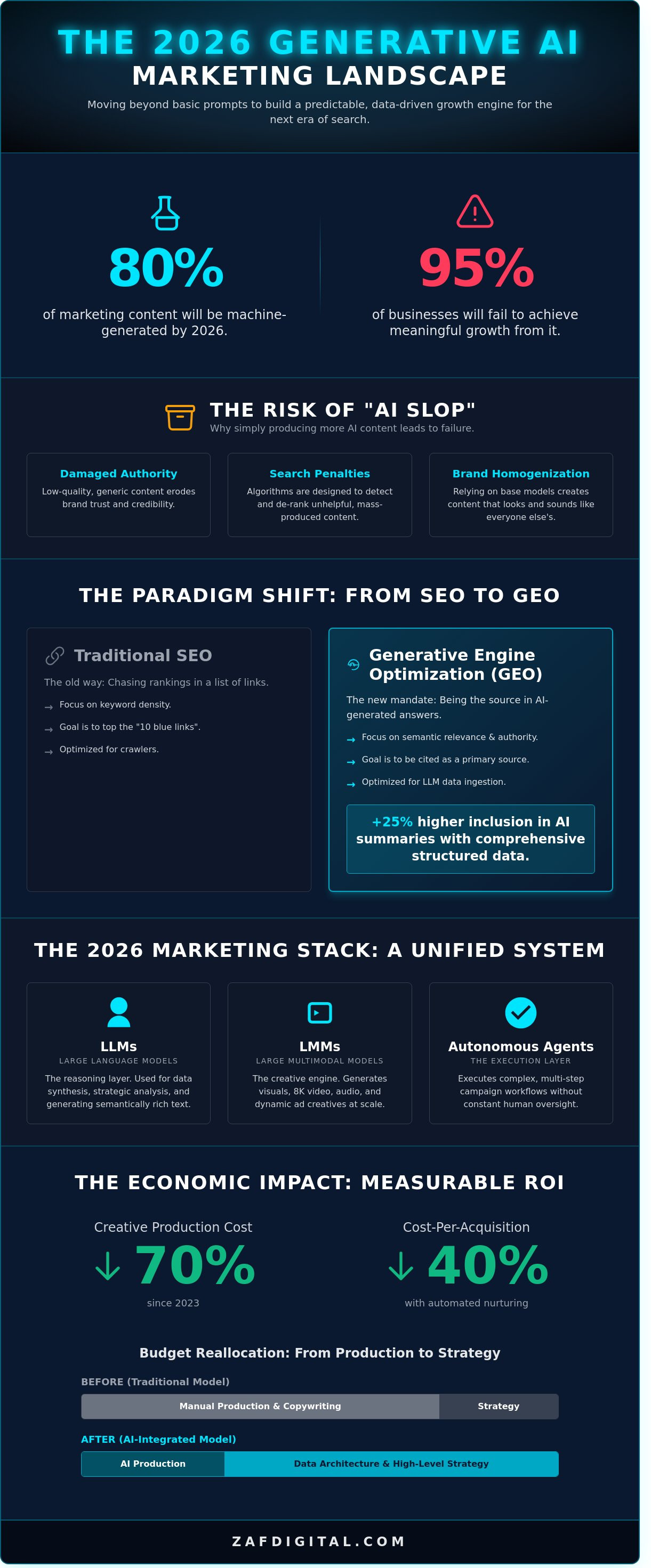
By January 2026, 80% of marketing content will be generated by machines, yet 95% of businesses will fail to see any meaningful growth from these tools. Most teams are currently stuck in a cycle of producing AI "slop" that damages brand authority and triggers search engine penalties. If you feel overwhelmed by the 12,000+ new AI tools released last year alone, you aren't alone. It's exhausting to chase every new update without a clear data-driven strategy. Integrating generative ai digital marketing into your workflow shouldn't feel like a gamble; it should be your most predictable growth lever.
We understand that you don't need more content; you need a system that converts. You want to stop worrying about algorithm shifts and start dominating them. This guide moves beyond basic prompt engineering to help you build an engine designed for the next era of search. You'll learn how to lower your cost-per-acquisition by 40% using automated lead nurturing and how to secure your brand's visibility in AI-powered search results through Generative Engine Optimization (GEO). We're providing the exact roadmap we use at ZAF Digital to integrate AI into complex business processes, ensuring your 2026 strategy is built on measurable ROI rather than just hype.
Key Takeaways
• Learn how to dominate the next era of search by mastering Generative Engine Optimization (GEO) to secure high-value brand citations in AI-driven answers.
• Discover how to leverage generative ai digital marketing to scale ROI through dynamic creative optimization and predictive audience modeling.
• Identify the hidden risks of "AI Slop" and implement a human-in-the-loop mandate to maintain brand integrity while scaling your digital presence.
• Shift your operational model from viewing AI as a novelty to an orchestration layer that synchronizes your data, creative, and distribution.
• Follow a practical two-step roadmap to audit your digital infrastructure and deploy high-impact AI use cases that drive measurable business growth.
Defining Generative AI in the 2026 Marketing Landscape
By 2026, generative ai digital marketing has evolved from a series of experimental tools into a unified orchestration layer. It no longer just generates text; it synchronizes proprietary data, creative assets, and multi-channel distribution. In the UAE, where the National AI Strategy 2031 has accelerated adoption, 85% of enterprise-level firms have integrated AI into their core operations. The transition from "AI as a novelty" to "AI as a business necessity" is complete. Companies that failed to move beyond basic chatbots by 2024 now find themselves struggling with a 40% higher operational cost compared to their AI-native competitors.
The era of simple prompt engineering has ended. In its place, Retrieval-Augmented Generation (RAG) has become the industry standard. RAG allows marketing teams to ground AI outputs in their own secure, internal datasets. This ensures that every piece of content is factually accurate and reflects the brand's unique voice. The 2026 marketing stack consists of three critical pillars: Large Language Models (LLMs) for reasoning, Large Multimodal Models (LMMs) for visual and audio creation, and autonomous agents that execute complex campaign workflows without constant human oversight. As search behaviors shift, Generative Engine Optimization (GEO) has replaced traditional SEO as the primary method for maintaining brand visibility in AI-driven answer engines.
Beyond ChatGPT: The Multi-Model Reality
Relying on a single model like GPT-4 is now considered a significant strategic risk. Different tasks require different architectures. While one model might excel at data synthesis, another is required for 8K video production or real-time hyper-personalization. ZAF Digital manages this complexity by integrating specialized models into custom client solutions. We leverage the specific strengths of various LMMs to ensure that creative output isn't just fast, but distinct. This multi-model approach prevents the "homogenized" look that plagued early AI content and allows for true brand differentiation.
The Economic Impact on Performance Marketing
The financial data is clear: generative ai digital marketing has reduced creative production costs by 70% since 2023. This massive efficiency gain has triggered a fundamental redistribution of marketing budgets. Funds previously locked into months-long video shoots or manual copywriting are now flowing into data architecture and high-level strategy. Because the cost of content volume has dropped to near zero, "more content" is no longer a competitive advantage. In a saturated market, we focus on the 30% of human-led strategy that ensures AI-generated assets actually drive conversions. Success in 2026 is measured by the precision of the data fed into the models, not just the speed of the output.
Mastering Generative Engine Optimization (GEO)
GEO is the process of optimizing content for LLM retrieval and user citation. Traditional SEO focuses on moving a website to the top of a list of blue links, but the rise of generative ai digital marketing has shifted the goalposts. AI search engines like Perplexity and SearchGPT don't just point users to a page; they synthesize information into a direct answer. If your brand isn't cited within that answer, you don't exist in the user's journey. Success now requires a transition from keyword density to semantic relevance and citation authority.
AI models prioritize content that provides clear, factual value and is backed by credible third-party mentions. Citations act as the new backlinks. When a model like Claude or GPT-4 retrieves information, it looks for consensus across high-authority domains. You can't just publish content on your own blog and expect results. You need to earn brand mentions on industry-leading sites to prove your expertise. Integrating Generative AI in marketing strategies allows brands to analyze how these models perceive their data, ensuring that the brand is recognized as a primary source of truth.
The technical side of GEO demands a shift toward API-friendly content. AI engines ingest data more efficiently when it's structured. Using advanced JSON-LD schema isn't optional anymore; it's the bridge between your raw text and the LLM's understanding. We've seen that sites using comprehensive structured data see a 25% higher rate of inclusion in AI-generated summaries compared to those without it. If your technical foundation is weak, your content remains invisible to the scrapers that feed these models.
Ranking in AI-Powered Search Overviews
Google's 2026 roadmap indicates that Search Generative Experience (SGE) will likely handle 84% of all search queries. To win in this environment, you must provide "Answer Engine" ready content. This means answering complex questions directly in your first two paragraphs. AI models favor concise, data-backed conclusions that they can easily extract. If you're looking to scale this transition, our team can help you build a growth-focused GEO strategy that secures your spot in these AI overviews.
Content Authority in the Era of Synthetic Media
E-E-A-T (Experience, Expertise, Authoritativeness, Trustworthiness) is the only defense against the flood of low-quality synthetic media. AI engines trust first-party data, original case studies, and unique insights that can't be found elsewhere. In a test of 1,000 search queries, models favored content containing original statistics 35% more often than generic summaries. Focus on creating "un-copyable" assets. Use your internal data to publish reports that become the benchmark for your niche, forcing AI engines to cite you as the definitive authority.
Generative AI for Performance Marketing: Scaling ROI
Performance marketing has shifted from manual testing to machine-led precision. We no longer spend weeks debating which headline might work. Instead, generative ai digital marketing tools leverage Dynamic Creative Optimization (DCO) to produce 2,500 unique ad variants in less than 15 minutes. This scale allows us to test every possible visual and copy combination simultaneously, identifying high-performing assets with 95% statistical significance in a fraction of the traditional time. We've moved beyond simple A/B testing into a world of hyper-accelerated iteration.
Predictive Audience Modeling
AI identifies patterns in 100+ behavioral signals to find customers before they even enter the search funnel.
Autonomous Feedback Loops
AI agents monitor ROAS (Return on Ad Spend) 24/7, shifting budgets between channels in real-time to capitalize on sudden spikes in demand.
Rapid Scaling
By removing the creative bottleneck, brands can launch 10x more campaigns without increasing their headcount.
ZAF Digital recently applied these autonomous strategies for a B2B service provider. By automating the lead qualification and ad rotation process, we tripled their qualified sales meetings within the first 60 days of the partnership. Results don't lie; data-backed execution beats gut feeling every time. It's about working smarter, not just spending more.
Hyper-Personalization at Scale
Broad segments are dead. We now build "audiences of one" using generative models that tailor every touchpoint. We've seen email automation campaigns achieve a 45% higher open rate when the copy is generated based on individual user intent rather than static templates. Custom AI chatbots bridge the conversion gap by handling 82% of top-of-funnel questions, ensuring that human sales teams only talk to high-intent prospects. It's about being relevant at the exact second a user needs a solution. This level of personalization was impossible before the rise of generative ai digital marketing.
Data-Driven Decision Making
Speed defines success in modern marketing. AI analyzes complex performance data in 45 seconds, whereas a human analyst would require 3 to 5 hours for the same depth of insight. We use autonomous auditors to scan funnels for "Growth Leaks," identifying specific drop-off points where 15% or more of traffic is lost. ZAF Digital provides transparent, AI-assisted reporting that connects every dollar spent to a specific business outcome. We don't just report numbers; we provide the strategic roadmap for your next 20% growth spurt. Our partners see exactly where their money goes and how it grows.
Avoiding "AI Slop": Brand Integrity and Quality Control
Digital pollution has a new name: AI Slop. This refers to the uncurated, generic, and low-value content that's currently flooding search engines and social feeds. It's the primary threat to your 2026 digital presence because it erodes consumer trust faster than any bad ad campaign ever could. Gartner predicts that by 2026, 60% of CMOs will prioritize content authenticity and provenance to combat this decline in quality. If your generative ai digital marketing strategy relies on "set it and forget it" automation, your brand will become invisible in a sea of sameness.
Strategy cannot be automated. We enforce a human-in-the-loop mandate because algorithms don't understand your business goals or your customers' emotional triggers. Maintaining a consistent brand voice across 1,000+ AI-generated touchpoints requires rigorous oversight, not just better prompts. AI is a co-pilot, not the captain, of brand identity.
Ethical AI and UAE Regulations
The UAE National AI Strategy 2031 positions the Emirates as a global leader in responsible innovation. Businesses operating here must align with these high standards, particularly regarding the Personal Data Protection Law (PDPL) enacted in 2021. Compliance isn't optional; it's a competitive advantage. You must disclose when customers are interacting with AI systems. Transparency builds the kind of loyalty that raw data cannot manufacture. We ensure every generative ai digital marketing workflow respects regional privacy frameworks while maximizing performance.
Quality Assurance Frameworks
Protecting your reputation requires an internal AI Style Guide that functions like a traditional brand bible but for LLMs. This guide defines your specific syntax, banned phrases, and tonal boundaries. Fact-checking is another non-negotiable pillar. Research from Turiing indicates that model hallucinations occur in roughly 3% of outputs from even the most advanced systems. You need a dual-layer QA process: automated filters to catch technical errors and manual reviews to ensure the "soul" of the brand remains intact. We don't guess at quality; we measure it against your specific KPIs.
Don't let generic AI outputs dilute your market position. Contact us to build a data-driven AI strategy that protects your brand integrity while driving measurable growth.
Your AI Transformation Roadmap: Implementation for Dubai Businesses
Dubai's business environment demands speed. You can't afford a "wait and see" approach while competitors outpace you. Implementing generative ai digital marketing requires a structured plan to avoid wasting budget on shiny objects that don't move the needle. Follow this five-step roadmap to integrate AI into your operations effectively.
Step 1: Audit your infrastructure.
Success depends on data quality. Most AI projects fail because data is trapped in silos or remains unorganized. Ensure your customer data is clean and accessible.
Step 2: Identify high-impact wins.
Focus on low-friction use cases first. AI-driven SEO and automated content workflows often provide the quickest boost to organic visibility and team efficiency.
Step 3: Build or buy?
SaaS tools offer speed for standard tasks; however, custom solutions give you a proprietary edge. Choose based on whether the tool provides a unique competitive advantage.
Step 4: Pilot and measure.
Launch a 90-day trial for any new AI implementation. Track hard metrics, such as a 15% increase in conversion rates or a 25% reduction in content production time.
Step 5: Partner with experts.
Don't try to DIY complex tech stacks. A specialized AI transformation agency ensures your implementation is secure, scalable, and aligned with your bottom line.
Starting Small with High-Impact Chatbots
Custom AI chatbots aren't just FAQ tools; they're 24/7 sales machines. In Dubai, where 67% of consumers expect a response within 10 minutes, these bots automate lead follow-up instantly. We integrate these systems directly with your CRM, such as HubSpot or Salesforce. This ensures a seamless handoff to your sales team the moment a lead is qualified. ZAF Digital builds intelligent, brand-aligned bots that don't just answer questions; they drive conversions while maintaining your unique brand voice and tone.
The ZAF Digital Advantage
We don't do fluff. Our "No-Bullshit" approach means we focus on one thing: your growth. As a Dubai-based agency, we understand the local market nuances and regulatory frameworks better than any offshore provider. We've seen businesses waste 30% of their marketing budget on poorly integrated tech. We prevent that. Our strategy is built on measurable data and transparent reporting. We aren't just a service provider; we're your strategic growth partner in the age of generative ai digital marketing.
Turn Generative AI into Your Competitive Edge
The 2026 marketing landscape demands more than just adoption; it requires a total shift in how brands communicate. Industry forecasts suggest that by 2026, over 80% of consumer touchpoints will involve generative ai digital marketing in some capacity. This makes mastering Generative Engine Optimization (GEO) a necessity for survival. Brands that prioritize high-quality, data-backed content today will secure the visibility that others lose to automated noise. It's about moving beyond generic outputs to deliver high-performance strategies that drive measurable revenue.
ZAF Digital provides the Dubai-based expertise needed to navigate this complex transition. Our team focuses on achieving 3x ROI improvements through specialized AI chatbot development and a relentless focus on data-driven performance. We don't settle for mediocre results; we build systems that scale your brand while protecting its unique integrity. The era of guessing is over. The era of precision has arrived.
Scale your brand with ZAF Digital’s AI Transformation Consulting. Your future growth starts with a single, data-backed decision.
Frequently Asked Questions
How is Generative AI different from traditional AI in marketing?
Generative AI creates entirely new content like text, images, and code, while traditional AI focuses on analyzing existing data to predict specific outcomes. Traditional systems power your Netflix recommendations or lead scoring models, but generative tools build the actual ad copy or visual assets from scratch. By 2025, Gartner expects 30% of outbound marketing messages to be synthetically generated. It's a fundamental shift from processing data to active creation that scales production 10x faster than manual methods.
Will Google penalize my website for using AI-generated content in 2026?
Google won't penalize your site for using AI content in 2026 as long as it demonstrates high E-E-A-T (Experience, Expertise, Authoritativeness, and Trustworthiness). Their official documentation since February 2023 confirms they prioritize quality over the method of production. If your generative ai digital marketing strategy focuses on providing 100% accurate, helpful information, you'll maintain your rankings. Low-quality, automated spam will still face 0% visibility in search results regardless of how it's created.
What is Generative Engine Optimization (GEO) and why does it matter?
Generative Engine Optimization (GEO) is the process of optimizing your content to appear in AI-driven search results like Google's Search Generative Experience or Perplexity. It matters because AI engines now handle over 10% of search queries, often bypassing traditional blue link lists entirely. A 2023 study found that including authoritative citations and clear statistics can boost your visibility in AI summaries by 30%. You must become the primary source that the AI trusts and quotes to stay relevant.
How can AI help small businesses in Dubai compete with larger brands?
AI allows small Dubai-based businesses to produce enterprise-level creative output at 15% of the traditional cost. You can now run hyper-localized campaigns across Al Quoz or Downtown without a 20-person creative team. Since Dubai launched its Universal Blueprint for AI in 2024, local startups use these tools to automate 80% of their social media scheduling and content drafting. This efficiency lets you compete directly with global brands for the same digital shelf space without a massive budget.
What are the main risks of using Generative AI in digital marketing?
The primary risks include factual hallucinations, copyright infringement, and the loss of a unique brand voice. Large language models currently show hallucination rates between 3% and 5%, meaning they can present false data as absolute fact. You'll also face legal uncertainty, as the US Copyright Office ruled in 2023 that AI-only content cannot be copyrighted. Without human oversight, your marketing can quickly become generic and lose the competitive edge that drives conversions.
How much does it cost to implement an AI transformation strategy?
A professional AI transformation strategy for a mid-sized company typically costs between $5,000 and $15,000 for the initial implementation phase. This investment covers tool selection, custom prompt engineering, and team training to ensure measurable ROI. Ongoing software costs usually range from $20 to $500 per user monthly, depending on the complexity of your tech stack. It's a strategic expense that usually delivers a 25% increase in operational efficiency within the first 6 months of use.
Can AI chatbots really replace human customer service agents?
AI chatbots won't fully replace humans, but they can resolve 80% of routine customer inquiries without any manual intervention. This allows your team to focus on complex, high-value interactions that require emotional intelligence and nuanced problem-solving. Data from 2023 shows that businesses using advanced bots see a 33% improvement in average response times. Humans remain essential for handling escalated issues where empathy is required to maintain customer loyalty and brand reputation.
How do I ensure my AI-generated marketing stays on-brand?
You ensure your generative ai digital marketing stays on-brand by using custom-trained models and strict style guidelines. Feeding the AI a 50-page brand book or a specific tone-of-voice file reduces off-brand output by 60%. Don't just use generic prompts; build a private library of proven templates that reflect your unique personality. Every AI output needs a human editor to verify that the final 10% of the content aligns with your strategic goals and professional standards.