

What if the biggest risk to your 2026 revenue isn't your marketing spend, but the "cost of inaction" on an underperforming website? You've likely faced stakeholders who view a digital overhaul as a vanity project, making the process of creating a business case for a new website feel like an impossible task. It's frustrating to deal with budget pushback when you know your current platform is bleeding leads, yet quantifying "brand value" in hard currency feels like an uphill battle.
We're here to change that narrative. We'll show you how to transform a simple tech request into a high-performance investment strategy that wins board approval. You'll learn to prove that a modern, accessible site isn't just an expense; it's a revenue-generating asset designed for a mobile-first world where 60.67% of traffic demands instant results. We'll provide the tools to align every department, eliminate the fear of scope creep, and build a roadmap that delivers measurable ROI.
We'll explore the financial impact of the 42% Core Web Vitals pass rate, the necessity of WCAG 2.2 compliance, and how to use data-driven projections to secure the $15,000 to $30,000 budget your growth requires.
Key Takeaways
• Stop treating your digital presence as a cost center. Instead, start viewing it as a strategic performance asset that drives measurable revenue.
• Master the process of creating a business case for a new website by using the "Cost of Inaction" framework to highlight the financial risks of technical debt.
• Identify critical conversion leaks in your current funnel. Project exactly how even a small uplift in engagement impacts your total ROI.
• Draft a board-ready executive summary that uses competitive benchmarking and data-driven projections to secure immediate budget approval.
• Leverage professional audits to align your web development strategy with long-term scalability and performance marketing goals.
The Strategic Shift: Why Your Website is a Performance Asset, Not a Cost Center
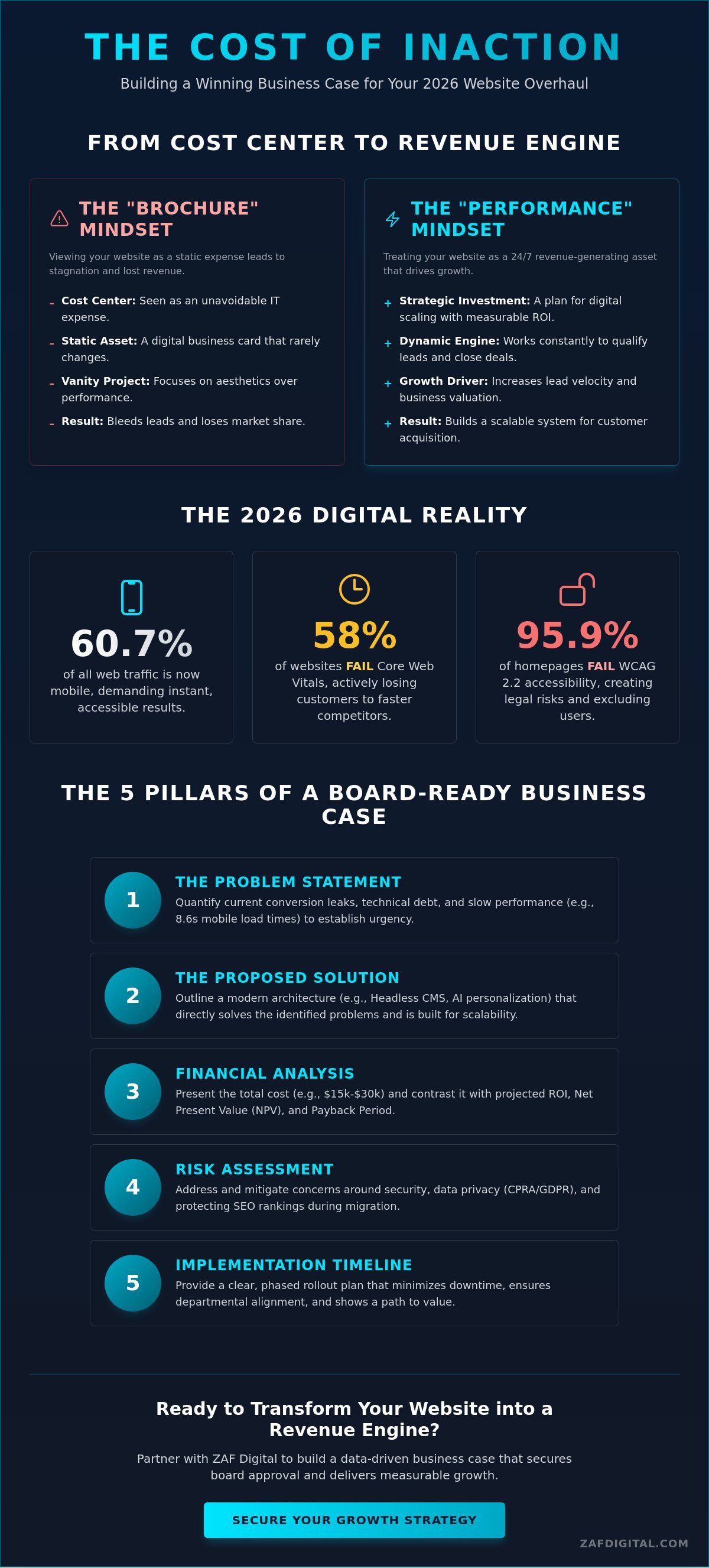
Your website isn't a digital business card or a static brochure anymore. In 2026, it's the engine room of your entire commercial operation. Many leaders still view a site refresh as an unavoidable expense, similar to paying the office rent or buying new laptops. This "Brochure Mindset" is a fast track to stagnation. To win budget approval, you must pivot to a "Performance Mindset" where the website is treated as a revenue-generating asset that works 24/7 to qualify leads and close deals.
To better understand the fundamentals of building a strong proposal, watch this helpful video:
A website business case is a risk-mitigated plan for digital scaling that ensures every dollar spent correlates with a specific growth metric. When you are creating a business case for a new website, you're building a bridge between technical requirements and financial outcomes. This document serves as the central hub for your growth marketing strategy, where data from every campaign is collected, analyzed, and converted into bottom-line results.
The Evolving Role of Web Design in 2026
Modern websites now handle complex lead qualification through AI-driven interactions and personalized user journeys. With 60.67% of traffic coming from mobile devices, "good enough" design is a massive liability. If your site is among the 58% that fail Core Web Vitals, you're actively losing market share to faster competitors. Investing in high conversion web design isn't just about aesthetics. It's about increasing business valuation by proving you have a scalable, automated system for acquiring customers.
Aligning Stakeholders with a Shared Vision
To secure approval, you need to speak the specific language of your gatekeepers. Your CFO doesn't care about "modern layouts"; they care about Net Present Value (NPV), the Payback Period, and the Internal Rate of Return (IRR). Your CTO is focused on security, technical debt, and the 95.9% failure rate of global homepages regarding WCAG accessibility standards. Moving from subjective design opinions to objective business goals allows you to present a unified front. When the board sees a roadmap that reduces legal risk while increasing lead velocity, the conversation shifts from "How much does it cost?" to "How soon can we start?"
The 5 Essential Pillars of a Modern Website Business Case
A robust proposal isn't a wishlist; it's a structural framework. When you're creating a business case for a new website, you must provide a logical sequence that moves from the pain of the present to the profitability of the future. A successful document relies on five specific pillars that address the concerns of every stakeholder in the room, from the marketing manager to the CFO.
Pillar 1: The Problem Statement.
This identifies current conversion leaks and technical debt. If your mobile page load time is 8.6 seconds, you're losing users before they even see your value proposition.
Pillar 2: The Proposed Solution.
Outline a modern architecture, such as a headless CMS or composable framework, integrated with AI to handle 2026's demand for personalization.
Pillar 3: Financial Analysis.
Contrast the total cost of ownership (TCO) with projected revenue. A professional site costing $15,000 to $30,000 is an investment that pays for itself through increased lead velocity.
Pillar 4: Risk Assessment.
Address security, data privacy compliance like the CPRA, and the protection of your current search rankings during migration.
Pillar 5: Implementation Timeline.
Provide a phased rollout plan that minimizes downtime and ensures department-wide adoption.
Quantifying the Problem: Identifying Conversion Leaks
Data is your best ally in creating a business case for a new website. With mobile devices accounting for 60.67% of traffic, any friction in the mobile experience is a direct hit to your bottom line. High bounce rates and cart abandonment aren't just "user behavior"; they're symptoms of an inadequate digital infrastructure. Poor seo and traffic performance often stems from failing the Core Web Vitals assessment, which only 42% of websites currently pass. Technical debt in 2026 leads to exponential loss in visibility as search engines and users alike penalize outdated architecture.
The AI Advantage: Future-Proofing Your Investment
In the 2026 digital economy, a website without AI is already obsolete. You can justify a higher initial investment by showing how automation reduces long-term overhead. Integrating ai chatbots for business allows you to handle lead qualification and customer support instantly, freeing up your team for higher-value tasks. Generative AI doesn't just lower content costs; it enables real-time personalization that significantly boosts Average Order Value (AOV). If you're unsure where your current site stands, a quick performance audit can reveal exactly which AI integrations will drive the most immediate ROI for your specific industry.
By focusing on these pillars, you move the conversation away from "what we want" and toward "what the business needs to grow." This level of analytical depth is what separates a rejected budget request from a funded growth strategy.
Quantifying ROI: Moving Beyond "It Looks Better" to Hard Data
Aesthetics are subjective; revenue is absolute. When you're creating a business case for a new website, your board doesn't want to hear about color palettes or "user delight." They want to know how much money is being left on the table every day the old site stays live. To win them over, you need to swap vague promises for a rigorous financial model that treats your website as a high-yield investment. Successfully creating a business case for a new website requires shifting the conversation from visual appeal to fiscal impact.
The Cost of Inaction (COI) Formula
The most powerful lever in any budget negotiation is the Cost of Inaction. This framework flips the script by showing that delaying a redesign is often more expensive than the project itself. You can calculate this by using a simple formula: (Lost Leads per Month) x (Lead-to-Close Rate) x (Customer Lifetime Value). If your current site's slow performance causes a bounce rate that's 20% higher than the industry average, those are lost opportunities that never return.
Visualizing this 12-month revenue gap makes the initial project cost look small compared to the hundreds of thousands in missed sales. It's no longer a question of whether you can afford a new site, but whether you can afford to keep the old one. Beyond recapturing lost leads, you should focus on the "Conversion Uplift." Moving your site's conversion rate from 2% to 3% isn't just a 1% gain; it's a 50% increase in lead volume without spending an extra cent on ads. This efficiency directly reduces your Customer Acquisition Cost (CAC), making every marketing dollar work harder.
Projecting Long-Term Value (LTV) and Scalability
A modern, high-performance site isn't a three-year disposable asset. By investing in scalable architecture, you eliminate the need for a total rebuild in 2029. This longevity compounds the value of your other digital efforts. For instance, a sophisticated video marketing strategy delivers much higher ROI when those assets are hosted on a site that loads instantly and guides users toward a clear conversion goal.
Operational savings also play a massive role in your ROI calculations. Every hour your sales team spends manually qualifying a lead that an AI chatbot could have handled is a wasted resource. By automating these touchpoints, you're not just improving the user experience; you're reclaiming hundreds of manual support hours every year. This combination of increased revenue and decreased operational cost provides the "no-bullshit" proof your stakeholders require to sign off on the project.
Step-by-Step: Writing Your Case to Win Board Approval
Your board doesn't have time for a 50-page technical audit. They need the bottom line. Creating a business case for a new website is an exercise in condensation. You must take complex technical debt and marketing projections and turn them into a high-impact narrative. Success depends on how well you can bridge the gap between digital performance and corporate fiscal responsibility.
Crafting the Executive Summary
The executive summary is your 30-second pitch for the "Busy Board Member." Focus on three non-negotiable numbers: the Total Investment, the Projected ROI, and the Payback Period. Be blunt about the risks. Transparency builds more trust than perfection. Use a growth marketing lens to prove that this isn't just about "fixing a site," but about capturing a specific segment of market demand that your current platform currently ignores. Mention that 95.9% of the top million homepages fail accessibility standards. This positions your project as a necessary move to mitigate legal and reputational risk while others remain stagnant.
Market Context: The Dubai/UAE Digital Landscape
In a region defined by high AI adoption and mobile-first users, "standard" web design is a recipe for failure. With mobile devices driving 60.67% of all traffic, your business case must reflect the local reality of the Dubai and UAE markets. Benchmarking against competitors in Dubai Silicon Oasis or the DIFC shows that the bar for digital excellence is rising. Your proposal should also address regulatory compliance. You must account for the UAE Data Protection Law and global shifts like the CPRA updates. Proving that your new site will be compliant by design protects the company from future litigation and data broker centralized systems.
Selecting the right partners is the final hurdle. While in-house teams are great for maintenance, they often lack the specialized performance marketing and SEO depth required to build a $15,000 to $30,000 revenue engine. A professional agency brings cross-industry intelligence that an internal department simply cannot match. To reduce the perceived risk of a large upfront cost, propose a phased approach. Use milestone-based funding where the next stage of the rollout is only triggered once specific performance KPIs are met.
If you want to ensure your proposal is backed by hard data and a "no-bullshit" strategy, partner with ZAF Digital to build a board-ready roadmap that secures your budget and guarantees performance.
From Business Case to Digital Innovation: Partnering with ZAF Digital
Building a document is only half the battle. Bringing that vision to life requires a partner who understands that every pixel must serve a financial purpose. ZAF Digital specializes in refining the process of creating a business case for a new website by providing the raw data and technical audits your board demands. We don't just build sites; we architect revenue systems. Our team understands that in 2026, a website is the primary driver of business valuation and market authority.
Our "ROI-First" approach ensures that your digital presence moves from a liability to a high-performing asset. We've seen businesses transform their trajectory by treating their website as the center of their AI-powered growth marketing engine. By integrating AI transformation into your digital core, we help you automate lead qualification and support. This moves your platform from a simple cost center to a legitimate growth engine that delivers measurable results month after month.
Our Performance-Driven Methodology
We begin with a 360-degree audit that leaves nothing to chance. This isn't a surface-level check. We dive deep into technical SEO, UX friction points, and conversion mapping. This data-driven foundation is what makes creating a business case for a new website so effective. We bridge the gap between creative design and AI-driven automation, ensuring your site handles the heavy lifting of user engagement. Only 42% of websites currently pass Core Web Vitals; we ensure you're in that top tier. ZAF acts as your strategic partner, aligning every digital touchpoint with your long-term business goals.
A typical case study snapshot for our partners involves a total shift in how they view their digital budget. By moving from a "brochure" to a performance asset, companies often see a significant reduction in their Customer Acquisition Cost. They stop wasting money on traffic that doesn't convert and start investing in a platform that qualifies every visitor. This transition is the difference between surviving the 2026 digital landscape and dominating it.
Next Steps: Get Your Digital Audit
Don't walk into the boardroom with guesses or "best practices." Request a strategic consultation to back your business case with verified insights. This is the "no-risk" starting point for board-level confidence. We provide the clarity you need to prove that a new website is the most logical investment your company can make this year. Our audits provide the "no-bullshit" transparency that CFOs and CEOs respect.
Partner with ZAF Digital for your next high-performance site. Let's build a roadmap that secures your budget and guarantees your digital future.
Turning Your Digital Strategy Into a Revenue Engine
The window for "good enough" web design closed years ago. By shifting your mindset from a brochure-based expense to a performance-driven asset, you've already taken the most difficult step. Successfully creating a business case for a new website isn't about chasing fleeting trends; it's about building a scalable system that protects your brand from technical debt and shifting regulatory landscapes. You now have the framework to align your stakeholders and prove that a high-performance site is the most reliable path to measurable ROI.
ZAF Digital brings Dubai-based expertise to international markets, combining AI-driven growth strategies with a relentless focus on your bottom line. We don't just provide services; we act as a strategic extension of your team to ensure every digital dollar works harder. We help you replace uncertainty with data-backed projections that win board approval every time. Ready to move from a simple proposal to a high-yield investment?
Secure your budget with a data-backed Digital Performance Audit from ZAF Digital. It's time to build the digital foundation your growth deserves.
Frequently Asked Questions
How long should a website business case be?
Keep your document between 2 and 5 pages. A busy executive needs a high-level summary that gets to the point immediately without wading through fluff. If it's too long, they won't read it; if it's too short, it lacks the data needed to justify the spend. Focus the bulk of your pages on the financial breakdown and the strategic roadmap.
What is the most important metric to include in a website business case?
Projected revenue impact is the most critical metric for any stakeholder. While marketing teams often focus on pageviews or bounce rates, the board only cares about how the site affects the bottom line. Show them the "Cost of Inaction" to illustrate exactly how much revenue the business loses every month by keeping the current underperforming platform live.
How do I calculate the ROI of a new website redesign?
Calculate ROI by subtracting the total project cost from the projected revenue increase, then dividing by that same project cost. Use a conversion uplift model to make these projections realistic. For example, if a 1% increase in conversion leads to $100,000 in new annual revenue and the site costs $25,000, your ROI is clearly defined and easy to defend.
Do I need a technical background to write a business case?
You don't need to be a developer to be successful in creating a business case for a new website. This is a strategic task that focuses on business outcomes rather than code. However, you must partner with a technical expert or agency to gather accurate data on site speed, security vulnerabilities, and the current state of your technical debt.
What are the biggest risks to mention in the business case?
Focus on SEO ranking loss during migration, data privacy non-compliance, and project scope creep. In 2026, failing to meet WCAG 2.2 accessibility standards is a major legal and reputational risk that can't be ignored. Addressing these risks upfront shows the board that you have a proactive mitigation plan and understand the complexities of a digital overhaul.
How much does a professional business website cost in Dubai?
A professionally built, revenue-generating business website in 2026 typically costs between $15,000 and $30,000. While simple sites might range from $2,000 to $8,000, custom enterprise solutions for the competitive Dubai market often exceed $15,000. This price range reflects the high standards for AI integration, security, and performance required to compete in the UAE's digital economy.
Should I include AI features in my website business case in 2026?
Yes, AI features are mandatory for future-proofing your investment. You should include costs for AI chatbots and personalization engines that reduce manual support hours and improve the user experience. These features transform the site from a passive digital brochure into an active sales tool that handles lead qualification and customer interactions automatically 24/7.
What happens if my business case is rejected?
If your proposal is rejected, pivot to a phased implementation plan. Ask for a smaller budget to fix the most critical conversion leaks or performance issues first. This allows you to prove measurable ROI on a smaller scale, which builds the necessary trust and data to secure the full budget for the complete redesign in the next quarter.