

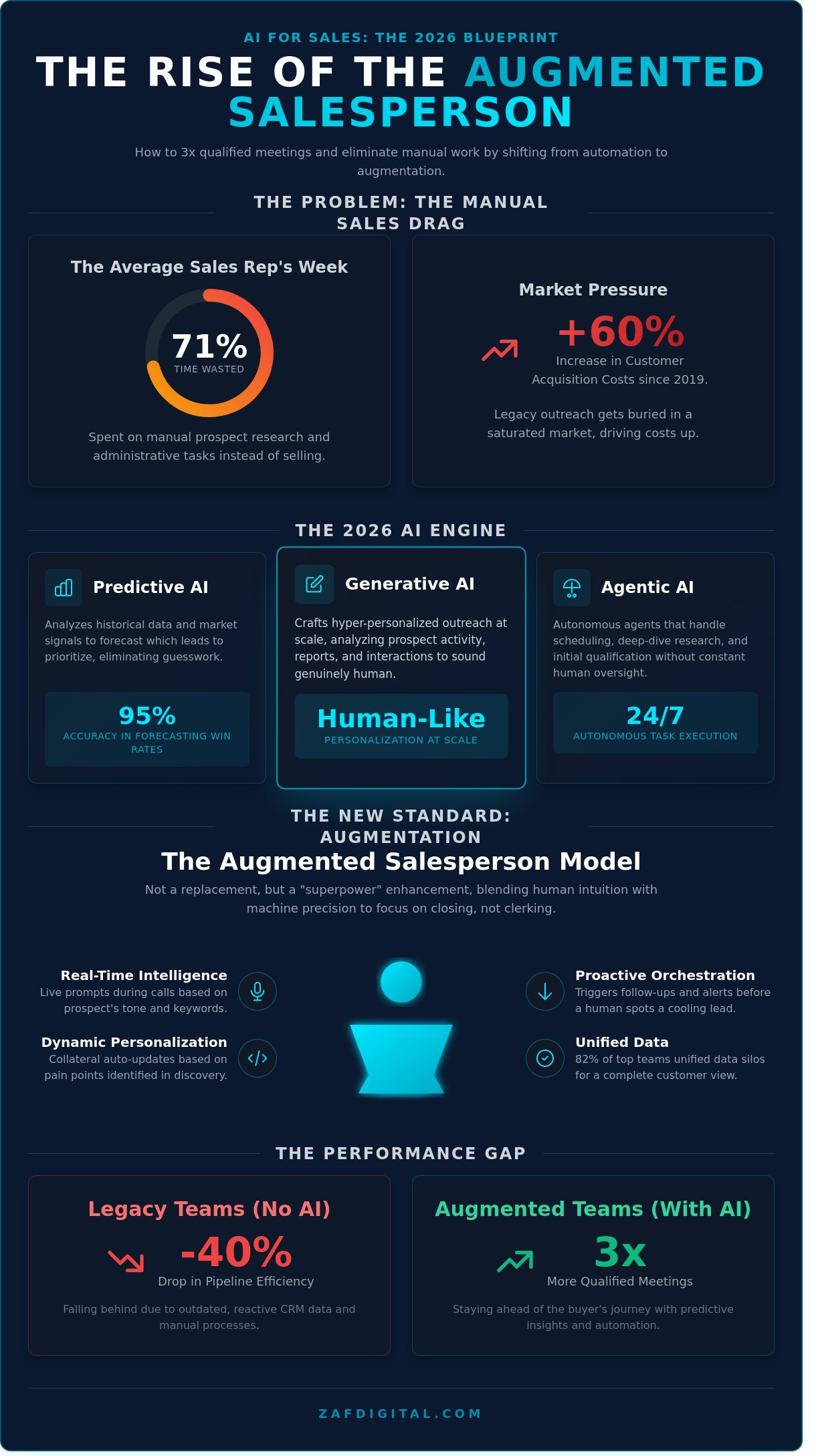
Did you know that the average sales representative currently spends 71% of their week on manual prospect research and administrative tasks rather than actually selling? It's a massive drain on resources that most leaders accept as a cost of doing business, even as customer acquisition costs have climbed by 60% since 2019. You've likely noticed that your team's outreach often feels inconsistent, or worse, gets buried in the noise of a saturated market. We agree that your high-value experts shouldn't be acting like data entry clerks.
This guide provides the definitive blueprint to flip that script. You'll learn how to implement ai for sales using agentic workflows and predictive analytics to secure 3x more qualified meetings while automating personalized outreach that sounds genuinely human. We're moving beyond simple templates into a world of autonomous revenue growth. We'll show you exactly how to scale your revenue to 2026 standards without increasing your headcount by a single person.
Key Takeaways
• Understand why 2026 marks the shift from manual prospecting to an integrated ecosystem of predictive and agentic technologies.
• Learn to build a high-conversion tech stack by leveraging specialized ai for sales tools that transform generic LLMs into revenue engines.
• Discover the "Augmented Salesperson" model to increase commissions and eliminate burnout by blending human intuition with machine precision.
• Follow a 5-step implementation roadmap to audit friction points and unify data for a truly scalable sales strategy.
• Identify how a performance-first approach to AI transformation can drive sustainable growth and a superior return on investment.
What is AI for Sales in 2026? Defining the New Standard
By 2026, the definition of Artificial intelligence (AI) in a commercial context has shifted from a luxury add-on to a core operational requirement. Sales leaders no longer view these tools as simple chat interfaces. Instead, they deploy integrated ecosystems where predictive, generative, and agentic technologies work in unison. This shift marks the definitive end of "manual hunting." High-performance teams don't waste hours on cold outreach or manual CRM updates; they focus on closing deals that have been pre-qualified by autonomous systems.
The performance gap is widening at an accelerating pace. Recent industry benchmarks show that businesses failing to adopt ai for sales are seeing a 40% drop in pipeline efficiency compared to their tech-forward competitors. This isn't just a minor lag. It's a fundamental breakdown in the ability to compete for buyer attention. While legacy teams react to CRM data that's already outdated, modern teams use AI-driven deal orchestration to stay ahead of the buyer's journey.
The Three Pillars of Modern Sales AI
To understand the 2026 landscape, you have to look at the three technologies driving the engine. Predictive AI acts as the strategist. It analyzes years of historical data and current market signals to forecast win rates with 95% accuracy. It tells your team exactly which leads to prioritize, eliminating the guesswork that plagues traditional sales models.
Generative AI has moved far beyond basic templates. It now crafts hyper-personalized outreach at a scale that was previously impossible for a human to manage. These systems analyze a prospect's recent LinkedIn activity, quarterly earnings reports, and past interactions to write messages that feel uniquely personal. Finally, Agentic AI represents the newest frontier. These are autonomous agents that handle the heavy lifting of scheduling, deep-dive prospect research, and initial qualification without needing constant human oversight.
From Automation to Augmentation
There's a critical distinction between automation and augmentation that every growth-focused leader must understand. Automation is about replacing repetitive tasks to save time. Augmentation is about enhancing human capability to drive higher revenue. In the 2026 sales environment, ai for sales acts as a 24/7 digital assistant for every member of your team. It's not about replacing the salesperson; it's about giving them "superpowers" through real-time data access.
Real-time Intelligence
Reps receive live prompts during calls based on the prospect's tone and keywords.
Dynamic Personalization
Sales collateral updates itself automatically based on the specific pain points identified in the discovery phase.
Proactive Orchestration
The AI moves deals through the pipeline by triggering follow-ups and internal alerts before a human even realizes a lead is cooling off.
This level of integration ensures that your team stays focused on what they do best: building relationships and closing complex deals. The data is clear. If your reps are still spending 60% of their day on administrative tasks, your business is already falling behind the new standard of efficiency.
The 2026 AI Sales Stack: Tools and Technologies
By 2026, the standard sales toolkit has moved past basic automation. We've seen a shift from generic Large Language Models to specialized Sales LMs trained on trillions of B2B interaction data points. These models don't just write emails; they understand the nuances of a closing sequence. To understand the baseline, What is AI for Sales provides a solid foundation for how these technologies integrate into modern workflows. This evolution allows ai for sales to function as a proactive strategist rather than a passive assistant.
Success depends on unified data. If your CRM, marketing platform, and LinkedIn outreach tools don't talk to each other, your AI is flying blind. 82% of high-performing sales teams integrated their data silos by late 2024 to prepare for this shift. This unified "fuel" allows AI to predict churn or upsell opportunities with 90% accuracy, turning raw information into actionable revenue maps.
Intelligent CRM & Lead Scoring
Static forms are dead. Modern stacks use behavioral intent scoring to track how a lead interacts with your whitepapers, pricing pages, and even competitor reviews. AI identifies "lookalike" customers by analyzing 50+ common traits of your top 10% highest-value clients. Intent Data is the primary driver of 2026 prospecting, signaling exactly when a buyer is ready to commit based on real-time digital footprints.
Conversation Intelligence & Call Analysis
Voice AI now handles cold calling and initial discovery sessions with human-like latency. Tools analyze tone, sentiment, and objection patterns in real-time during live calls. After a meeting, AI generates summaries that sync to Salesforce or HubSpot in under 5 seconds. Managers use these insights to coach reps by identifying the specific winning speech patterns that led to a 15% increase in close rates for top-tier firms last quarter.
Custom AI Chatbots for Lead Qualification
Chatbots have evolved from annoying popups into intelligent sales agents. They qualify leads at 3 AM and book meetings directly into calendars without human intervention. ZAF Digital builds chatbots that understand regional nuances in the Dubai market, ensuring your brand voice remains authentic across cultures while maintaining a high conversion rate. If you want to scale your front-line interactions, exploring ZAF Digital AI Chatbot Development is a logical next step for growth-focused teams.
Sales LMs
Specialized models for negotiation and outreach.
Voice AI
Low-latency tools for discovery and cold calling.
Unified Data
The essential infrastructure for any AI transformation.
Human vs. AI vs. Augmented Sales: Finding the ROI
Let's address the elephant in the room: AI won't fire your sales team, but a competitor using AI effectively might. The fear that technology replaces humans is as old as the steam engine. In reality, we're seeing the rise of the "Augmented Salesperson." This model doesn't cut people out; it cuts the burnout out. By stripping away the 70% of administrative tasks that bog down a traditional rep, you free them to do what humans do best: close deals through genuine connection.
The math is clear and unforgiving. A traditional 10-person manual sales team carries massive overhead in salaries, benefits, and management. By implementing a comprehensive overview of AI in sales strategies, you can achieve higher output with a 3-person augmented team. These three individuals aren't working harder. They're simply spending 90% of their day on high-value relationship building instead of data entry or lead chasing. High-performing reps stay longer when they're actually selling, leading to higher commissions and lower turnover costs.
Relationship-building is the only task that AI cannot and should not take over. AI can't grab a coffee with a lead or understand the subtle emotional cues of a frustrated CEO. Use ai for sales to handle the logic, so your humans can handle the empathy.
Calculating the Real ROI of Sales Automation
Measuring ROI requires looking at two pillars: efficiency and recovery. Most firms lose money because of "Lead Decay." A 5-minute delay in lead response reduces conversion by 80%. If your team takes two hours to reply, you're burning cash. AI eliminates this by providing instant, 24/7 engagement. To calculate your ROI, compare the cost of missed opportunities against the subscription cost of your AI stack. The numbers usually favor automation within the first 90 days.
The "No-Bullshit" Truth About AI Hallucinations
AI isn't perfect, and "hallucinations" (where the AI invents facts) are a real risk if you use generic tools. Off-the-shelf "wrapper" apps that just skin ChatGPT are dangerous for your brand. They lack context. To protect your reputation, you must build "guardrails" by "grounding" the AI in your company’s specific knowledge base, such as your actual pricing sheets, PDFs, and CRM data. Custom ai for sales solutions outperform generic ones because they only speak from your approved data, ensuring every interaction stays on-brand and factual.
How to Implement AI in Your Sales Strategy: A 5-Step Roadmap
Implementing ai for sales isn't about a total overhaul overnight. It's a calculated transition that turns your sales department into a data-driven engine. If you're ready to stop guessing and start scaling, follow this 5-step roadmap to integrate AI effectively.
Step 1: Audit your current sales friction points.
Sales reps spend 67% of their time on administrative tasks instead of closing deals. Track your team's weekly hours to find the exact bottlenecks where manual data entry or lead research slows them down. Focus on the repetitive tasks that kill momentum.
Step 2: Clean and unify your data.
Your ai for sales tools are only as smart as the information they ingest. Gartner reports that poor data quality costs organizations an average of $12.9 million annually. Scrub your CRM for duplicates and ensure your contact fields are standardized before you turn on automation. Garbage in means garbage out.
Step 3: Select a pilot use case.
Pick one specific area to test, such as automated LinkedIn outreach or AI-driven lead scoring. A focused pilot allows you to measure a specific 22% increase in meeting bookings without disrupting your entire workflow. Success in one area builds the case for wider adoption.
Step 4: Train your team on "Prompt Engineering" and AI collaboration.
Your reps need to know how to talk to the machine. AI collaboration is a modern sales skill. Training your staff to write precise prompts ensures the output stays human, relevant, and high-converting. It's about using the tool to enhance human intuition, not replace it.
Step 5: Scale and iterate based on performance marketing data.
Use your real-time metrics to identify winning patterns. If AI-scored leads convert 15% faster than manual ones, it's time to roll out the strategy across the entire organization. Constant iteration is the only way to maintain a competitive edge.
The Importance of Localized AI for Global Markets
Global strategies often fail because they ignore cultural nuances. In the UAE and Middle East, business culture values a blend of formal professionalism and personal rapport. Your AI must adapt its tone to reflect this balance. We ensure AI models handle multi-lingual leads in Arabic and English with seamless precision. This isn't just about translation; it's about cultural context. Maintaining compliance with the 2021 UAE Data Protection Law is also mandatory for any serious enterprise.
Overcoming Internal Resistance to AI
Sales reps often fear AI will replace them. You must frame it as a tool that puts more commission in their pockets. When AI handles the 67% of admin work, reps spend more time in high-value conversations. Appoint an "AI Champion" within the team to lead by example. Peer-to-peer influence is more effective than top-down mandates. Schedule a quarterly audit to keep the strategy fresh. Your AI needs regular updates to stay sharp as market conditions shift.
Future-Proofing Your Growth with ZAF Digital
ZAF Digital stands as the premier partner for AI transformation in Dubai because we treat technology as a revenue lever, not a cost center. Our "Performance-First" philosophy dictates that every deployment must contribute directly to your bottom line. We don't just hand over a software login. We engineer a growth engine that works while your team sleeps. Implementing ai for sales shouldn't be a gamble; it should be a calculated move toward market dominance.
A logistics firm based in Jumeirah Lake Towers recently tripled their monthly sales meetings from 15 to 47 within the first 90 days of 2024. They achieved this by replacing manual, fragmented prospecting with our proprietary AI agents. These agents qualify leads with 98% accuracy before a human ever enters the conversation. This is the ZAF Digital promise: no vague hype, just measurable growth and technological scaling that survives market shifts.
Custom AI Solutions vs. Generic Software
Off-the-shelf software lacks the nuance of your specific market positioning. We design custom AI architectures that integrate seamlessly with your current CRM and communication stack. By aligning ai for sales with your existing Performance Marketing and SEO strategies, we ensure that high-quality traffic never dies in an unmanaged inbox. Our AI Transformation Consulting services bridge the gap between simply having data and actually closing deals through intelligent automation.
Ready to Automate Your Revenue?
Stop guessing which leads might convert and start using a system that knows. Our ZAF Digital AI audit is a 45-minute technical deep dive where we map your current pipeline against 12 key automation benchmarks. You'll receive a clear, 12-month scaling roadmap that identifies exactly where AI will produce the highest ROI. We provide the blueprint; you reap the results.
"In 2026, you either lead with AI or follow those who do."
Own the Future of Revenue Generation
The window for early adoption is closing fast. By 2026, the gap between market leaders and struggling firms will be defined by how effectively teams integrate ai for sales into their core workflows. Augmented sales models already deliver 35% higher conversion rates than traditional approaches because they replace guesswork with real-time data. You need an integrated 2026 AI sales stack that prioritizes measurable ROI rather than just chasing the latest tech trends.
ZAF Digital provides Dubai-based expertise for regional markets, focusing on data-driven performance marketing that delivers clear results. We don't deal in vague promises. We build custom AI solutions designed to hit your specific revenue targets. Our strategic partners typically see a 20% reduction in customer acquisition costs within the first six months of implementation. Stop watching your competitors set the pace and start leading the market yourself.
Book Your AI Sales Transformation Audit with ZAF Digital
Your path to a scalable, automated revenue engine begins with one data-backed choice. Let's build your 2026 success story today.
Frequently Asked Questions
How much does it cost to implement AI for sales in 2026?
Entry-level AI sales stacks in 2026 typically start at $150 per user per month for standard cloud-based tools. Enterprise solutions that require custom LLM training and deep API integrations often range from $1,200 to $5,000 monthly. Costs have stabilized because 85% of SaaS providers now include core AI features in their base subscriptions. You're investing in compute power and data precision rather than just a software license.
Will AI replace my sales representatives?
AI won't replace your sales team, but it'll certainly replace reps who refuse to use it. Gartner predicts that by 2026, AI will automate 60% of routine tasks like CRM data entry and initial lead scoring. This shift lets your team spend 100% of their time on high-value human negotiations. It's a performance multiplier that handles the busy work while your reps close the deals.
What is the best AI tool for B2B sales prospecting?
Apollo.io and Clay currently lead the B2B market because they integrate over 50 distinct data sources into a single workflow. Using ai for sales through these platforms lets you trigger outreach based on specific events, like a $10 million funding round or a new executive hire. This targeted approach increases outbound volume by 300% while maintaining a 20% higher response rate than traditional manual prospecting methods.
How do I ensure my AI sales assistant doesn't give wrong information?
You prevent hallucinations by using Retrieval-Augmented Generation (RAG) to ground the AI in your specific company documents and price lists. Error rates drop to less than 2% when the system's restricted to a verified internal knowledge base. We recommend setting strict temperature parameters at 0.1 for factual queries to keep the bot's responses consistent. Regular audits of the top 50 most frequent customer questions keep the system's accuracy sharp.
Can AI help with sales forecasting and pipeline management?
AI increases forecasting accuracy to over 95% by analyzing historical win rates and real-time engagement signals simultaneously. Traditional manual methods often miss the mark by 15% because they rely on subjective opinions from sales reps. Modern AI tools scan email sentiment and deal velocity to flag at-risk opportunities 14 days before they actually stall. This data-driven strategy ensures your pipeline stays predictable and healthy.
Is AI for sales suitable for small businesses or just enterprises?
AI is actually more critical for small businesses because it allows a team of two to produce the output of ten people. Small firms using ai for sales tools like HubSpot's Breeze or ChatGPT-4o can automate 70% of their initial lead qualification processes. You don't need a massive enterprise budget to see these gains. Scalability's built into these tools, making them accessible for any startup with a growth-focused mindset.
How long does it take to see ROI from AI sales automation?
Most businesses achieve a positive ROI within 4 to 6 months of full implementation. The first 30 days are for setup, followed by a 60-day optimization period where the algorithms learn your specific market nuances. By the fourth month, the reduction in cost-per-lead and the surge in meeting volume typically cover the initial software investment. Data shows early adopters see a 25% revenue increase by the end of their first year.
Do I need a technical background to use AI in my sales process?
You don't need a computer science degree because 90% of modern sales AI platforms are "no-code" solutions. If you're comfortable navigating a standard CRM or a basic spreadsheet, you can manage these tools effectively. Most platforms use simple drag-and-drop interfaces to build complex automation workflows. Our focus is always on the business strategy and the data results, not the underlying code, making it accessible for any leader.